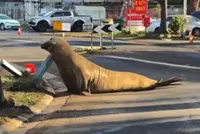
HOBART: Now weighing about 1,000kg, the five-year-old southern elephant seal has in recent days emerged from the Southern Ocean and quickly resumed his role as Tasmania’s least cooperative resident.
The flippered internet celebrity, with more than 1.4 million followers on TikTok, has a documented history of obstructing roads, occupying front yards and treating public infrastructure as toys or sparring partners.
In his current season of disruption, he has dismantled roadside bollards, blocked traffic, and body-slammed a parked Toyota Land Cruiser.
His visit to the southern Australian state in 2026 began with the usual disruptions. Traffic slowed. Residents peered through curtains from the safety of their homes. Wildlife officers were summoned. Somewhere, a local Facebook group lit up with the familiar message: “Neil’s back.”
Before long, a video emerged of the seal engaged in what supporters described as a rigorous infrastructure audit.
A line of sturdy roadside bollards, installed at considerable expense and embedded firmly in concrete, found itself subjected to several minutes of determined testing by 1,000kg of marine enthusiasm. Over and over, Neil is seen knocking against the posts.
The bollards lost.
Online commentators rushed to Neil’s defence.
“He is providing a service to the community,” one wrote. “Identifying problematic infrastructure.”
Another praised him as “the city inspector demonstrating those bollards aren’t up to code”.
A third noted that the barriers were designed to withstand impact from a car. But, as another observer pointed out, engineers perhaps failed to anticipate a “sustained marine assault”.
A video posted online on June 24 showed wildlife officers using a padded pole and board to persuade Neil to move off a road for his own safety and that of motorists.
The state’s Department of Natural Resources and Environment defended the technique, describing it as a safe and internationally recognised method used by trained wildlife experts.
‘Teenage boy’ behaviour
Neil was born in 2020 in Salem Bay, on the Tasman Peninsula, and returns regularly to the area.
Unlike most elephant seals, which grow up in large colonies surrounded by other seals, Neil appears to regard towns, driveways and roadside infrastructure as his social environment.
Experts say that helps explain some of his behaviour.
“They’re teenage boys,” elephant seal researcher Iain Field said of juvenile males. As they grow, they test boundaries and practise the behaviors needed to compete with other males, he added.
Most young elephant seals do this with fellow seals.
Neil, lacking suitable companions, has apparently expanded the definition of “fellow seals” to include traffic cones, wheelie bins, fences and occasionally motor vehicles.
The attention has only added to Neil’s growing fame.
Social media accounts dedicated to his activities attract followers from around the world eager for updates on a seal whose chief talents appear to be sleeping in inconvenient locations and accidentally creating municipal headaches.
Wildlife specialists warn, however, that Neil’s size makes him potentially dangerous despite his popularity. The public is advised to stay at least 20m away and keep dogs much farther back.
The warnings may become even more important in coming years.
Neil is still a subadult and could eventually weigh several tonnes. Researchers say his behaviour may become more territorial as he approaches breeding age.
For now, though, Tasmania’s most notorious seal remains primarily a nuisance rather than a menace.
After spending a few weeks ashore, Neil is expected to return to sea before reappearing months later with new weight, new confidence and, presumably, fresh opinions about local infrastructure.
The bollards, meanwhile, have been given advance notice. - The Straits Times/ANN