




Japan seized the spotlight at last month’s Shangri-La Dialogue, stepping into a vacuum left by the Chinese defence chief – who skipped the forum for a second year – and using the stage to sharpen its warnings over Beijing’s military rise.
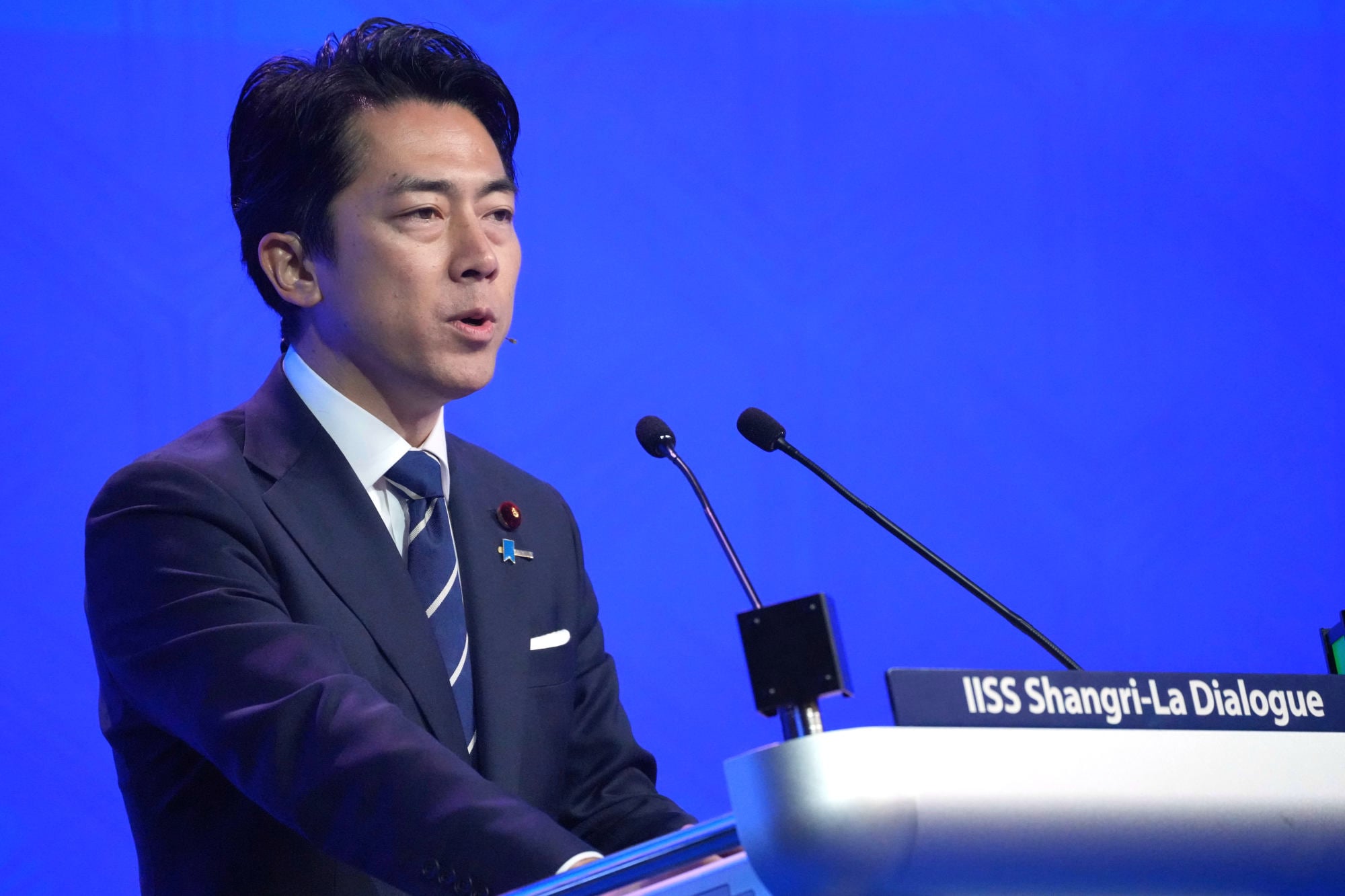
Speaking in Singapore on May 31, the final day of the security forum, Japan’s Defence Minister Shinjiro Koizumi pushed back against Beijing’s accusation that Japan is engaging in a “new militarism” and instead took aim at China’s growing military capabilities and lack of transparency.
Japan’s prominence was amplified when a scheduled session on China’s cooperative partnerships in the Asia-Pacific – a slot that would have offered Beijing a platform to present its vision for regional security – was cancelled.
Tokyo made headlines during the forum when Koizumi took the unusual step of meeting US Defence Secretary Pete Hegseth in a clear bid for public reassurance that Washington remains fully committed to Asia. While it was meant to project a strong, united front between the US and Japan, it exposed Japan’s anxiety about its own security and dependence on the alliance.
In a sign that Tokyo is building the capabilities of a military power, Koizumi and other top officials last year floated the idea of Japan constructing nuclear-powered attack submarines, potentially breaking the country’s nuclear taboo amid suggestions both inside and outside the country that it could eventually acquire nuclear weapons.
Beyond the rhetoric, Tokyo has stepped up its expansion of a network of security partnerships that unnerves Beijing, which views it as a potential threat to regional stability. Japan and the Philippines moved ahead with expanded defence cooperation, including negotiations on an agreement to protect classified military information.
Koizumi also welcomed Wellington’s announcement that an upgraded Japanese Mogami-class frigate had been shortlisted to replace New Zealand’s Anzac-class fleet.
Analysts view these developments as critical links in a multilayered regional military architecture that is being forged as US commitment is perceived as waning across Asia, and amid Beijing’s eagerness to capitalise on the resulting vacuum.
This emerging framework combines security assistance and economic lifelines as well as minilateral and flexible diplomatic engagements to offer Indo-Pacific nations an alternative to choosing between China and the US.
Yet, experts say that Tokyo, while lacking the massive financial muscle to counter Beijing on its own, should work together with allies to compete quantitatively, while carefully avoiding the explicit, anti-China branding that would scare its regional partners away.
Multilayered approach
This strategic shift is a direct response to a changing Washington. The National Security Strategy released by the Donald Trump administration in December notably focused on US dominance in the western hemisphere. It said its top priority for the Indo-Pacific was to “win the economic future” because economics represented the “ultimate stakes” of this region.
Washington’s reliability as a security partner has also been questioned following Trump’s insistence that allies such as Japan and South Korea raise their defence budget, and for slapping high tariffs on its key strategic partners, such as India.
“The driver is simple: hedging against regional instability and a potentially less reliable US, while ensuring sea lanes remain open and smaller states aren’t coerced by Beijing,” said Stephen Nagy, a professor of politics and international studies at the International Christian University in Tokyo.
Pratnashree Basu, an associate fellow specialising in the Indo-Pacific at the Delhi-based Observer Research Foundation, said Tokyo was pursuing a more holistic approach to regional engagement that went beyond traditional security ties.
“Japan recognises that many Southeast Asian and Pacific Island states prioritise development and economic resilience over traditional security concerns,” Basu said.
“Hence, Tokyo seeks to build durable partnerships by integrating security assistance with infrastructure financing and energy transition support, while avoiding the perception of pure military balancing.”
The toolkit
Japan is gradually realising this vision through a set of interlocking instruments that form a cohesive security and development toolkit.
It took a concrete step in May when Japanese Prime Minister Sanae Takaichi announced an updated Free and Open Indo-Pacific (FOIP) framework, moving away from Shinzo Abe’s 2016 focus on principles, such as the rule of law, towards practical economic and security tools. The recalibrated strategy prioritises undersea cables, secures energy supply chains and pursues maritime security for partners.
Under the updated FOIP blueprint, Tokyo is increasingly linking its traditional Official Development Assistance (ODA) with the newly minted Official Security Assistance (OSA) to fund dual-use ports and airports.
“Japan’s basic ODA policy enshrines the principle of non-military use, and so Tokyo introduced the OSA programme to enable the provision of support directly to the military entities of Japan’s strategic partners,” said Jumpei Ishimaru, a research analyst specialising in Japan’s defence policy at the International Institute for Strategic Studies.
Ryosuke Hanada, a doctoral candidate at Sydney’s Macquarie University, noted that before the security assistance framework was initiated, development aid had been overextended in an attempt to cover regional maritime domain awareness. The defence aid programme was created to fill that gap, especially for partner nations lacking adequate capital to buy standard weapons.
“It enables Japan to forestall a power vacuum in the region – a vacuum that would likely be filled by China rather than the US,” Hanada said.
Basu also noted that funding ports and airports was more politically palatable for recipient nations than direct military aid, while also developing infrastructure that could support coastguards and, in some cases, defence-related logistics.
“In this sense, Japan views connectivity infrastructure as both a development tool and a strategic enabler of a more resilient Indo-Pacific order.”
Driven by this strategy, the security aid framework has scaled up in just three years from four countries and 2 billion yen (US$12.48 million) to 12 countries and 18.1 billion yen, expanding its reach to provide advanced radar systems and drones.
Beyond acting as a strategic counterweight, Kei Koga, an associate professor at Singapore’s Nanyang Technological University, noted that the programme gave Japanese military hardware a vital proving ground.
“It can also indirectly contribute to Japan’s own defence industrial base by creating opportunities to showcase Japanese equipment ... and expand Japan’s role in the international defence market,” said Koga, whose research areas include Indo-Pacific security and Asean.
This industrial push dovetails with Tokyo’s broader export pivot. Following a decision in April to lift its ban on lethal weapons exports, Japan can now sell defence equipment to 17 countries, including six Asean nations: the Philippines, Malaysia, Indonesia, Vietnam, Thailand and Singapore.
The strategy allowed Japan to take a concrete step forward on June 5, when Tokyo and Jakarta agreed to have talks on the potential export of Japanese Asagiri-class destroyers to Indonesia.
Beyond warships, Tokyo launched the US$10 billion Power Asia initiative in April – a targeted package to help regional partners secure emergency energy supplies and build long-term resilience amid the Strait of Hormuz crisis.
According to Ishimaru, as Tokyo pushes forward defence export talks with Indonesia and expands security grants to lock in deeper diplomatic, military and economic ties across the region, it is broadening its reach.
This multipronged approach was on full display during a June 10 bilateral summit in Tokyo, where Takaichi and Malaysia’s Prime Minister Anwar Ibrahim agreed to deepen defence ties across three key areas.
The leaders signed a maritime cooperation pact for joint training and intelligence-sharing in the South China Sea and the Strait of Malacca. Japan will also expand military aid to Malaysia under its security assistance framework, providing drones and surveillance gear to counter grey-zone coercion, while both sides pledged to scale up joint naval drills and accelerate defence technology projects.
Anwar explicitly welcomed Tokyo’s lifting of its lethal arms export ban, citing it as an opening for broader procurement opportunities.
Why Asean is receptive
In deploying this toolkit, Tokyo is leveraging deep regional trust. According to the 2026 ISEAS-Yusof Ishak Institute survey, Japan remains Asean’s most trusted major power, with 65.6 per cent of respondents expressing confidence in it – outperforming the European Union, the US and China.
According to Koga, Japan’s support gives regional states additional strategic options and reduces their dependence on any single great power.
The Philippines represents Japan’s deepest defence cooperation in Southeast Asia. Bound by a reciprocal access agreement for joint military exercises, Manila is negotiating intelligence-sharing and the potential transfer of up to six Abukuma-class destroyer escorts.
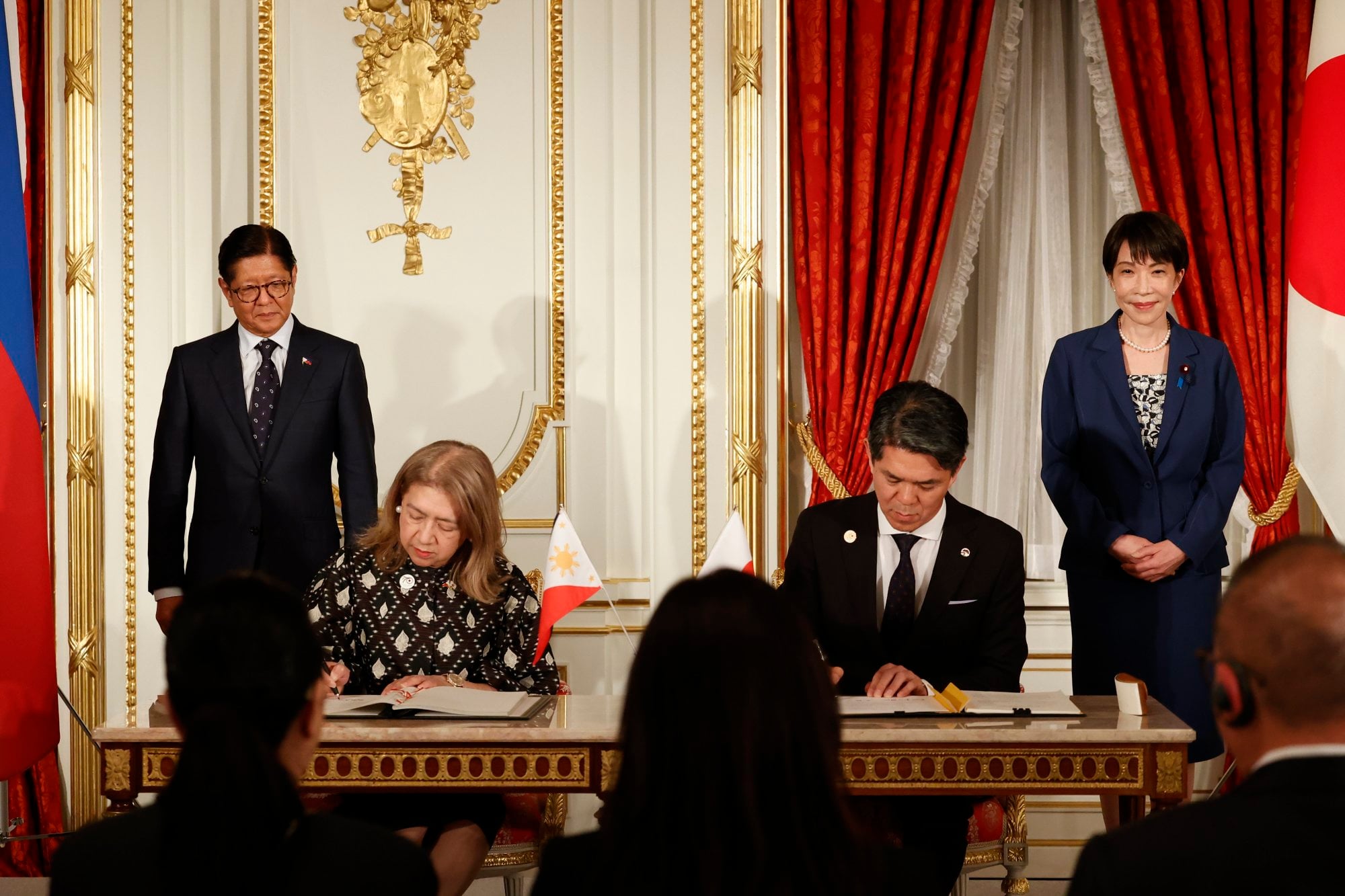
During a state visit to Japan late last month, President Ferdinand Marcos Jnr elevated Philippine-Japan ties to a comprehensive strategic partnership.
Uncertainty about US commitments under the Trump administration has further driven Tokyo and Manila closer, according to Koga.
“This is not aimed at replacing their alliances with the United States, but by strengthening defence and security ties, both countries can demonstrate that they are taking greater responsibility for their own security,” Koga said.
Experts caution that the Philippines is an exceptional case rather than a replicable model for the rest of Asean.
John Bradford of the Yokosuka Council on Asia-Pacific Studies noted that Manila and Tokyo shared similar risk calculations regarding China’s maritime assertiveness, along with a consensus that engagement must be paired with “multi-domain deterrence”.
“Both sought to cautiously engage with growing Chinese power while managing tension in the waters of the contest with China,” Bradford said.
For Ishimaru, “the Philippines is a unique case, driven not only by its strategic importance to Japan but also by military factors – including its hosting of US bases”.
Tensions persist between Beijing and Manila around contested features in the South China Sea, just as Tokyo has competing claims over the Diaoyu Islands – which Japan calls the Senkaku Islands – in the East China Sea.
Limits and China’s advantage
For all its regional ambitions, Tokyo faces a sobering array of structural roadblocks that result in China still maintaining its strategic lead.
Abroad, Asean’s strict non-alignment stance puts a hard ceiling on defence and security cooperation. Nagy noted that Asean countries saw Japan as a reliable third option to balance the US and China, but that “their strict non-alignment and fear of entrapment definitely put a ceiling on how deeply they’ll integrate militarily with Japan”.
He added that while Asean states might adopt piecemeal aspects of OSA projects, most would not pursue the level of “overt alignment” that Tokyo and Manila had.
At home, Japan is hamstrung by tight fiscal limits, a shrinking demographic pool and an operational bottleneck that leaves defence equipment “aftercare” in trouble.
Japan’s ruling LDP has approved a draft proposal to revise the country’s three key security documents, calling for funding to transform defence capabilities within five years. While no specific spending target is set, the proposal cites examples of defence budgets above 3 per cent of GDP, fuelling concern over further increases.
The LDP will submit the plan to the prime minister this month, with formal cabinet approval expected by year-end. Takaichi has already accelerated the previous 2 per cent of GDP defence spending target, achieving it in fiscal 2025, two years ahead of schedule.
Hanada warned that a critical operational gap persisted in the mechanics of long-term maintenance and aftercare, as OSA equipment transfers were managed by Japan’s foreign ministry rather than its defence entities, meaning post-delivery support “remains ad hoc rather than systematically integrated”.
“Until that is resolved, the depth of integration – and the credibility of the capabilities provided – will be limited,” he said.
While some analysts believe Tokyo simply cannot match Beijing’s financial muscle or coercive economic leverage, facing fiscal constraints and military capability gaps, Koga warned of appearing to build an explicit counter-China coalition.
“This would make many regional states more cautious about cooperation,” he said.
Additional reporting by Amber Wang -- SOUTH CHINA MORNING POST


