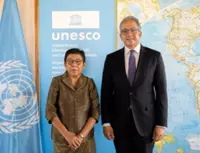
PHNOM PENH: The recent election of Cambodia to Unesco’s Intergovernmental Committee for the Safeguarding of the Intangible Cultural Heritage (2026–2030) has unfortunately given rise to misleading narratives on certain Thai social media platforms, where certain individuals have suggested that Cambodia could use its position to obstruct or block future cultural heritage nominations submitted by Thailand.
Such narratives are not only factually inaccurate but also fundamentally contradict the spirit, objectives and procedures of Unesco’s 2003 Convention.
The 2003 Convention was created to safeguard living heritage, promote cultural diversity, encourage dialogue among peoples and strengthen international cooperation.
It was never intended to serve as a platform for cultural competition, political confrontation or claims of exclusive ownership over traditions that often evolved through centuries of interaction among neighbouring communities.
Unesco’s Representative List does not determine ownership of culture, nor does inscription grant exclusive rights to a State.
Its purpose is to recognise and safeguard living traditions for the benefit of humanity.
As a member of the Intergovernmental Committee, Cambodia assumes an international responsibility to contribute to the safeguarding of intangible cultural heritage worldwide, not merely its own heritage.
Committee members are expected to uphold the principles of professionalism, impartiality and cooperation.
They do not possess veto power over nominations submitted by other States Parties.
All nominations are first examined by an independent Evaluation Body composed of experts and accredited organisations before being considered collectively by the Committee.
Cambodia’s election should instead be viewed as recognition of the country’s longstanding commitment to cultural heritage safeguarding.
As one of the Southeast Asia’s oldest civilisations, Cambodia has actively contributed to international heritage protection through conservation efforts, archaeological research, capacity-building initiatives and cooperation within Unesco and Asean frameworks.
Its election reflects the confidence of the international community in Cambodia’s ability to contribute constructively to the safeguarding of humanity’s living heritage.
At a time when misinformation can spread rapidly across social media, it is incumbent upon Thailand’s cultural authorities, scholars, journalists and public institutions to promote accurate knowledge of Unesco’s procedures and the true objectives of the 2003 Convention.
Greater efforts in public education and awareness-raising are necessary to prevent the recurrence of misconceptions and narratives that may create unnecessary tensions, undermine international cultural cooperation and misrepresent the spirit of the Convention.
Discussions concerning cultural heritage should be guided by scholarship, evidence-based analysis, mutual respect and cultural diplomacy rather than by nationalism, speculation or inflammatory rhetoric.
Cambodia’s election to the Intergovernmental Committee is not a victory over any country, nor is it a threat to any nation’s cultural aspirations.
It is a responsibility entrusted by the international community to serve the interests of the Convention and the safeguarding of intangible cultural heritage everywhere.
The future of cultural heritage protection in the region will be strengthened not by competition and suspicion, but by cooperation, knowledge-sharing and mutual understanding. That is the true spirit of Unesco. - The Phnom Penh Post/ANN
[Roth Santepheap is a geopolitical analyst based in Phnom Penh. The views and opinions expressed are his own.]