BENGALURU, (India): Ever since the FIFA World Cup 2026 began, Indian football lovers have scanned the teams for Indian faces.
X handles like @IndianFootyBest have rounded up all the names: Tahsin Mohammed Jamshid, Qatar forward, who has Malayalee parents; Diogo Costa, Portuguese goalkeeper, a Goan granddad; Sarpreet Singh, New Zealand midfielder, has Punjabi parents. And Samuel Moutoussamy, Democratic Republic of the Congo midfielder, whose father is Tamil.
Indians commenting on the post lamented having to celebrate Indian-origin footballers representing other countries, since the Indian football team did not qualify for the FIFA World Cup. The Indian men’s team has a FIFA world ranking of 139. The women’s team ranks 69.
The Indian government might have found the country’s sports fans a way out of these second-hand celebrations.
It is considering introducing a Sports Passport to allow Indian-origin athletes who are citizens of other countries to represent India, a move that could transform the future of Indian sports.
Who is eligible for India’s sports passport?
The Ministry of Youth Affairs and Sports reportedly sent a proposal to the Prime Minister’s Office of a Sports Passport framework that could potentially allow an Overseas Citizen of India (OCI) and a Person of Indian Origin (PIO) to represent India without acquiring full citizenship, both of which are official immigration and identification statuses granted to peoples of Indian origin but who are citizens of foreign countries.
Sports news website Khel Now quoted an official close to the developments saying that the “detailed proposal” sent to the Prime Minister’s Office pitches “a Sports Passport framework to boost India’s performance in global sports such as football, basketball and tennis. It is likely to take six to eight months before the government of India makes a decision on the subject”.
India does not permit dual citizenship, like many Asian countries including Singapore, Malaysia and Japan. An Indian acquiring citizenship in any foreign country must give up the Indian passport immediately. The OCI is a lifetime visa for Indian-origin foreigners, but not citizenship.
Decades ago, overseas Indians did represent India in international sports like swimming, rugby and tennis, but that changed in 2008, when the sports ministry mandated that only an Indian passport holder could represent India.
The change was made to protect the interests of local players, who were losing opportunities to their overseas counterparts, but the new sports passport proposal seeks to reverse this once again.
“Indian laws prohibit dual nationality, but this is at odds with how sporting nationality works. For instance, FIFA rules say that a footballer can play for any country they can demonstrate a deep connection with, through ancestral ties or residence,” said sports lawyer Nandan Kamath, the managing trustee of the GoSports Foundation, a non-profit that helps develop Olympic and Paralympic talents.
Nearly a quarter of all players at the ongoing 2026 FIFA World Cup represent nations that are not their birthplaces, compared with the early 2000s, when the share of foreign players was 10 per cent.
A boost for India’s global sports performance?
“A sports passport can be India’s way to get around the citizenship rules by creating an exception for a limited use like sport. There is no point holding back when the rest of the world is adopting this,” Kamath told The Straits Times.
The Indian diaspora is the largest group of immigrants in the world, at more than 37 million people. The sports passport proposal is part of a broader national strategy to engage them, as outlined in India’s National Sports Policy 2025.
This would offer Indian-origin sportspeople with foreign citizenships a chance to play on India’s national teams in international sporting events, should they want to and if they are good enough.
For India, this could mean more international sporting wins – or at least an improved record, especially in football, basketball and tennis.
Despite having over 1.4 billion people, the country has consistently ranked low in many sports, due to the overwhelming dominance of cricket, bureaucratic mismanagement, and inadequate grassroots infrastructure.
The sports ministry and All India Football Federation did not respond to ST’s requests for details on the proposal.
Experts who have been part of the discussions on overseas players told ST that the Sports Passport proposal was made in preparation for India’s bid to host the 2036 Olympic Games and to increase the cricket-obsessed country’s cup tallies in other sports.
The move also follows the Indian men’s football team’s failure to qualify for the 2026 FIFA World Cup and the AFC Asian Cup 2027. In the meantime, Tahsin, a 19-year-old footballer from the south Indian state of Kerala, became the first Indian passport holder to play in the World Cup – representing the Qatari national team.
Tahsin’s father had long worked in Qatar as an accountant, and Tahsin himself was born in Doha. The Indian national is playing for Qatar through its Mission Passport, a document through which foreign-born athletes can represent the Gulf state in international competitions. The mission passport does not grant him any social rights, permanent status or financial benefits available to Qatari nationals.
Countries like Bahrain, Spain and Turkey also have similar documents or systems to attract foreign-born talent to represent their national teams and strengthen their squads, while the handful of foreign athletes who played on India’s national teams in the past have had to give up their other citizenship.
If India implements a similar sports passport, analysts said it would most impact team sports, especially football.
“Getting good foreign-born players in a heavily professionalised sport like football will be a game changer,” said Kunaal Majgaonkar, former head of content and media at JSW Sports, a training foundation.
Majgaonkar was part of the team that helped Ryan Williams, an Australian forward, get an Indian passport. Williams was eligible because of his Indian and football lineage: his father is English, but his mother is an Indian-born Anglo-Indian who played football for Australia after she moved there. Williams played for the Bengaluru team under the Indian Super League for five years before he gave up his Australian citizenship for Indian nationality.
Within four minutes of debuting in the India blue jersey in the AFC Asian Cup qualifiers against Hong Kong, Williams scored a goal – the fastest goal ever scored by an Indian debutant, declared media reports.
“Ryan Williams justified his presence in the national team. But getting the passport took him more than a year, and it’s not something every foreign player will do,” said Majgaonkar.
Critics, however, say the proposal is a shortcut to a structural problem, and would demotivate local players.
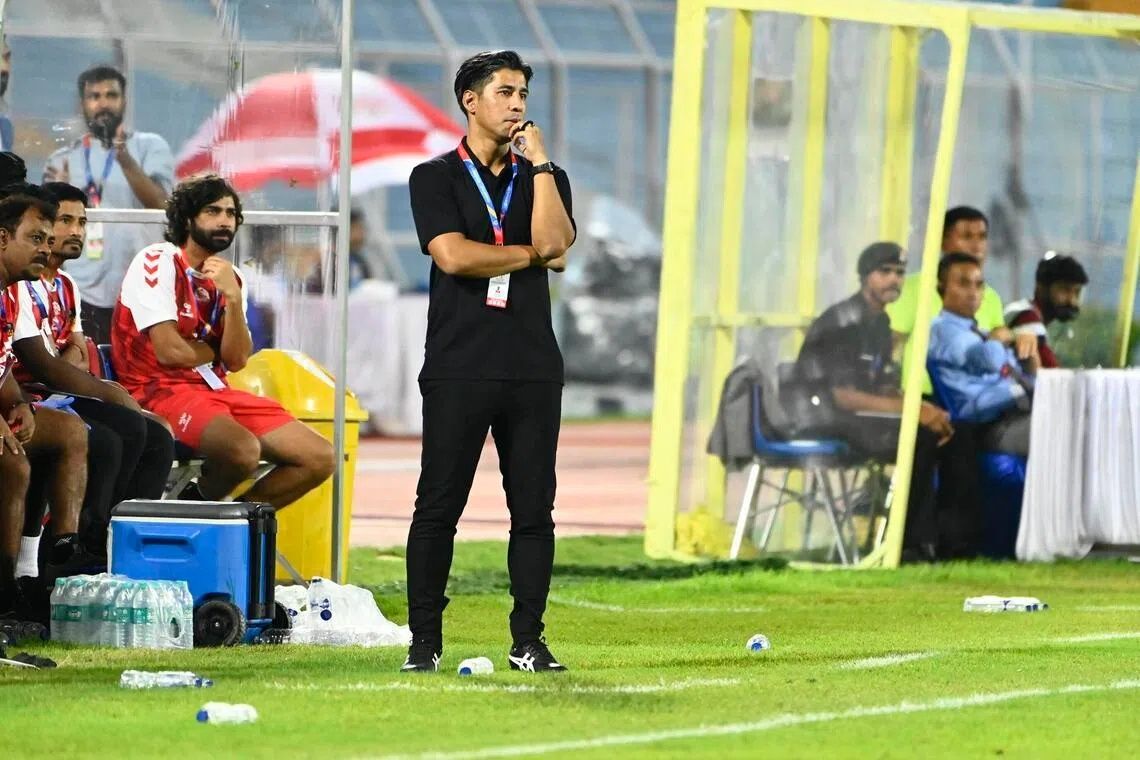
“It’s just not sustainable to have a real national team with foreign players who are parachuted in,” said Arata Izumi, a midfielder who surrendered his Japanese passport to take up Indian citizenship in 2012.
Arata Izumi was the first to surrender his Japanese passport to take up Indian citizenship in 2012.
Born to a Japanese mother and Indian Gujarati father, he was the first Japanese professional footballer to move to India in 2006 and play for top clubs like East Bengal and Pune until he took up Indian citizenship and represented the Indian national team in nine international matches from 2013 to 2014.
“A major reason the Indian team accepted and supported me as their own was because I had spent many years living in India, became part of the football community, and changed my citizenship, all of which showed my passion and dedication,” he said.
If the Indian government spent all its effort and resources on foreign players, but did not invest in lifting local players to international standards, “nothing will change”, Izumi told ST.
Now coaching children in a football academy with 700 students in Pune, Izumi believed that while small countries like Cabo Verde and Qatar could justify having foreign players, India, with its 1.4 billion people, “had no excuse”, and should find talented football stars in its own backyard.
“We must focus more on improving the quality of coaches, giving the best foreign coaches the time and resources to develop Indian coaches. People who understand both established global football cultures and Indian football can help develop a stronger football identity in India,” Izumi said.
Proponents of the Sports Passport, however, said that while recruiting foreign players alone might not help India hit all its sporting goals, overseas players could nevertheless infuse energy and knowledge into the system.
“It will catalyse the entire ecosystem. Local players can learn from the overseas recruits through osmosis. When India wins more games, it will motivate Indian players to up their game, more investors to infuse money, and there can be more training infrastructure,” said Kamath.
The football federation, he said, had already identified around 20 Indian-origin overseas players it could be approaching once the Sports Passport policy is finalised. - The Straits Times/ANN