JAKARTA: Indonesia’s next presidential election is not due until 2029, but it seems the fight may have started early in 2026.
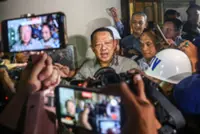
President Prabowo Subianto (pic) is facing sustained scrutiny over the economy, state spending, the cost of living and declining foreign investor confidence – a moment some rivals appear eager to seize.
In the last few weeks, some of the country’s biggest political names have already stepped back into the spotlight – from presidential hopeful Anies Baswedan to senior minister Agus Harimurti Yudhoyono to former president Joko Widodo.
Anies, for example, has re-emerged in public debate after more than a year of relative silence, commenting more frequently on economic and government policies. Meanwhile, Agus has spoken out on a range of issues as he builds his profile in government – even tacitly criticising his own boss, Prabowo.
Widodo, known popularly as Jokowi, is preparing a nationwide tour that will keep him in the public eye. Widodo cannot run again as the Constitution limits a maximum two presidential terms. However, his planned tour is intended to support his elder son, incumbent Vice-President Gibran Rakabuming Raka.
He is also aiming to boost the electability of the Indonesian Solidarity Party (PSI), which his younger son Kaesang Pangarep chairs and which Widodo backs as its patron.
Rival steps out of shadows
The resurgence of these political heavyweights coincides with mounting domestic anxieties.
The Indonesian rupiah has recently plummeted, becoming the worst-performing currency in Asia. Compounding the economic gloom, the Jakarta Composite Index has taken a severe hit, tumbling to its lowest levels since May 2021 as foreign investors pull back.
Much of this financial strain has been attributed by critics to inefficient state spending.
Prabowo’s administration has aggressively pushed its flagship free nutritious meal programme (MBG), aiming to feed millions of people but placing a heavy burden on the state budget.
Further inflating expenditures is the “Red and White Cooperative” programme. This initiative has involved the construction of cooperative buildings across hundreds of regencies and, notably, the import of trillions of rupiah worth of Indian-made trucks.
The import bill has also drawn sharp public ire, given that Indonesia has its own established automotive manufacturing sector.
“Frankly, things are not okay. The rupiah has fallen to record lows, prices are rising, job opportunities are narrowing, household buying power is weakening, savings are being eroded. And this affects the livelihoods of ordinary people,” Anies said in an Instagram post on May 20.
“In a situation like this, what the market and the public need most is one thing: certainty. Not false calm, not sugar-coating the problem, but certainty born of transparency, or a clear direction, of a government that knows where it is taking this country,” he added.
This was not the only time Anies has openly criticised the current administration. Last week, he weighed in on a heated public debate between Cabinet Secretary Teddy Indra Wijaya and former ambassador Dino Patti Djalal. Taking aim at Teddy, Anies publicly backed Dino, describing the veteran diplomat as a highly respected figure to whom the nation owes a great deal of gratitude.
Anies’ renewed outspokenness marks a significant shift from his quiet demeanour following the 2024 presidential election. In that three-way race, Anies came in second place, securing nearly 41 million votes and trailing behind Prabowo, who clinched a decisive victory with more than 96 million votes.
Boni Hargens, a political analyst at the University of Indonesia, said Anies’ public criticism is a calculated move. Having established his opposition credentials, Anies must continue to demonstrate relevance and differentiation.
“By targeting a tangible economic grievance, he appeals to urban middle-class voters and business communities sensitive to import costs and financial instability,” Boni told The Straits Times.
Barbs from within Cabinet
Criticisms have not only come from Anies, who is largely deemed an opposition leader. Coordinating Minister for Infrastructure Affairs Agus, popularly known as AHY, made remarks that political experts considered self-criticism and a brave reminder to his own boss.
In a May 17 speech at the Hotel Indonesia roundabout in Central Jakarta before government researchers, Agus stressed that economic development should not destroy the environment.
“It has been proven that a damaged, ruined environment causes natural disasters. And those who suffer most, who are most affected and become the victims, are of course the communities living around it,” Agus said.
“It is certainly unfair for anyone to exploit nature in order to extract its resources while neglecting the environment there, damaging the earth,” he added.
A week later, on May 23, Agus raised the issue of persistent “sectoral ego” among ministries and agencies within Prabowo’s administration. He said this dynamic makes each ministry feel it is the most important, to the point of competing over state budget allocations, even though the government’s overarching goals are the same.
Agus’ decision to openly voice self-criticism about the Cabinet’s internal condition is a bold and risky move, according to observers.
His main motivation is presumed to be a push to improve a Cabinet seen as struggling to coordinate amid an unfavourable economic and political climate, political analyst Sebastian Salang told ST.
“At the same time, the move could also serve as a political investment to enhance his positive image ahead of 2029,” Sebastian said.
He pointed out that the move could be upsetting to Prabowo, particularly given the President’s leadership style, which is not accustomed to criticism from his ministers. Despite that, Agus still holds potential to be a presidential candidate in 2029.
University of Indonesia’s Boni also pointed out that Agus has begun invoking the language of “development based on ecological integrity”. This serves as a pointed critique of the Prabowo administration’s controversial food estate programme in Papua, which has been widely criticised for causing environmental degradation.
“As recently as 2025, Agus still harboured hopes of being retained as Prabowo’s running mate in 2029. However, as that prospect has dimmed, a pivot towards the opposition becomes increasingly rational,” Boni added. - The Straits Times/ANN