
TOKYO: Long lines can be seen for “¥100 breakfasts,” which are offered at university cafeterias and other locations. While the primary goal was to improve the lifestyle habits of students who skip breakfast, those waiting in line are now struggling with high living costs.
As soaring food prices threaten the programme’s future, some universities are raising funds by involving local companies that wish to attract students as future employees.
Musashino University in Tokyo began offering the ¥100 breakfast programme at its two Tokyo campuses from April this year, in response to financial difficulties faced by some students.
The Musashino Campus cafeteria offered four types of ¥100 meals on May 19, including a breakfast set featuring dishes like fried chicken or ham cutlets that change every day.
These meals normally cost over ¥500. About 40 of the 50 meals prepared by the cafeteria sold out within 30 minutes of opening at 8.15am. They sell out almost every day.
“My friends and I let each other know about which supermarkets have cheap ingredients,” said a freshman in the Faculty of Education. “I’m grateful for a hot breakfast that I can eat for ¥100.”
Rising food costs
The ¥100 breakfast was introduced at universities across the country in the 2000s with the aim of helping students living in dormitories improve their often-erratic lifestyle habits. In many cases, the costs are covered by parents or alumni.
At Kansai University’s Senriyama Campus in Osaka, the university co-op, which operates the cafeteria, launched the ¥100 breakfast program in the 2015 academic year.
Since the 2018 academic year, the costs have been covered by a parents’ support association and an alumni association.
Currently, the co-op prepares 170 meals on weekday mornings — meals that would normally sell for around ¥500.
However, food costs have risen by ¥50 to ¥100 per meal over the past decade. The price of rice has risen by 160% within that period.
Although contributions from the parents’ association and other groups have increased by 25% since the 2023 academic year, student demand has also grown.
When funds fall short, the university co-op reportedly makes up the difference by serving curry.
Firms sponsor breakfasts
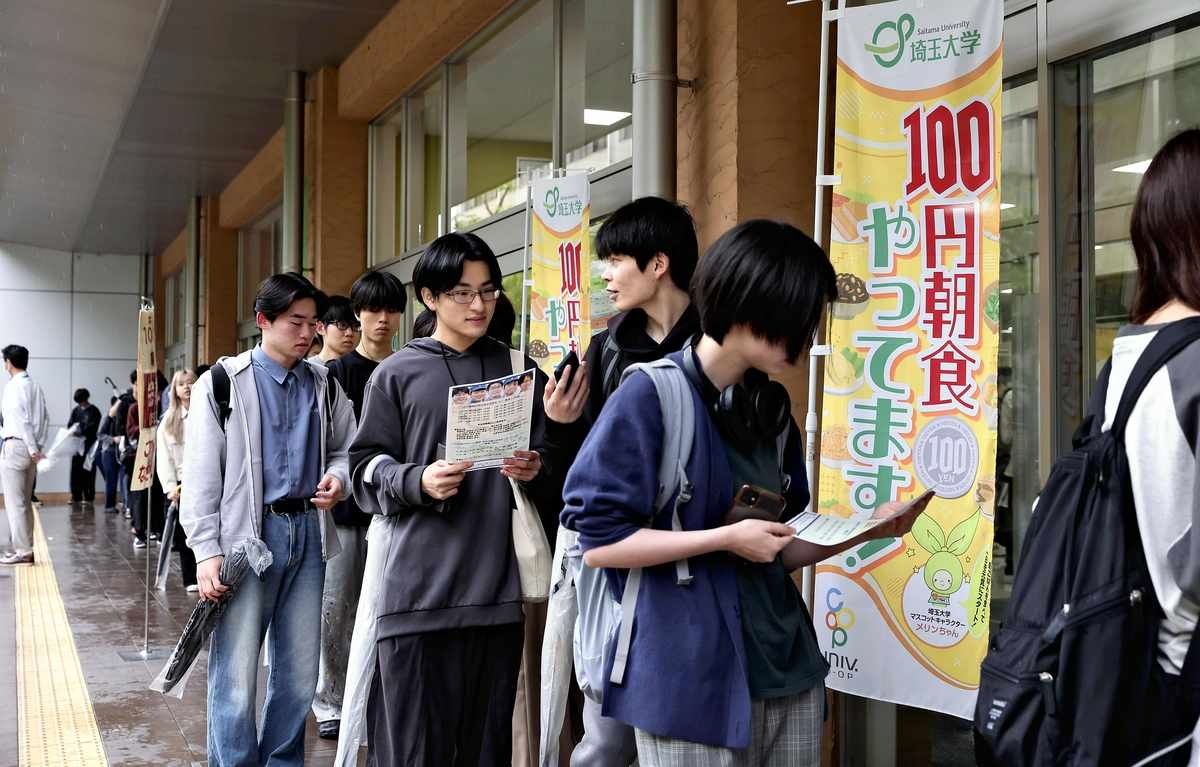
As it becomes increasingly difficult to maintain the ¥100 breakfast, Saitama University in Saitama has been raising sponsorship money from local companies, led by its Career Center, to cover operating costs.
Firms can donate in units of ¥150,000 and are allowed to hold one lecture for students as they eat breakfast.
They can also distribute flyers to the students and display advertisements on the cafeteria’s TV screens.
A human resources representative from Omori Machinery Co., a packaging equipment manufacturer in Koshigaya, Saitama Prefecture, visited the campus on May 22.
Starting at 8am, 175 students lined up at the cafeteria for the ¥100 breakfast of fried chicken rice bowl and miso soup.
As the students began eating, the HR representative explained the company’s operations and told the students: “We’re an extremely stable company. Please be sure to check out our website.”
“I can learn about local companies while eating breakfast,” said a freshman in the Faculty of Liberal Arts. “It’s like killing more than two birds with one stone.”
Curry rice price index on rise
Rising prices are weighing heavily on the finances of students and their parents.
According to the curry rice price index — a measure of the cost of ingredients and utilities needed to cook one serving of homemade curry, released by private research firm Teikoku Databank Ltd. — the average cost for one serving of homemade curry for the fiscal year ended March 2026 was ¥353. The cost rose by ¥95 from five years ago.
Meanwhile, a survey conducted last year by the Tokyo Federation of Private University Faculty and Staff Unions targeting parents of freshmen at nine universities and one junior college in the Tokyo metropolitan area found that monthly allowances sent to students since June averaged ¥91,600.
This represents a decrease of about 30% from the peak of ¥124,900 recorded in 1994, the highest figure since the survey began in 1986.
Rent for students living alone reached a record high of ¥71,800 per month on average, leaving only ¥660 per day for living expenses after rent was deducted from the allowance.
“Students are forced to rely on part-time jobs to make ends meet, which could hinder their academic performance,” said a representative from the unions. - The Yomiuri Shimbun