Xenophobia and financial woes in the West have created tremendous opportunities for higher education institutions in Hong Kong and the broader Eurasian region, the head of a leading university in Kazakhstan has said.
Professor Waqar Ahmad, president of Nazarbayev University, also revealed on Wednesday that the institution would soon launch another joint undergraduate programme in computer science and artificial intelligence with Polytechnic University.
Starting next year, the programme will allow students to spend two years at the university in Astana and two years at PolyU to earn two distinct degrees.
In an interview with the South China Morning Post, Ahmad underscored a shifting academic landscape, noting that the traditional dominance of American and British institutions was beginning to falter.
“It’s very difficult for students to go to North America and the UK on the back of different things,” he said.
Ahmad pointed to “xenophobic, anti-immigrant rhetoric” in the United States, which he described as “totally counterproductive and self-destructive” for attracting top minds. He also highlighted the fiscal crises plaguing higher education in the United Kingdom, where he said roughly three-quarters of universities were facing severe financial difficulties.
“That is a potential disaster for North America and Britain. It’s a huge opportunity for this region,” he said, adding that it was now up to Asia – including Hong Kong – to fill that vacuum and attract the talent.
“There isn’t a university, either today or in history, which achieves great things without attracting talent from across the world. So it’s a tremendous opportunity for Hong Kong, in particular, as it is a hugely multicultural community.”
Ahmad acknowledged Hong Kong’s unique advantages as an education hub, highlighting that it was the only city in the world boasting five universities ranked in the top 100 globally.
“A lot of countries and cities want to become international hubs for higher education, and they struggle,” he said, citing the lack of a broader economic ecosystem required to retain international talent.
While global cities such as London, New York and Washington successfully retained top graduates of various nationalities due to an abundance of big tech and major industries, Hong Kong also offered similar career prospects ranging from finance to innovation, with Shenzhen just across the border, Ahmad noted.
“There are plenty of reasons why people would be attracted,” he said.
Ahmad also highlighted the benefits of partnering with Hong Kong and other Asian universities.
“One of the unfortunate things with a number of the leading European, and particularly North American and British universities, is that it’s not in their interest to have an equal partnership,” he said. “It’s because if you have an equal partnership, you cannot benefit financially at the expense of somebody else.”
In contrast, he described the collaborations between Nazarbayev University and its counterparts in Hong Kong and mainland China as genuinely equal partnerships where both sides would benefit and drive regional advancement.
The joint programme with PolyU, details of which are due to be announced in a few months, comes on the heels of a similar partnership last year with the Hong Kong University of Science and Technology to launch a joint bachelor of business administration degree.
Ahmad said the degree would target students looking to explore commercial opportunities in the booming Eurasian region, a current market gap in traditional business schools.
The first intake of roughly 15 to 20 students will begin their studies in the coming academic year.
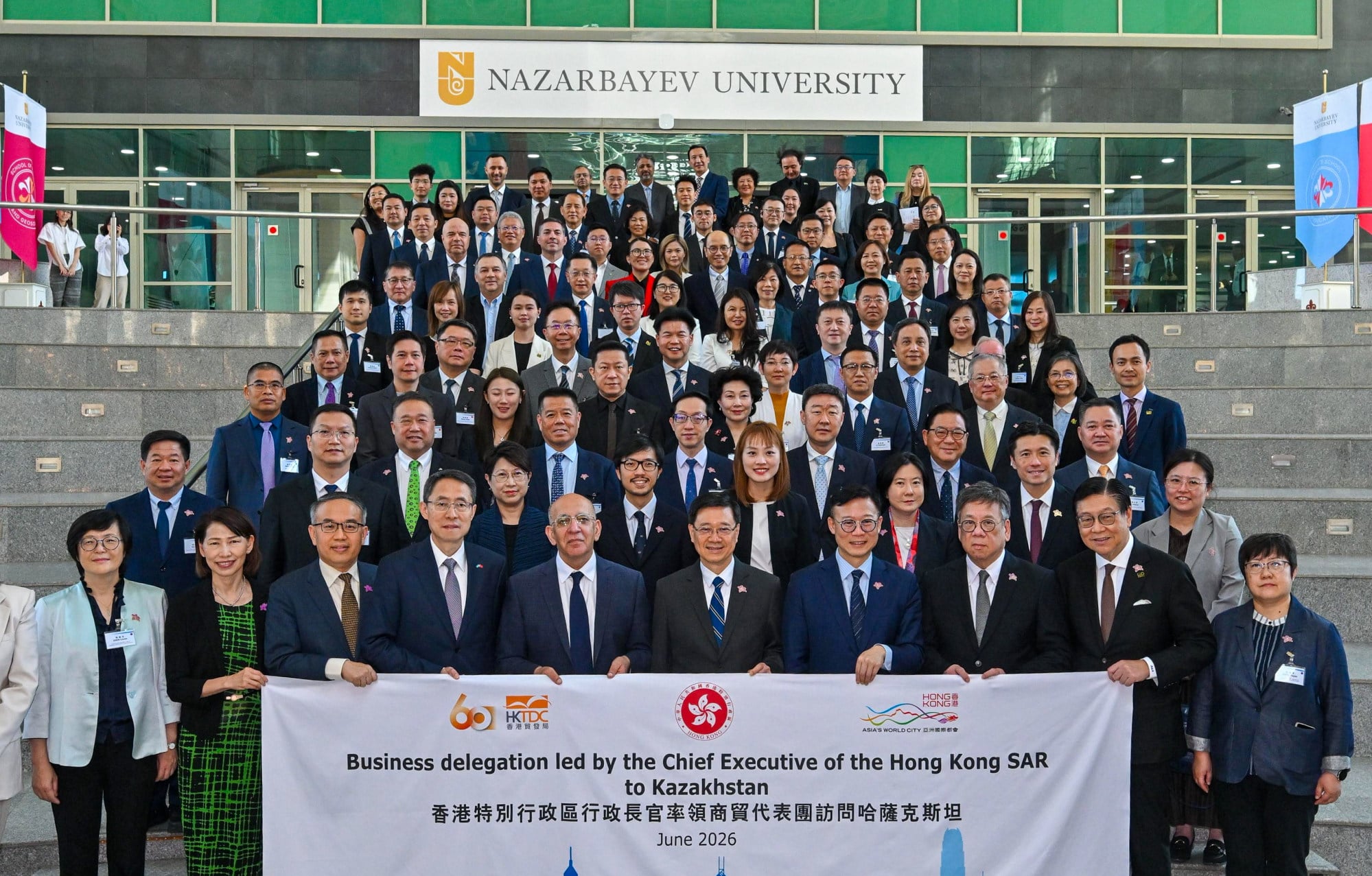
Nazarbayev University holds significant geopolitical weight as it was where Chinese President Xi Jinping first announced the concept of building an “economic belt” along the ancient Silk Road.
That concept later evolved into the Belt and Road Initiative, Beijing’s high-profile transcontinental infrastructure and investment strategy.
The university, founded in 2010, started to admit international students this year, drawing applicants from China, Pakistan, Nigeria and neighbouring Central Asian countries.
Ahmad attributed this interest to growing regional investments in education, infrastructure, logistics and transport networks.
He also praised Hong Kong leader John Lee Ka-chiu’s strategy of exploring emerging markets in the Middle East and now Central Asia, amid geopolitical uncertainties.
Lee’s high-level delegation to Central Asia visited Kazakhstan – with Nazarbayev University as one of its stops – before leaving for Uzbekistan on Wednesday as part of a five-day trip.
“Nobody should rely on a single market,” Ahmad said. “You need to diversify your income sources. If you do not do that, then you do not have sustainability.” -- SOUTH CHIN AMORNING POST