
The United States is reportedly bringing a powerful new weapon to the Iran war: large artificial intelligence (AI) models tasked with automating every stage of the targeting process, from satellite imagery analysis to final strike selection.
But how these systems operate remains strictly classified, with incidents such as the February bombing of a primary school that killed more than 200 children in southern Iran raising public concerns about AI’s potential role in committing war crimes.
Now China has taken a first step towards transparency.
Chinese aerospace researchers last month unveiled the Air Target Agent System, a powerful LLM agent collaboration AI tool designed to take satellite surveillance beyond image recognition – enabling it to analyse what it sees, draw conclusions and act on them autonomously.
The system combines large language models (LLMs) with AI agents capable of breaking down complex tasks, automatically selecting algorithms, coordinating workflows and recovering from failures without human intervention.
It can fuse satellite data with intelligence gathered by drones, security cameras or humans on the ground to reduce errors in target screening.
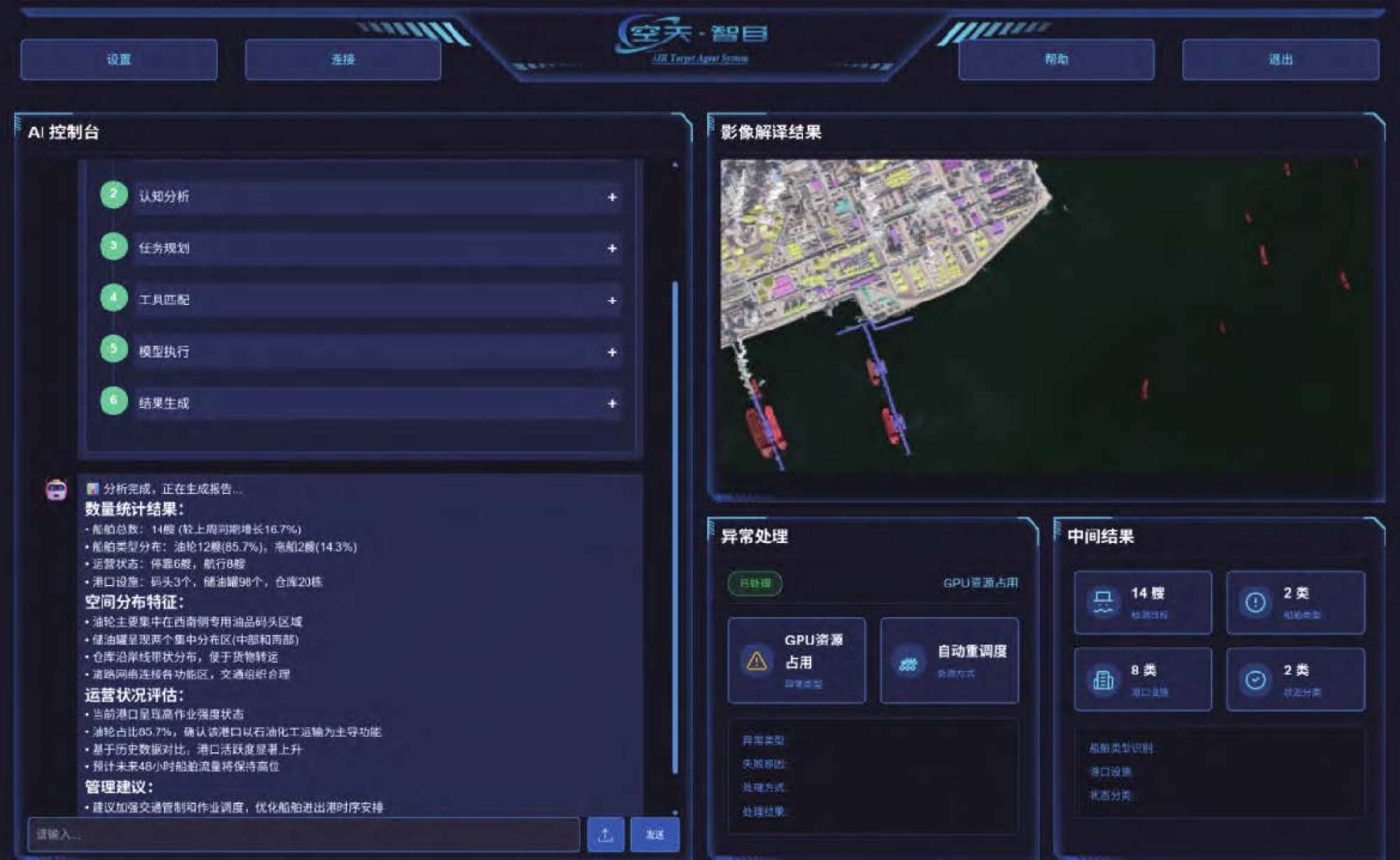
Researchers said the system had already been tested in a port-monitoring scenario, in which it autonomously analysed ship activity and operational conditions. The team said the system cut the time needed to complete the analysis from 342 seconds to 198 seconds, while GPU (Graphics Processing Unit) utilisation increased by 148.4 per cent.
The study was published in the Chinese peer-reviewed Journal of Space Engineering University by researchers from the Aerospace Information Research Institute of the Chinese Academy of Sciences and its key laboratories.
The Space Engineering University is run by the People’s Liberation Army Aerospace Force.

“Compared with traditional methods, [the system offers] good practicability, stability and scalability in terms of execution efficiency, anomaly recovery, resource utilisation and tool integration efficiency,” wrote lead researcher Wang Lei and his colleagues.
The study described the shift as a transition from traditional “data-algorithm-driven” systems towards “cognition-driven” remote sensing.
The work reflects a broader global race to apply generative AI to Earth observation. US and European organisations are pursuing similar technologies through projects such as Google Earth AI, Nasa’s Earth Science Data Systems programme and the European Space Agency’s AI foundation-model initiatives. Academic projects including EarthGPT and GeoChat are also exploring the use of large AI models for remote-sensing interpretation.
China may hold several advantages in this emerging field, including vast domestic data volumes, a rapidly growing commercial space industry, and strong state backing for integrating AI with aerospace infrastructure.
The Chinese system is built around what researchers describe as an “AI brain plus tool army” architecture. The LLM acts as the cognitive centre responsible for understanding requests, planning workflows and allocating computing resources, while AI agents execute tasks, use specialised tools and coordinate subtasks automatically.
“The next-generation intelligent and scalable remote sensing information processing system has laid a solid technical foundation,” Wang wrote.
One of the platform’s breakthroughs is automatic task decomposition. When a user issues a command such as analysing port operations, the system can independently split the request into ship detection, vessel classification, dock analysis and traffic prediction tasks before organising them into an optimised workflow.
Unlike traditional serial-processing systems, the AI platform can execute multiple subtasks in parallel while sharing intermediate results to avoid redundant computation. The study showed that CPU (Central Processing Unit) utilisation improved from 34.2 per cent to 67.8 per cent, while task success rates rose from 70 per cent to 90 per cent.
The system also demonstrated autonomous fault recovery. During one port-monitoring experiment, a target-recognition model failed because GPU resources were already in use. The platform automatically diagnosed the problem and switched to an alternative model, without human intervention.
“In the future, we will further explore the optimisation of the collaborative LLM-agent mechanism in more complex scenarios, the enhancement of multi-modal data fusion processing capabilities, and deployment and optimisation strategies in larger-scale, real application scenarios,” Wang said.
He added that the goal was to develop an intelligent system for interpreting remote-sensing targets that could operate autonomously and apply its capabilities to new situations. -- SOUTH CHINA MORNING POST