




A single drop of blood could soon be used to screen for early-stage cancer, according to Wen Liaoyong of Westlake University in Hangzhou.
Wen’s team has compressed what was once a refrigerator-sized detection system into something that fits in your hand – and boosted accuracy to about 10,000 times that of conventional methods.
The findings were published in the journal Nature Photonics on May 13.
“This work establishes a scalable and robust nanophotonic biosensing paradigm for miniaturised, high-performance diagnostics in clinical, remote and at-home settings,” Wen wrote in the paper’s introduction.
A former University of Connecticut researcher, Wen joined Westlake University’s school of engineering in 2019 as an assistant professor and independent principal investigator. He was promoted to associate professor last July.
Wen’s research focuses on novel multi-component nanostructured materials and their multifunctional applications.

Traditional equipment for detecting cancer biomarkers in blood requires prisms, spectrometers and complex optical paths. The resulting machines are typically the size of a double-door refrigerator, and are therefore confined to laboratories or specialised testing institutions.
Wen’s team uses a mechanism called Q-modulated refractometric sensing to shrink the equipment to handheld size.
Unlike traditional spectroscopy, which detects the wavelength of light, this mechanism measures light intensity.
If the measurable range of refractive index changes – shifts in how light bends through a sample when biomarkers are present – were a one-metre ruler, this system could detect changes as small as a few micrometres.
To achieve this, Wen’s team designed a 3D chip using metamaterials – engineered surfaces that manipulate light in ways natural materials cannot.
The work builds on findings published last year in Nature Materials, in which the team used aluminium to achieve high-precision manufacturing across the entire scale range, from nano to macro.
Traditional optical chips based on metasurfaces are “written” one stroke at a time using electron beam lithography – a process akin to copying a book word by word – making them difficult to mass-produce, with each chip costing hundreds of US dollars.
Wen’s team has, in effect, advanced chip manufacturing from the “book copying” era to the “movable type printing” era. By first creating a master version and then mass-producing it, thousands of highly consistent chips can be printed on an eight-inch wafer at once, with the cost per chip falling to US$5.
Because the new mechanism measures only light intensity, the entire detection system can be extremely simple – comprising no more than a 3D BIC sensing chip, an LED light source and a photodetector.
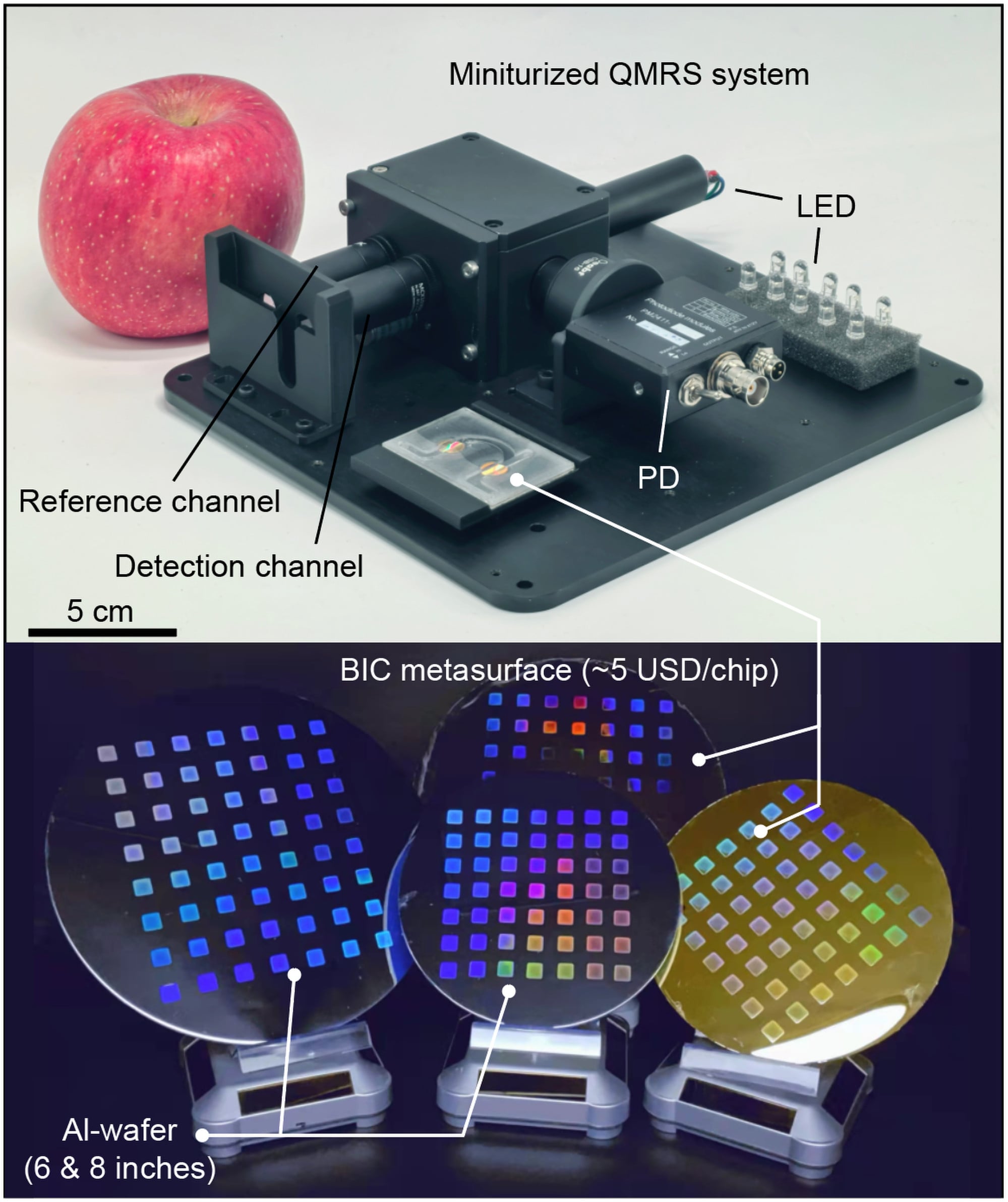
Once assembled, it is compact enough to be used at home, rather than requiring a laboratory environment.
To demonstrate the system’s capabilities, Wen collaborated with Xiamen University to detect small extracellular vesicles (sEVs) related to lung cancer.
Such sEVs are important biomarkers in liquid biopsy, but their extremely low levels in early-stage patients make them difficult to detect using traditional methods.
Wen’s handheld device proved about 10,000 times more sensitive than the standard enzyme-linked immunosorbent assay (Elisa) at detecting these early-stage lung cancer biomarkers.
In tests across 171 clinical serum samples from lung cancer patients, the device showed strong discrimination, achieving up to 94.9 per cent accuracy for early lung cancer detection and 92.1 per cent for post-operative monitoring. By contrast, traditional Elisa methods achieved only 74.7 per cent.
According to the research paper, the platform has broader applications beyond tumour screening.
“Micro-nano manufacturing technology – as a core supporting technology of the modern information society – has been widely applied in fields such as optical, electrical and magnetic signal interaction, becoming a key force in promoting digital and intelligent transformation,” Wen said. -- SOUTH CHINA MORNING POST


