
SINGAPORE: The storm clouds that likely caused the onset of severe turbulence on a Singapore Airlines (SIA) flight from London to Singapore in May 2024 went undetected by the on-board weather radar and caught the captain by surprise.
A visual inspection of the skies by the pilots in their immediate flight path also indicated there were no clouds, based on a final report on the incident involving Flight SQ321. The Transport Safety Investigation Bureau (TSIB) released the report on Tuesday (May 19) – two days before the second anniversary of the ill-fated flight.
Detailing its findings into the incident on May 21, 2024, which left one person dead and 79 others injured, the department in the Ministry of Transport said it was inconclusive whether there were issues with the weather radar.
While the radar manufacturer’s tests found no evidence of the tool failing to detect and display weather conditions, TSIB noted that the possibility of this “cannot be ruled out”. The radar manufacturer was not identified in the report.
TSIB cited observations from maintenance records of the same aircraft's radar failing to display weather events as recently as six days before the incident. The pilots ferrying the turbulence-stricken plane back from Bangkok – where SQ321 made an emergency landing – also spotted indications that the radar was understating weather conditions.
The Boeing 777-300ER aircraft was carrying 211 passengers and 18 crew members from London to Singapore when it encountered turbulence over south-west Myanmar.
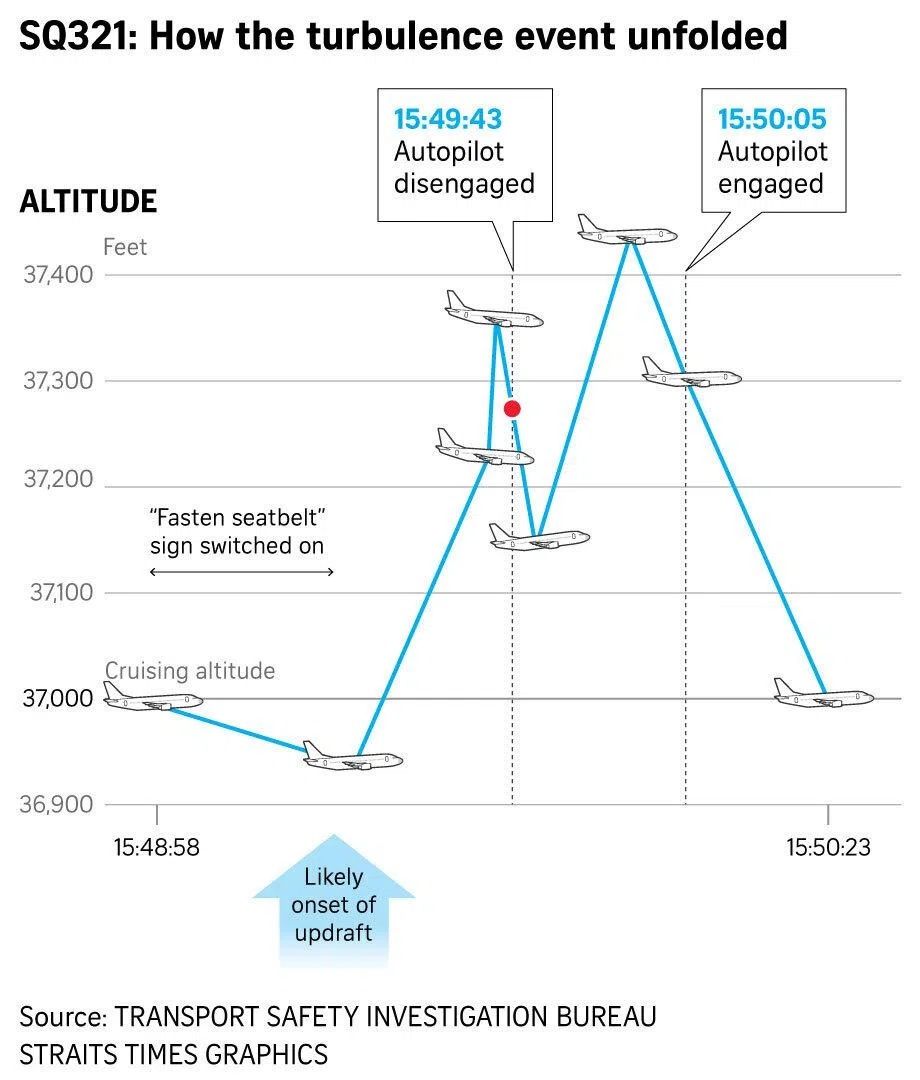
It was cruising at an altitude of 37,000ft at 3.49.23pm Singapore time, going at a speed of 0.84 Mach – or 1,037kmh – when turbulence struck.
According to the digital flight data recorder, the aircraft underwent rapid changes in gravitational forces ranging from plus 0.44G to plus 1.57G within 17 seconds.
Gravitational forces, or G-forces, measure rapid acceleration or deceleration by comparing it with the normal pull of gravity on earth. The normal baseline is set at plus 1G, meaning at plus 1.57G, a person would feel as if they were 1.57 times their body weight.
Two pilots – a pilot-in-command and an augmenting pilot, both captains – were in the cockpit, while a senior first officer was in the crew rest area. On long-haul flights, airlines carry an augmenting pilot or pilots, so that flight crew can take turns to rest.
The augmenting pilot deployed the speed brakes after noticing that the aircraft was about to exceed its maximum operating speed.
The pilot-in-command, meanwhile, adjusted the cruising speed to 0.82 Mach – the recommended speed for flying through turbulence – and switched on the seatbelt sign to alert those on board. The pilots did not have time to make a public announcement to passengers and crew.
As the aircraft’s altitude rose, the autopilot system pitched the aircraft’s nose down to return to its cruising altitude of 37,000ft.
Despite being at a five-degree downward tilt, the plane continued to climb at a rate of more than 2,000ft per minute, eventually reaching 37,362ft at 3.49.41pm.
Based on simulations done in still air, the downward tilt would have caused the plane to descend at a rate of 6,000 to 7,000ft per minute. Hence, SIA suggested that it was likely that the aircraft had encountered an updraft, a fast-rising column of air, with a speed of 8,000 to 9,000ft per minute.
TSIB said the turbulence was likely the result of a rapidly growing cloud.
In less than a second, the aircraft’s vertical acceleration plummeted from plus 1.35G to minus 1.5G, causing those who were not belted up to become airborne.
The G-force then increased to plus 1.5G in the next four seconds, which would have resulted in those airborne to come crashing down.
The pilots flew the plane manually to stabilise it, switching back to autopilot only at 3.50.05pm.
At about 3.51pm, the pilot-in-command was heard on the cockpit voice recorder, asking: “How come suddenly? Let me remove this (the sunshade on the side window) and see.”
Subsequent recordings in the ensuing minutes indicated that the captain had his weather radar set at the highest sensitivity at the time of the incident.
At this setting, the radar would amplify the amount of precipitation detected. For instance, lower-intensity precipitation that would typically appear in green on the navigation display could show up in yellow or red, indicating a higher severity. This allows pilots to decide the best path to navigate bad weather.
The display did not indicate anything of this nature.
“Faced with the unexpected turbulence event, the actions of the flight crew are understandable and appropriate for the situation,” said TSIB.
It is unclear why the pilots were unable to notice the widespread clouds.
TSIB said there were four other planes flying over south-west Myanmar at the time, of which three were flying in clear visual conditions. The crew on these planes saw widespread clouds.
These aircraft deviated from their planned routes to avoid the inclement weather by tapping their own weather radars, which were noted to be different from that used on SQ321.
The flight crews also said they visually estimated the top height of the clouds to be between 35,000ft and 50,000ft. They were, however, on different flight paths, not flying at the same height as the SIA plane, and could not provide information on the clouds in the vicinity of the SIA aircraft.
“The investigation team is unable to understand why the flight crew of the occurrence flight (SQ321) did not see the widespread clouds,” said TSIB.
When transporting the plane from Bangkok back to Singapore on May 26, 2024, checks done by a separate flight crew found that one of the two weather radars was displaying less information compared with the other one.
Data from SIA also showed that out of 29,000 flights involving its Boeing 777 fleet between May 2023 and July 2025, there had been 103 flights that experienced weather radar issues.
Three of them involved the plane used for SQ321. On April 29, 2024, and May 1, 2024, the radar on the right-hand side displayed less information.
Less than a week before the turbulence incident, the same radar on May 15, 2024, also failed to display any information, despite the flight crew observing storm clouds outside the cockpit.
Following these incidents, SIA carried out maintenance work on the aircraft, conducting a system test for the weather radar per the aircraft manufacturer’s guidelines.
If the radar passes the test, it is considered fit for use, according to Boeing’s standards, and there is no other troubleshooting action or test to conduct. Such issues do not have to be highlighted to Boeing either.
Because no error messages are generated during such malfunctions, TSIB advised flight crew to closely compare external visual cues with what is displayed on their screens.
The bureau made several safety recommendations, including for the International Civil Aviation Organization to mandate the installation of a recording function on all aircraft with a maximum take-off mass of more than 27,000kg and officially certified before Jan 1, 2023.
At present, only aircraft meeting that weight criteria and are officially certified after Jan 1, 2023, have this function, which would have enabled the investigation team to view what the flight crew saw on their navigation displays.
The aircraft operating SQ321 entered service in 2008.
TSIB also recommended that Boeing guide flight and maintenance crew to ascertain whether a weather radar is malfunctioning, and that the radar manufacturer develop a way to record images of weather information displayed to crew in order to rectify malfunctioning radar displays.
SIA has also made several moves after the incident. These include improving its turbulence monitoring and awareness tools, guiding its crew on how to troubleshoot suspected radar malfunctions, and sending reports of such issues to Boeing and the radar manufacturer for follow-ups.
In response to queries, SIA said it acknowledged TSIB’s final report, adding that it had fully cooperated with the authorities throughout the investigation.
“We sincerely apologise to all passengers and crew members on board flight SQ321 for their traumatic experience. The safety and well-being of SIA’s passengers and staff are our top priority.” - The Straits Times/ANN