
A US government witness in a trial of an alleged illegal Chinese police station in New York testified on Monday that he was harassed after holding a protest against establishing the Fuzhou-directed facility, one of several that China purportedly set up overseas.
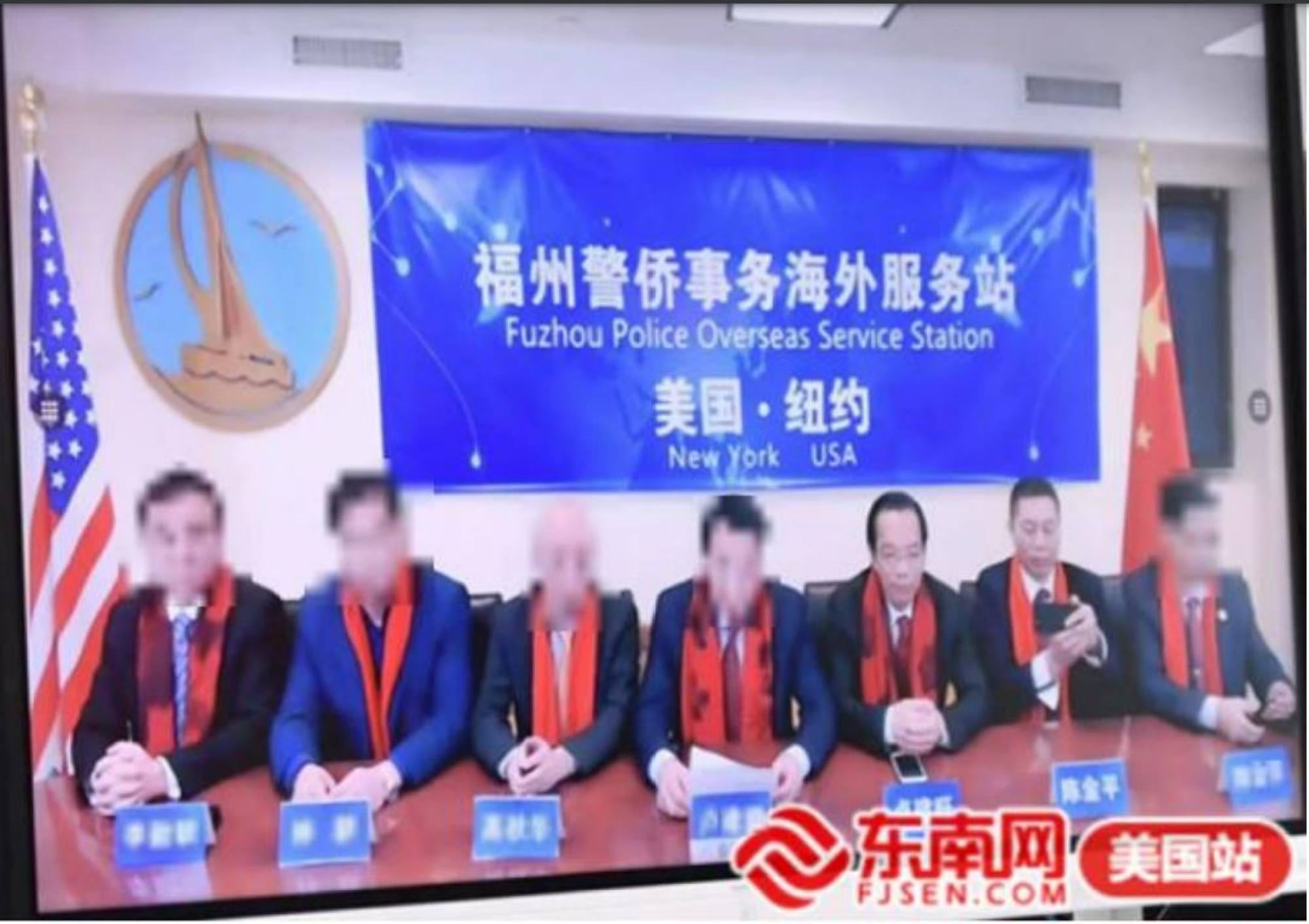
The US government has charged Lu Jianwang, 64, with acting as an unauthorised agent of China; conspiracy to act as a foreign agent and obstruction of justice. Prosecutors argue that it is part of a pattern that underscores China’s bid to expand its influence well beyond US shores.
Lu has pleaded not guilty, and his lawyers maintain that the police station was simply a service centre where overseas Chinese could renew their drivers’ licenses as a convenience during the pandemic.
Testifying on behalf of the government, dissident Xu Jie said he travelled from his home in Pomona, California, to New York after the police station was set up, and he live-streamed a demonstration against it on YouTube, after which he was harassed.
Asked whether he understood what the term “dissident” meant, Xu responded: “I’m very much familiar with dissident. I am one of them. In China, I understand it to be a group of people who criticise the Chinese government.”
Xu, a native of Nanjing, participated in the 1989 Tiananmen Square democracy protests before fleeing the country in 2013 for Laos and then heading to the US in 2018.
Xu testified that he has been cursed at, received death threats and been inundated with phone calls, as many as 176 a day, before and after live blogging the protest against the alleged overseas police station. He added that he did not know who was doing it and said he had never met Lu.
Later in the day, however, the government showed WeChat messages from Lu’s phone that included a request from Fuzhou police to gather information and verify Xu’s identity, listing Xu’s address on Holt Avenue in Pomona. “No need to contact him directly,” the message read. “Just verify his existence, that’s it.”
The Chinese embassy in Washington said it was not aware of the specifics of the case. “China is a country that upholds the rule of law, strictly abides by international law, and respects the judicial sovereignty of all countries,” said spokesman Liu Pengyu. “The so-called secret police stations do not exist.”
Prosecutors maintain that Lu helped set up the police station, which was allegedly used to monitor and harass overseas Chinese, within the facilities of a fourth-floor Chinese community centre in Manhattan’s Chinatown. Chen Jinping, pleaded guilty to working as an unauthorised agent for China in December 2024 and is awaiting sentencing.
Xu testified on Monday that his vehicle was smashed twice while parked behind his Pomona office without anything being stolen, adding that his house and office were also broken into five times. He said he could not prove that it was directly related to this case, but saw it as a long-term pattern of harassment since he left China.
Prosecutors appeared more keen on proving through Lu’s phone records that Xu was the victim, even if he did not know who was directing it.
Xu, bald with round glasses, said he has no plans to return to China, adding that he had been arrested more than 100 times before he left and that his farm business was lost in what he believed was a coordinated government campaign.
Lu’s lawyer, John Carmen, suggested in cross-examination that Xu was only protesting against the Chinese government and Communist Party for the money, citing the US$7,000 per month he made early on with his YouTube channel, and that he was on something of a vendetta.
“I want to answer your question. However, I feel the angle of your question has some problems,” Xu fired back, explaining that he started the channel while still in Laos at a loss; money was never the motivating factor; and it is now a tiny part of his income supplemented as a Lyft driver and working for an express package company.
“In Laos, not only was I not paid, I had to pay for the expenses and volume of viewers,” he said through an interpreter.
Carmen, Lu’s defence lawyer, questioned whether Xu knew Lu or had any detailed information on the police stations before travelling from California to film the protest. Xu responded that he only knew about the police facilities from what he had read in Chinese news.
“Globally, it’s not that unique,” he said. “There are many of them around.”
Xu said he moved to the US because, he alleged, the Chinese police were working very closely with Laotian authorities and were about to arrest him. “Living in America, at least we have the law to protect us,” he said. “I admire a country that has a separation of powers.”
A significant difference between the defence and prosecution in the case has been whether the US government could enter into evidence allegations that the Chinese government contacted Lu in 2015, asking him to monitor Falun Gong protesters in advance of Chinese President Xi Jinping’s September 24-25 trip to Washington that year.
Judge Nina Morrison ruled that this evidence would not be allowed because it could prejudice the jury, was not part of this trial, was not pertinent to the opening of the police station in 2022, and could “raise the risk of unfair prejudice” and stereotypes about dual loyalty.
A second government witness, FBI Special Agent Carrie Crossmore, testified about interviewing Lu at his house in the Bronx, a New York City borough. She talked through photos and WeChat messages the FBI collected from Lu’s phone, including those from Fuzhou asking about Xu.
Crossmore also cited photos found on Lu’s phone of supposed Falun Gong adherents that Fuzhou authorities reportedly wanted Lu and others in the Chinatown facility to nose around on. The US government alleged that around 50 contacts on Lu’s phone were working for the Ministry of Public Security in Fuzhou.
But during his cross-examination, Carmen questioned the clarity of the FBI special agent’s interview report, citing the lack of a video or a final written report that Lu signed off on.
“You’re not a neat note taker?” he asked. “You can’t always read your own handwriting?”
“It depends on the day,” responded Crossmore. -- SOUTH CHINA MORNING POST