BANGKOK: Thai foreign minister Sihasak Phuangketkeow appeared to reverse his earlier position on maritime negotiations with Cambodia on Tuesday (May 12), returning to language previously used by Prime Minister Anutin Charnvirakul and supporting the use of the UN Convention on the Law of the Sea (UNCLOS) as the framework for future talks.
His flip-flop comes after days of conflicting public statements from within the Thai government over Cambodia’s decision to pursue compulsory conciliation under UNCLOS, following Bangkok’s unilateral withdrawal from the 2001 Memorandum of Understanding on overlapping maritime claims, commonly known as MoU 44.
Speaking to Thai media at Government House on May 12, Sihasak said Thailand would only discuss maritime issues with Cambodia under UNCLOS and insisted that Koh Kut Island “clearly belongs to Thailand”.
According to reports published by Thai outlet The Nation, Sihasak reiterated that Thailand will not recognise Cambodia’s reported move to register MoU 44 as evidence concerning a maritime boundary line allegedly passing through Koh Kut.
“As for MoU 44, we have already terminated it,” Sihasak said. “Thailand and Cambodia will hold talks under UNCLOS.”
He added that any maritime boundary issue must be handled within “internationally accepted rules of law” under the 1982 UN convention, the same legal framework Cambodia has invoked since Thailand’s withdrawal from the bilateral agreement.
The foreign minister also declared that if maritime boundaries were drawn under UNCLOS principles, “it will be clear that Koh Kut already belongs to Thailand”.
His remarks represented a notable change in tone from statements he made just one day earlier.
On May 11, Sihasak publicly distanced Thailand from Cambodia’s push for compulsory conciliation under UNCLOS, rejecting suggestions that Bangkok had accepted or agreed to the process.
In comments to Thai media, he stressed that bilateral negotiations must come first and argued that compulsory conciliation could not proceed without mutual agreement.
“The most appropriate starting point was for Thailand and Cambodia to negotiate directly and exhaust bilateral talks before considering other mechanisms under the convention,” he said at the time.
Sihasak also criticised what he described as “unilateral Cambodian statements” and warned against Phnom Penh seeking negotiating advantages before formal discussions had begun.
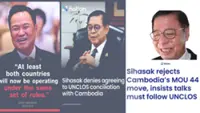
Those remarks appeared to contradict statements made earlier by Prime Minister Anutin Charnvirakul, who had publicly welcomed the fact that both countries would now operate under the same international legal framework following Thailand’s cancellation of MoU 44.
On May 6, Anutin reportedly said that after the withdrawal of the agreement, “both countries will now be operating under the same set of rules”.
“Thailand no longer has the MoU 44, so whatever discussions take place from now on, new rules and frameworks must be agreed upon together,” the Thai premier said.
Anutin later confirmed that he had personally informed Cambodian Prime Minister Hun Manet of Thailand’s withdrawal during a meeting on the sidelines of the Asean Summit in Cebu on May 11.
According to Anutin, Manet responded that Cambodia had “no alternative” but to pursue compulsory conciliation under UNCLOS. The Thai prime minister added that Thailand supported the use of UNCLOS principles because future negotiations would now be conducted under a common legal framework.
The apparent inconsistency between Thailand’s top leaders had raised questions over Bangkok’s actual position on Cambodia’s UNCLOS decision and whether divisions existed within the Thai government over how to handle the maritime dispute.
Tuesday’s comments from Sihasak, however, appeared to bring the foreign ministry back into alignment with Anutin’s earlier position.
Thailand unilaterally withdrew from MoU 2001, which for more than two decades served as the primary bilateral mechanism governing negotiations over overlapping maritime claims.
Manet expressed regret over Thailand’s withdrawal, describing the agreement as the only mutually accepted bilateral framework for peaceful negotiations.
He said Cambodia, committed to international law and peaceful dispute settlement, now had “no choice but to rely on international law”, particularly the compulsory conciliation mechanisms provided under UNCLOS.
Phnom Penh maintains that the process could help both countries achieve a fair and lasting settlement while preserving peace and stability between the two neighbours. - The Phnom Penh Post/ANN