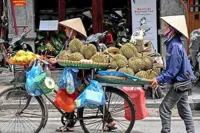
KUNMING (Xinhua): Monthong durians from Thailand are now priced starting at 28 yuan (about US$4.09) per kilogram at a fruit wholesale market in Kunming, capital of southwest China's Yunnan Province.
Meanwhile, on live-streaming e-commerce platforms across the country, shoppers can get a two-kilogram-plus durian yielding six generous pods of flesh for just 129 yuan, shipping included.
Once seen as a luxury treat, the spiky, pungent "king of fruits" has recorded consistent price drops in China, bringing "durian freedom" closer to reality thanks to faster logistics, industrial upgrading and expanded supply.
SPEED GAINS
In mid-April, Thailand, Malaysia and other Southeast Asian countries entered their peak durian harvest season.
Thanks to cold-chain freight trains running on the China-Laos Railway, Thai durians now reach Kunming in just 26 hours.
Within 48 hours, the produce is distributed to more than 30 cities nationwide, including Guangzhou in south China, Shanghai in east China and Shenyang in northeast China. Train services have also been scaled up: from two daily trips on normal days to six during the peak harvest season.
Data shows that from January 1 to April 26 this year, the China-Laos Railway transported 50,300 tonnes of imported durians from Southeast Asia, a surge of 94.2 percent year on year.
Besides rail delivery, sea and road freight routes have also accelerated operations. Guangzhou's Nansha Port, China's largest seaport for durian imports, has run "durian express" routes for six years, with 10 weekly direct voyages from Thailand's Laem Chabang Port that take just four days to complete. The process from unloading to entering Guangzhou's wholesale market takes as little as two hours, with nationwide delivery to major cities completed within 24 hours.
Meanwhile, customs clearance is also getting much faster. At Yunnan's Mohan Port, the application of 5G technology and China's BeiDou Navigation Satellite System has slashed durian clearance time from four hours to just 15 minutes.
"Driven by the cross-border transport enterprise cooperation and promotion mechanism within the Greater Mekong Subregion (GMS), customs clearance and inspection procedures have become highly efficient and convenient, greatly boosting durian transport efficiency," said Li Jing, general manager of a local international freight forwarding company.
"Ripening agents are no longer used during transportation, allowing durians to ripen naturally and better preserving their quality and freshness," Li added.
DEMAND PUSH
By 2025, China represented over 90 percent of global durian consumption. Durian imports via Yunnan's ports alone were valued at 2.05 billion yuan in the first two months of 2026, up a staggering 351.6 percent year on year, according to Kunming Customs.
At the International Fruit Conference held in Kunming in late April, industry insiders widely recognized China as not only a major durian consumer but also a "bellwether" shaping Southeast Asia's durian sector.
Wu Juntao, brand operations director of Thailand KAF Group, said Thailand's total durian output exceeded 1.68 million tonnes in 2025, with roughly 927,000 tonnes, or more than 55 percent, exported to China. The steady demand from the Chinese market has directly spurred farmers and businesses across Southeast Asia to ramp up durian cultivation.
Chinese consumers' growing appetite for higher-quality durians is also driving industry upgrades. Thailand has banned "four improper practices," namely underripe fruits, pest-infested produce, false certifications and artificial coloring, with violators facing entire consignment rejections and credit sanctions.
Moreover, some companies have begun promoting the "tree-ripened" concept, introducing AI-powered sorting and full-chain traceability systems to better guarantee durian quality.
HOMEGROWN HOPE
Thailand once dominated China's durian import market almost exclusively. Today, Vietnam, the Philippines, Malaysia, Cambodia and Laos have all gained approval to export fresh durians to China. Diversified supply has not only led to more reasonable prices but also allowed ASEAN countries to share benefits from China's vast consumer market.
While domestic durian output remains limited in China for now, expanded cultivation and technological progress are set to make homegrown durians an important market alternative and further enrich consumer choices.
Durian is a quintessential tropical fruit that demands extremely specific growing conditions. Ao Pingxing, director of the durian industry research center at Yunnan Agricultural University, noted that temperature extremes, whether too high or too low, as well as strong winds, can cause durian trees to wither or shed leaves, slowing or stunting growth significantly.
This explains why durian cultivation in China, despite an early start, has advanced slowly. Official records show China first introduced durian planting from Southeast Asia in 1958, but it was not until 2019 that a breakthrough in large-scale trial cultivation was achieved in south China's Hainan Province. The key constraints had been seedling quality and cultivation techniques.
In recent years, Yunnan and other regions have begun pursuing breakthroughs. Experimental cultivation is already underway in areas with tropical climate conditions within Yunnan's Xishuangbanna, Pu'er and Dehong.
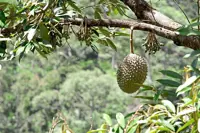
In April this year, an eight-year-old Monthong durian tree in Jinping County, Honghe Hani and Yi Autonomous Prefecture in Yunnan, bore its first naturally ripened fruit, weighing 3.7 kilograms.
Research efforts are also gathering pace. The Yunnan Institute of Tropical Crops has brought in more than 70 durian varieties and is carrying out cold-tolerance breeding studies. In Gengma County, Yunnan Agricultural University has partnered with local authorities to build a 20-hectare demonstration orchard, introducing premium varieties including Black Thorn and Musang King.
According to Ao, durians typically take five to eight years from planting to reach full production, and most durian trees in China are still in the growth phase. Hainan leads domestic durian cultivation. Despite an expected increase in output this year, overall production will stay limited, and homegrown durians, due to higher labor, technology and management costs, remain more expensive than imports, making a near-term price advantage unlikely.
"Still, with technological advances, we will eventually be able to grow premium homegrown durians, and that's a major step forward in realizing genuine durian freedom," Ao said. -- XINHUA