




Hong Kong universities are rapidly gaining favour among mainland Chinese families as they shun the intense domestic competition of the gaokao and uncertainties stemming from Sino-US tensions, embracing the city’s generous non-local admission quotas.
The Blue Book on Mainland Students Studying in Hong Kong released late last month underscores this trend, attributing it to geographic proximity, cultural familiarity, and pragmatic considerations regarding career prospects and residency planning, even as admission becomes fiercely competitive.
“In the past three to five years, the scale, structure and underlying logic of mainland students pursuing education in Hong Kong have undergone a qualitative change,” wrote the authors from Peking University’s Sustainability Research Institute and two education companies.
“What began as an elite pathway for a small number of top-performing students has evolved into a complex ecosystem spanning schooling, multiple undergraduate admission channels, a large-scale influx into taught master’s programmes, and ever-closer links between study, career planning and long-term residency status,” according to the report, unveiled in Beijing on April 26.
In the 2023-24 academic year, 38,100 non-local students were enrolled in Hong Kong’s taught postgraduate programmes, a staggering 207 per cent increase from 2020-21. At the University of Hong Kong (HKU) alone, mainland students accounted for 63.4 per cent of non-local undergraduates and an overwhelming 92.4 per cent of taught postgraduates, the authors wrote, citing data from the city’s Education Bureau.
The authors predict that Hong Kong will emerge as an “educational magnet” for mainland students, bolstered by policies that have doubled non-local student quotas to 40 per cent of local places starting from the 2024-25 academic year.
While the United States, Britain, Canada and Australia remain popular overseas study destinations for mainland Chinese families, concerns over safety and visa issues amid geopolitical tensions are prompting a shift.
Singapore stands as “Hong Kong’s most direct Asian rival”, particularly appealing to high-net-worth families and top applicants. Both cities offer world-class, English-medium universities. However, the authors argue, Hong Kong’s deepening integration with the Greater Bay Area gives it a unique edge.
Hong Kong has overtaken the US to become the second most popular study-abroad destination for mainland Chinese students in 2026, according to a report released in March by New Oriental Education & Technology Group, a leading private education company on the mainland.
Britain retained its position as the top destination for the seventh consecutive year, while the US slipped to third place for the first time since the annual report was launched in 2015. Singapore is ranked sixth, the same position as last year, following Australia and Japan. The report is based on an online survey of nearly 7,000 students and parents.
The Blue Book also highlights practical advantages to studying in Hong Kong for mainland students, including shorter travel distances from home, lower overall costs compared with four-year programmes in the US, the IANG (Immigration Arrangements for Non-local Graduates) visa – which allows non-local graduates to work in Hong Kong after graduation – and relatively strong employment prospects both in the city and across the bay area’s burgeoning tech and innovation sector.
Yu Wen, mother of an eighth-grade student at a public school in Beijing, has decided to move her daughter to an international school starting next year. The change is intended to bypass the brutal gaokao competition and pave the way for an undergraduate degree in Hong Kong.
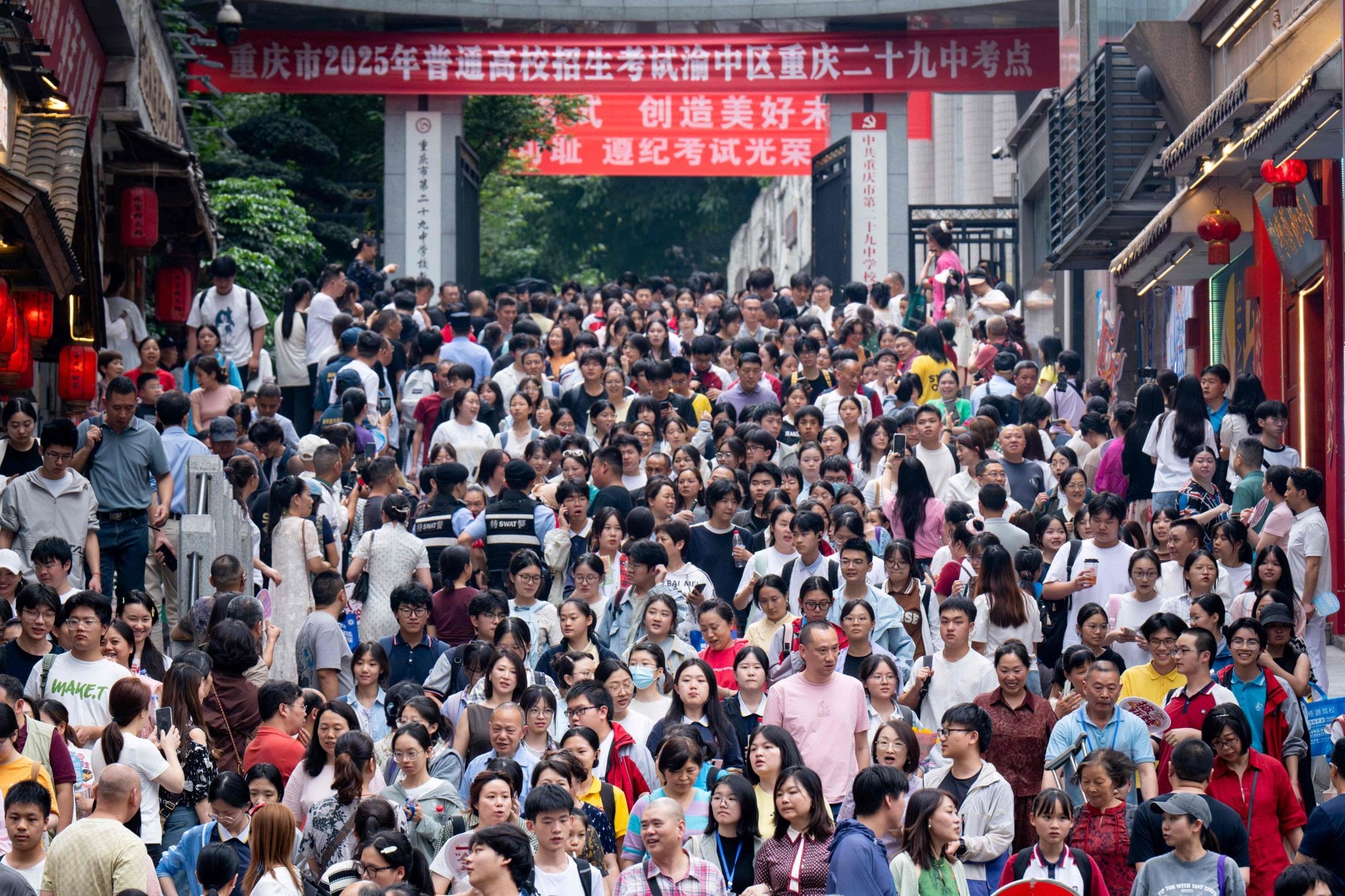
More than 13 million students sat the gaokao last year. Admission to China’s roughly 150 top-tier universities – those typically linked to the best job prospects – is fiercely competitive, with national admission rates averaging just 1.6 to 5 per cent, according to data from China’s Ministry of Education.
“I would definitely avoid the hellish gaokao,” Yu said. “And with rising safety concerns and ongoing Sino-US tensions, studying in the US no longer feels as secure or predictable as before.”
She had also considered Singapore, but said that Hong Kong had the advantage of being much closer – meaning she would be able to visit more often. “After graduation, my daughter can look for work either in Hong Kong or in the Greater Bay Area’s tech and innovation hubs,” she said.
The problem, however, was that “everyone seems to be thinking the same way”, Yu said. “Hong Kong’s top universities have become incredibly competitive, so it’s not easy to get in.”
Amy Feng, a consultant at Beijing-based international education agency CAC Edu, agreed about the challenge.
“Applying to Hong Kong’s top three universities [HKU, Chinese University of Hong Kong and Hong Kong University of Science and Technology] for undergraduate programmes now requires academic strength comparable to getting into Tsinghua or Peking University. It’s extremely difficult,” Feng said.
“As a result, for many families, the US top 30 universities remain a more realistic choice for undergraduate study.”
Some families remain committed to the US for other reasons. Li Qingquan, a Shanghai parent whose son is graduating this year from an international school, has already secured Hong Kong residency through an entrepreneur investment route. Yet he ultimately decided to send his child to a US university.
“We have laid the groundwork for Hong Kong [residency], but my son still chose the US,” Li said. “Hong Kong is excellent in many ways, but it feels a bit small. My son is more interested in the wider cultural diversity in the US.”
Cen Jianjun, chairman of the overseas study service branch of the China Education Association for International Exchange, remains optimistic about Hong Kong’s role as a regional education hub.
“With its world-class universities, blend of Sino-Western education systems and the unique advantages of ‘one country, two systems’ – backed by the motherland while connecting globally – Hong Kong offers clear [structural advantages], especially as cooperation in the Greater Bay Area deepens,” Cen said. -- SOUTH CHINA MORNING POST


