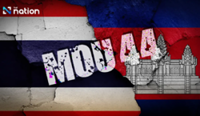
Bangkok unilaterally terminated a longstanding agreement with Cambodia to work towards joint offshore energy exploration, defying calls from its neighbour to stay the course on the 25-year-old pact.
The Thai Cabinet’s cancellation of the agreement, which seeks to develop a framework to jointly explore hydrocarbons in parts of the Gulf of Thailand where the two countries’ claims overlap, had long been expected and follows two rounds of armed conflict between them last year.
The withdrawal was an election campaign pledge of Thai Prime Minister Anutin Charnvirakul, who rode a wave of nationalism stoked by the fierce fighting with Cambodia to become the first Thai premier to be reelected in two decades.
“Cancelling the deal is not related to the border conflict with Cambodia, but part of my policy. It has been 25 years and there has been no progress,” Anutin said, adding that Cambodia would be informed of the decision.
Cambodia’s Foreign Minister Prak Sokhonn expressed regret over the termination and said Phnom Penh “has no option” but to settle the boundary issue under processes outlined in the United Nations Convention on the Law of the Sea, or UNCLOS.
“Cambodia’s decision to pursue compulsory conciliation under UNCLOS reaffirms its commitment to resolving maritime disputes peacefully and in accordance with international law,” he said in a statement.
Despite multiple rounds of meetings, the agreement known as “MOU 44” has made little progress since it was signed, with the process derailed by political instability in Thailand, intermittent disputes between the two neighbours and fierce opposition from Thai nationalists.
The two-track agreement had proposed the creation of a framework to allow offshore oil and gas to be jointly explored in overlapping areas while parallel negotiations take place on formal demarcation.
A Thai government spokesperson said that UNCLOS would be used as a reference to negotiate directly with Cambodia on maritime boundary demarcation.
Thailand has historically refused to take part in Cambodian efforts to settle border disputes using international mechanisms, including the International Court of Justice (ICJ), insisting those be negotiated bilaterally.
A ceasefire has been in place between Thailand and Cambodia since late December after two eruptions of fighting along large stretches of their 817km border.
Each side blames the other for triggering both rounds of clashes, which killed close to 150 people and displaced hundreds of thousands of people. — Reuters