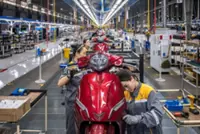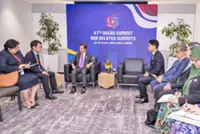
HANOI/PHNOM PENH (Bernama): An Asean policy think tank cautions that sustained high energy costs will undermine the region’s manufacturing competitiveness, particularly in energy-intensive industries and key production hubs across Southeast Asia.
The Jakarta-based Economic Research Institute for ASEAN and East Asia (ERIA) anticipates that rising fuel, gas, and logistics costs will directly increase production expenses.
Higher prices for petrochemical feedstocks, fertilisers, and transport inputs indirectly drive up costs across both manufacturing and agriculture.
"Sustained high energy costs will certainly put pressure on ASEAN’s manufacturing competitiveness, especially in energy-intensive sectors and major production hubs such as Vietnam, Thailand, Malaysia, and Indonesia,” ERIA President Tetsuya Watanabe told Bernama in an exclusive interview.
However, he said that this does not mean ASEAN will lose its industrial edge, but the foundations of its competitiveness must adapt to rapidly changing conditions.
"In the future, ASEAN’s strength cannot rely only on low-cost production. It must increasingly rest on resilience, diversification, efficiency, and value addition.
"This requires stronger regional connectivity, more efficient energy use, accelerated investment in domestic and regional energy resources, and better integration of supply chains across ASEAN,” he said.
ERIA’s observations come as regional economies are grappling with high fuel costs and energy supply instability since military conflict erupted in West Asia on February 28.
Much of the crude oil and gas that is imported to produce electricity to propel Southeast Asian economies is now exorbitantly priced, and supply is uncertain due to the shipping route crisis in the Persian Gulf.
Crude oil is currently trading at US$120 (RM476) per barrel compared to the pre-conflict price of about US$70 (RM278).
Over-dependence on imported fuel has only exposed ASEAN to geopolitical risks from major energy exporters during a crisis, such as the ongoing Gulf turmoil.
According to the Paris-based International Energy Agency, about 80 per cent of oil and oil products shipped through the Strait of Hormuz last year were routed to Asian markets.
Watanabe describes the current energy dilemma as fundamentally a structural issue.
"ASEAN’s vulnerability does not come only from high import dependence but also from concentrated supply sources, heavy reliance on strategic chokepoints, and the lack of sufficiently operational regional emergency mechanisms.
"The current crisis has made visible what was already embedded in the system, with external shocks (being) transmitted very quickly into domestic fuel prices, electricity costs, inflation, and industrial pressure,” he said.
The need of the hour, said Watanabe, is to rebalance ASEAN’s energy system towards resilience, rather than retreating from the energy supply markets.
First, maximising indigenous energy resources wherever each country has comparative potential - whether biomass, biofuels, domestic gas, hydropower, geothermal, coal, or renewable energy.
"Second, strengthening intra-ASEAN trade and balancing mechanisms for biofuels, coal, natural gas, and eventually electricity, so that regional resources can be mobilised more efficiently during times of disruption,” said Watanabe.
Third, ASEAN must deepen frameworks such as the ASEAN Power Grid, the Trans-ASEAN Gas Pipeline and the ASEAN Petroleum Security Agreement, while collaborating with the wider Asian region to diversify supply partnerships, storage arrangements and emergency support.
"In short, the region needs a more diversified, integrated, and resilience-based energy architecture,” he said.
According to ERIA, there is also a need for practical regional reserve architecture that combines national stocks, coordinated release mechanisms, hosted reserves, and supply distribution arrangements.
This would improve predictability and reduce panic, competition during crises, and strengthen collective bargaining power.
"Over time, ASEAN should think in terms of a regional energy security architecture, not only petroleum security. That means linking oil security with gas resilience, intra-ASEAN trade in indigenous resources, strategic fuel substitution, and stronger electricity connectivity,” said Watanabe.
These measures are critical; otherwise, the burden will increasingly reach households, farmers, fishers, transport operators, and small and medium enterprises.
Rural communities are more vulnerable because rising fuel prices increase irrigation costs, transport costs, and fertiliser prices, while also squeezing household spending. So, the real cost is not only fiscal - it becomes social and developmental, said ERIA.
"That is why ASEAN’s response must include not only energy measures, but also support for food systems, rural livelihoods and productive sectors,” he said. -- Bernama