TOKYO (Reuters/AFP): Japan issued a special advisory on Monday (April 20), warning of an increased risk of earthquakes at magnitude 8.0 or stronger, after a powerful jolt rattled the country’s north and prompted a tsunami warning.
The Japan Meteorological Agency said in a statement that “the likelihood of a new, huge earthquake occurring is relatively higher than during normal times”.
The warning for the northern region came a few hours after a 7.7-magnitude earthquake struck the area, shaking large buildings in the capital Tokyo, hundreds of kilometres from the epicentre.
The quake, which was initially estimated at magnitude 7.4 before being revised to 7.5 and again to 7.7, hit at 4.53pm (3.53pm Singapore time) in Pacific waters off northern Iwate prefecture.
There were no immediate reports of serious injuries or significant damage, Chief Cabinet Secretary Minoru Kihara told a news conference.
A Cabinet Office official told a separate televised briefing that “while it is uncertain whether (another) major earthquake will actually occur, we ask that you take disaster preparedness measures based on the principle that you are responsible for your own safety”.
The April 20 tremor had an epicentre in the Pacific Ocean and was 10km deep, according to the JMA.
Authorities had urged residents to stay away from coastal areas where tsunami waves of up to 3m were expected.
Prime Minister Sanae Takaichi said the government had set up an emergency task force and urged citizens in the affected areas to evacuate to safety.
Authorities had urged residents to stay away from coastal areas where tsunami waves of up to 3m were expected.
Prime Minister Sanae Takaichi said the government had set up an emergency task force and urged citizens in the affected areas to evacuate to safety.
“Possible damage and casualties are now being looked into,” Ms Takaichi told reporters at her offices in Tokyo.
Several port towns including Otsuchi and Kamaishi - both hard-hit by a massive earthquake and tsunami in 2011 - issued evacuation orders for thousands of residents, according to public broadcaster NHK.
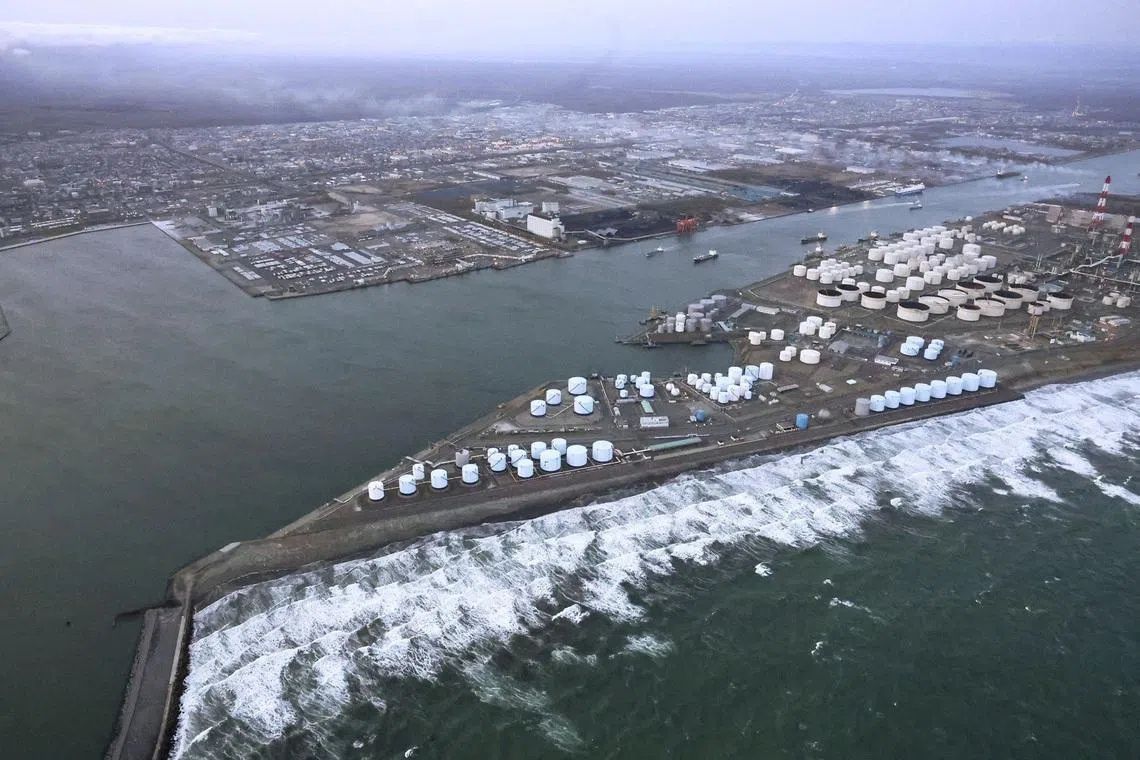
The biggest waves were forecast to hit Iwate and Aomori prefectures at the top of Japan’s main Honshu island, and the northern island of Hokkaido, authorities said.
In the hour following the earthquake, tsunami waves as high as 80cm had been detected, while warnings remained for waves as high as 3m.
A 3-metre tsunami could cause damage to low-lying areas, flooding buildings, and anybody exposed would be caught in its currents, according to the JMA.
“Evacuate immediately from coastal regions and riverside areas to a safer place such as high ground or an evacuation building,” it said, warning that damage due to tsunami waves was expected.
“Tsunami waves are expected to hit repeatedly. Do not leave safe ground until the warning is lifted.”
Ships sailed out of Hachinohe port in Hokkaido in anticipation of the waves, footage aired on NHK showed, as a ‘Tsunami! Evacuate!’ alert flashed across the screen.
Bullet train services in Aomori at the northern tip of Japan’s main Honshu island were halted due to the tremors, Kyodo news agency reported.
There are no nuclear power plants currently in operation in Hokkaido and Tohoku regions but Hokkaido Electric Power and Tohoku Electric Power have a number of shutdown nuclear power plants there.
Tohoku Electric said it was checking the impact of the earthquake and tsunami on its Onagawa nuclear power plant.
The Singapore Embassy in Tokyo advised Singaporeans to monitor local conditions closely and refer to the JMA website and NHK News for the latest updates, as well as for warnings and advisories.
Japan is one of the world’s most seismically active countries, sitting on top of four major tectonic plates along the western edge of the Pacific “Ring of Fire”.
The archipelago, home to around 125 million people, typically experiences around 1,500 jolts every year and accounts for about 18 per cent of the world’s earthquakes.
The vast majority are mild, although the damage they cause varies according to their location and the depth below the Earth’s surface at which they strike.
In 2011, a magnitude-9 quake triggered a tsunami that left 18,500 people dead or missing and caused a devastating meltdown at the Fukushima nuclear plant. -- REUTERS, AFP