
SINGAPORE: Since the outbreak of the Iran war, Vignesh Kumaravel’s quantitative trading models have struggled to perform due to “extreme volatility” in global stock markets.
The quant finance professional, whose job involves coding systems to turn market signals into profits, said that higher prices have also hit him personally. He and some Vietnamese friends cancelled a trip to Kuala Lumpur after short-haul airfares doubled.
“For now, I haven’t changed my daily habits or food choices, but I am definitely being more careful with extra spending,” said the 26-year-old.
Just as Vignesh fine-tunes his trading algorithms, Singaporeans are adapting their daily routines to cope with the higher prices unleashed by fighting in the Middle East.
The Feb 28 air strikes on Iran by the United States and Israel triggered a series of retaliatory responses that have damaged oil and gas infrastructure in the Gulf, as well as the closure of the Strait of Hormuz, a key route for global oil and liquefied natural gas shipments.
Of the 30 people The Straits Times interviewed on the war’s impact on their spending, a slight majority said they have been affected by rising prices and made changes to their lifestyles.
Retirees and younger workers were more likely to say they have been impacted, while professionals and office workers were less affected, with some saying they have not yet tightened their belts.

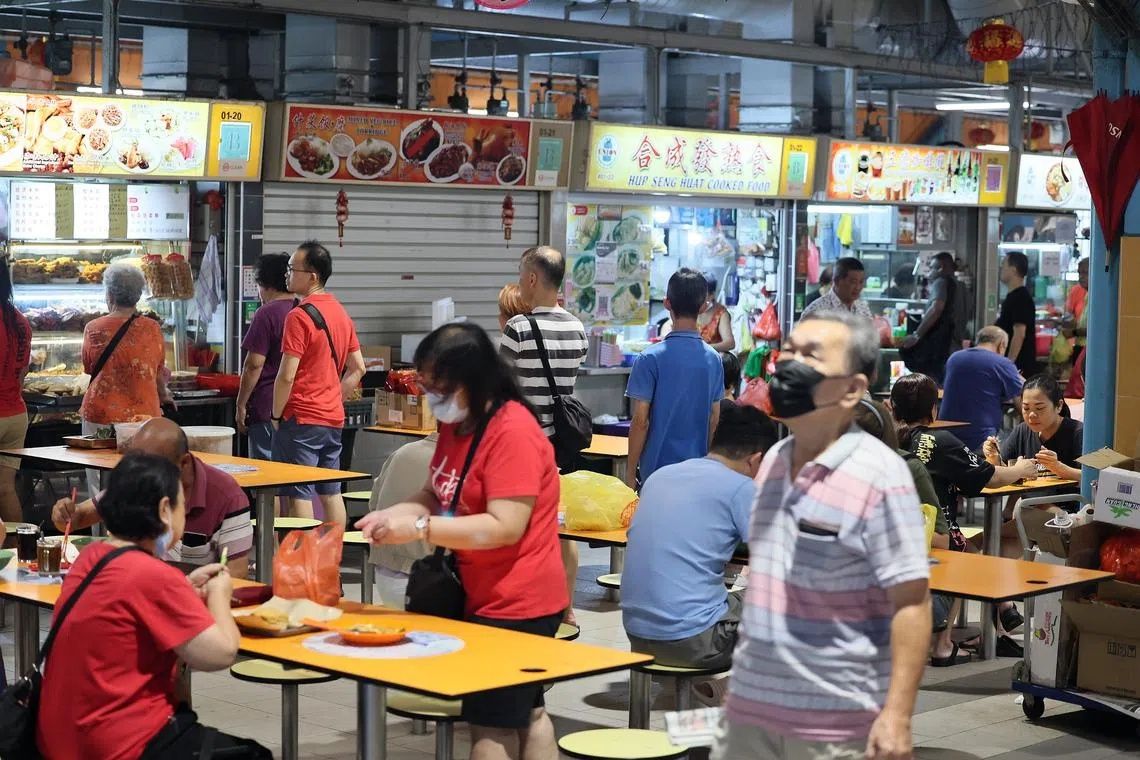
Homemaker Jean Chua, 63, noted how fishball noodles at the Elias Mall coffee shop near her home now cost S$4.30, up from S$4 earlier in the year. The price of a hot coffee there has also risen from S$1.20 to S$1.50.
Besides food, the cost of home repair services has also gone up. She recounted how a plumber quoted her $120 in April to fix a toilet issue, which she found expensive. He had cited higher petrol prices in setting his rate. In the end, her husband bought a replacement part for $12 at a hardware shop and fixed the problem himself.
Like some Singaporeans looking to stretch their dollar, her family crosses the Causeway to Johor Bahru once a month – both for groceries and for some discretionary spending such as a restaurant meal, a massage and a head spa, and the occasional movie.
“It’s not that we don’t want to spend here, but you get much better value in JB,” she said.
For Francis Chin, 75, his compact 1.3-litre Honda Jazz feels expensive to drive these days. Instead, he now walks 2km every day to get from his home to the neighbourhood centre in Ang Mo Kio Avenue 9.
The retiree is also now more deliberate about comparison-shopping on Lazada and Shopee, and buying household goods like utensils from value shops rather than in malls.
Civil servant Fatmah Khan, 23, said her family has been stocking up on olive oil, as their supplier had cautioned that stocks may be affected by a prolonged closure of the Strait of Hormuz.
Some are also shifting their consumption habits.
A finance professional who wanted to be known only as Chong said he has stopped buying drinks from coffee shops entirely and brings his own instant coffee sachets to the office.
“Twenty coffee sachets for $3 is much more worth it for me, compared with $1.20 per cup,” said the 35-year-old. He also cooks simple dinners more now rather than eating out, and estimates that this has brought his food expenses down from $500 to $300 each month.
Others, like tour guide Tansel Kaya, 29, have taken more drastic actions.
The self-described “heavy meat-eater” has bought more of his favourite top cut beef since the conflict first broke out. He is glad he did so, as wholesale prices have since risen from $13.90 per kg a few weeks ago to $18.90 now.
The Singaporean has also taken to showering at his gym in between tours, which has helped to cut about $20 to $30 from his monthly utilities bill.
Meanwhile, a small business owner who gave his name as Joey said he has stopped taking his two children to paid play venues like indoor playgrounds.
Through parenting portals, he found free alternative activities such as cycling at West Coast Park, Marina Barrage and Gardens by the Bay, and visiting the national museums.
“There are also some malls with free indoor playgrounds if the weather is too hot or if it’s raining,” noted the 43-year-old, rattling off options such as Shaw Plaza, Great World City and Marina Square.
Air-con, regional holidays not up for negotiation
Four in five interviewees who spoke about their electricity use said air-conditioning was non-negotiable, given Singapore’s hot and humid weather.
When it came to holidays, there was general agreement that overseas trips remain vital for one to recharge, though more respondents said they will be cutting back on long-haul flights and will vacation in the region instead.
This mirrored the findings of a survey on household needs released by Singapore Management University in 2024, where close to two-thirds of Singapore residents polled said air-con is a must.
More than half of the 4,000 respondents in the nationally representative survey also considered an annual trip to a South-east Asian destination an essential need.
Homemaker Brenda Thio, 54, said that while she is monitoring the war’s impact on prices, her consumption habits have not changed.
“At the moment, life goes on... I’m lucky I have saved enough for retirement and can withstand some price increases,” she said. “The weather is terribly hot, so I need my air-con.”
Kaya, the tour guide, still keeps the air-con on throughout the day. Having suffered from dengue fever in 2020, the Rivervale resident said he is wary of mosquitoes flying into his home.
“I will just live normally as I do now, and pay more and save less. I will still use the air-con at home,” he said.
Tech worker Michael Tan, who is in his 40s, said his family has had to reconsider their holiday plans. They were looking to visit Tromso, Norway, in December to see the Northern Lights, but were put off by the estimated tab: $12,000 for two adults and two children.
“We’re waiting for prices to settle down – between $9,500 and $10,000 would be about right,” he said.
Homemaker Vasuki Perumal, 56, said she will still go on overseas holidays, and is satisfied with visiting nearby countries such as Thailand and Malaysia.
“Holidays are essential once a year to maintain our mental wellness,” she said.
Opportunities for ‘third places’, reduction in energy use
Experts said Singaporeans have so far made fairly small adjustments to their lives to cope with rising costs, as the Republic has yet to face the energy and supply chain crunch experienced by some countries in the region.
Dr Christopher Toh, an associate faculty member at the Singapore University of Social Sciences, noted that merchants such as FairPrice Group have managed to maintain the price of staples for consumers despite the Iran war, which is a relief for lower-income households.
The Government also announced nearly $1 billion in support on April 7 to help households and businesses manage increased costs, while also allowing the Singapore dollar to strengthen to blunt the impact of imported inflation, he added.
Even so, the Republic’s energy buffers and strategic stockpiles are designed to prevent catastrophic system failure, not shield the country from price fluctuations, said Dr Toh.
“The truth is the island state is a price-taker in the global energy markets,” he said. “We do not set prices – we pay them.”
SMU’s Professor Paulin Straughan said Singaporeans’ reactions could also be because the war is an abstraction, with the fighting so far away.
But the pain might become more palpable when the June holidays roll around, when the children are home and utility needs rise – such as for air-con and device use, the sociologist noted.
Prof Straughan said it is timely for “third places” such as libraries, community centres and shopping malls to step up to organise programmes and bring people together, which would reduce individual household energy consumption.
With electricity prices on people’s minds, the crisis is a good opportunity to emphasise the enduring pleasures of reading a book or playing a board game, she added.
Prof Straughan also suggested finding ways to make per-appliance energy costs more transparent, which would give Singaporeans the agency to shift their energy use.
“If I can see that my giant refrigerator, which has only three ticks, is using up so much energy and costing me so much, I may want to use my climate vouchers and change to one with five ticks,” she said.
“We should empower Singaporeans and unlock our agency to reduce household energy utilisation, and save collectively as a country.” - The Straits Times/ANN