BEIJING: White Rabbit candy has not changed in 60 years. The wrapper still has the same white cartoon rabbit and red and blue stripes. The waxy inner lining still melts on your tongue before the milky sweetness hits. The price is still the few yuan it has always been.
But some other things have changed. When a pop-up shop in Shanghai began selling drinks flavoured like White Rabbit candy in 2019, people queued for up to four hours for a cup priced at 20 yuan (US$2.9). One person posted on Weibo afterward: "What I drank is not milk tea, but a cup of love."
The year before, when the brand had released a limited-edition lip balm, the first batch of 920 units — priced at 78 yuan for two — sold out in just half a second.
China's nostalgia economy has reshaped how brands are marketed. The conventional explanation is that consumers are buying memories: that the 1980s and 1990s generations are spending money on the childhoods they once had. This is true, but it only explains the cheap candy, not the expensive lip balm. And it does not explain the four-hour queue.
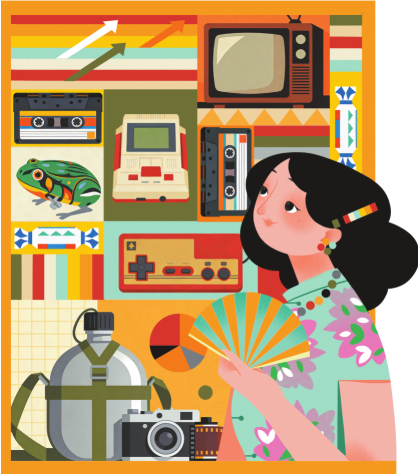
The young woman waiting in that line was born after 1995. She is not buying a taste she remembers. The White Rabbit lip balm offers a mood rather than a memory. It offers a sense of coherence. The nostalgia economy is not selling the past. It is selling the feeling of continuity.
The desire for continuity is not new. Around 1147, a writer named Meng Yuanlao completed Dongjing Meng Hua Lu (Eastern Capital: A Dream of Splendor), a reconstruction of daily life in the Northern Song Dynasty (960-1127) capital. Meng wrote it from exile, after the city had been ransacked and the world he described had ceased to exist. Readers were drawn to it for the feeling it conjured: the sensation of living a life that had cohered.
China's transformation over the past four decades has been extraordinary and disorienting. When a society moves this fast, memory cannot keep pace with experience. The neighborhood where you grew up has been redeveloped. The job your father held for 30 years no longer exists. The social world has been thinned out.
Nostalgic recall is not a faithful recording of the past but a reconstruction that filters warmth and connection. People seek the feeling that life makes sense. In an era when that feeling is hard to find, they are willing to pay for it.
White Rabbit candy means different things depending on when you were born. For those who grew up in the 1980s, it appeared at New Year and carried the gravity of scarcity. For someone born later, it was simply there, familiar but not weighed with meaning. The same candy, the same taste, but two different emotional registers.
Personal nostalgia is powerful but finite. Research suggests that the tastes formed in adolescence tend to lodge permanently, shaping what feels familiar for the rest of one's life. The person who grew up unwrapping White Rabbit candy carries something that cannot be transferred.
The more durable opportunity lies in the second kind of consumer, the one who never lived through the original moment but is drawn to what it represents. They cannot be reached through memory, but through cultural inheritance, through the feeling of a continuous thread of identity running from then to now.
The best nostalgia products do not ask you to remember; they invite you to belong.
The White Rabbit milk tea is itself a cautionary tale. Once customers reached the counter after four hours, many were disappointed. "It tastes just like any regular bubble tea out there," one told reporters. Another posted: "It's just exploiting the classic brand."
That comment points to the central vulnerability of the nostalgia economy. When heritage is used primarily as a pricing justification, when retro packaging is the product and what is inside is ordinary, consumers notice. The disappointment runs deeper than a normal commercial letdown, because something more personal has been involved.
White Elephant instant noodles show an alternative path. A video of disabled workers returning from their shift spread on Weibo. The warmth that followed attached itself to a brand which has had, for decades, a workforce of roughly one-third disabled people. Shoppers cleared shelves. The market rewarded meaning, not just memory.
There are two more risks. When vintage design becomes a formula, the symbols stop carrying weight. And a nostalgia economy that speaks only to one generation's memories is not building a shared culture.
When the pop-up closes and the limited edition sells out, what remains? If the answer is nothing but the memory of a queue, the brand has squandered its inheritance rather than grown it.
Black Myth: Wukong, a breakout hit on Steam, did not ask players to remember anything. What it offered was an experience so richly imagined that players felt they had been given access to something real. Not a memory, but a root.
Li-Ning's debut at the New York Fashion Week followed a similar logic. Consumers were responding to the discovery that something they had written off still had a future. The thread connecting the past to the present was clearly there.
The question facing China's nostalgia economy is not whether there is a market for continuity but whether the industry will serve that market with depth or exploit it with shortcuts.
Some of us grew up with White Rabbit candy. Others were born too late to. But we are all looking for the same thing: a cultural identity with roots deep enough to hold, and a sense that what is being built today is worth remembering tomorrow. Nostalgia does not offer the past. It offers a reason to feel at home in the present.
The candy itself has not changed after all. The question is whether its seller understands the difference between squandering an inheritance and building one. - China Daily/ANN
** Sun Yacheng is a professor of marketing at the School of Economics and Management in Tsinghua University; and Song Luyang is an associate professor of marketing at the School of Management in Huazhong University of Science and Technology.