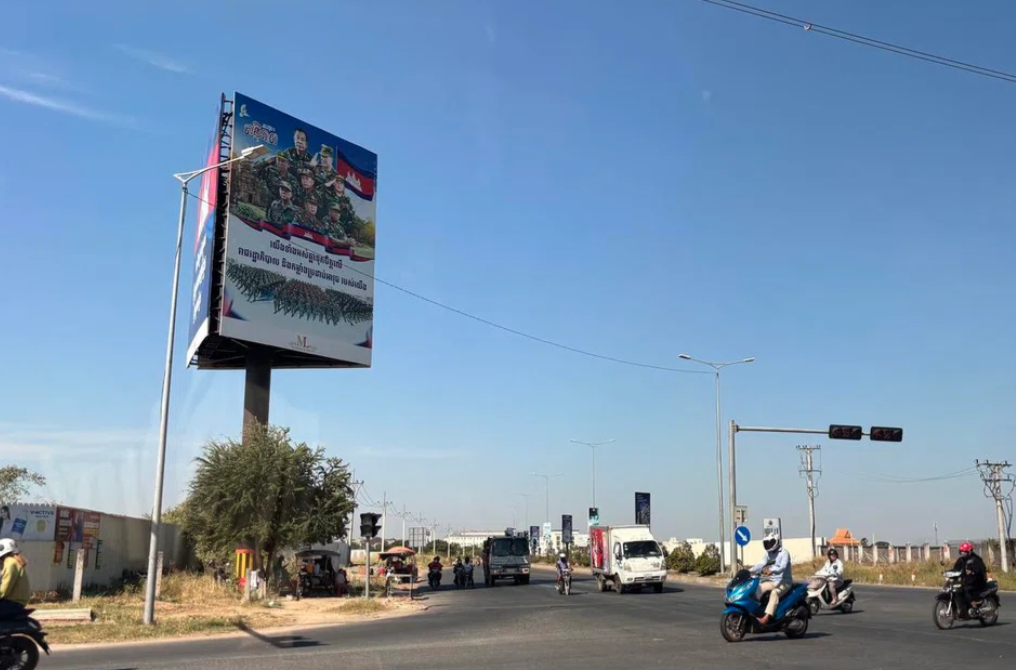
PHNOM PENH: The drive from the new Techo International Airport into Phnom Penh encapsulates much of what the Cambodian leadership wants to showcase, both domestically and to the world.
Flanking freshly sealed roads are ready-to-move-in business and industrial parks, hotels, high-end shopping complexes and advertising billboards marketing luxury condominiums. Interspersed among them are the ubiquitous propaganda posters backing the military, many featuring long-time strongman leader Hun Sen alongside his son, Prime Minister Hun Manet, both dressed in military fatigues.
Three months after a ceasefire on Dec 27, Cambodia is still counting the cost of its bruising border conflict with Thailand, which displaced more than one million civilians and severed trade and labour links between the two countries.
The hostilities began as a five-day clash in July 2025 over longstanding territorial disputes along the poorly demarcated shared border, before reigniting in December in a more devastating round of fighting.
While the Cambodian government’s portrayal of Thailand as the larger, bullying neighbour succeeded in rallying nationalist sentiment at home, that political dividend is already fading.
The economic aftershocks – not helped by the ongoing Middle East conflict – have begun to bite at a critical juncture in Cambodia’s generational leadership transition.
Prime Minister Hun Manet is still seeking to step out of the shadow of his father, who served as prime minister for nearly four decades and remains a dominant presence in Cambodian politics. But the economic fallout from the border conflict is putting the Prime Minister’s authority to the test.
Energy minister Keo Rattanak has said Cambodia would look to Singapore and Malaysia to make up for supply shortfalls from Vietnam and China, which have restricted fuel exports until at least the end of March.
The country relied on Thailand for about 29 per cent of its petroleum in 2024, before ceasing trade at the onset of their conflict.
Even before the Middle East war, the repercussions from Cambodia’s clashes with Thailand have been felt most immediately along its shared border with Thailand and in sectors tied to cross-border trade. Around 950,000 Cambodian migrant workers returned from Thailand, creating a vast shock of unemployment that the domestic labour market has struggled to absorb.
The exodus also cut off an important source of remittances, which dropped 37 per cent from US$2.95 billion (S$3.78 billion) to US$1.86 billion in 2025, heaping further financial pressure on rural households in border provinces already heavily impacted by conflict.
While all but 37,500 Cambodian villagers, based on latest figures, have left displacement shelters and returned home, many of them are still struggling to pick up the pieces.
“Everything I earned and put into my business has been completely destroyed,” said Sim Srong, 39. His gas station and adjoining convenience store in Samraong, about 20km south of the border, were heavily damaged by airstrikes during the initial outbreak of hostilities in July.
He estimated his losses at more than US$100,000. “It took me 20 years since I first arrived in the village to build up my business and in the end, it’s all gone,” he told The Straits Times.
Not far down the road, Nhep Sarath’s roadside grocery store was destroyed in the December fighting.
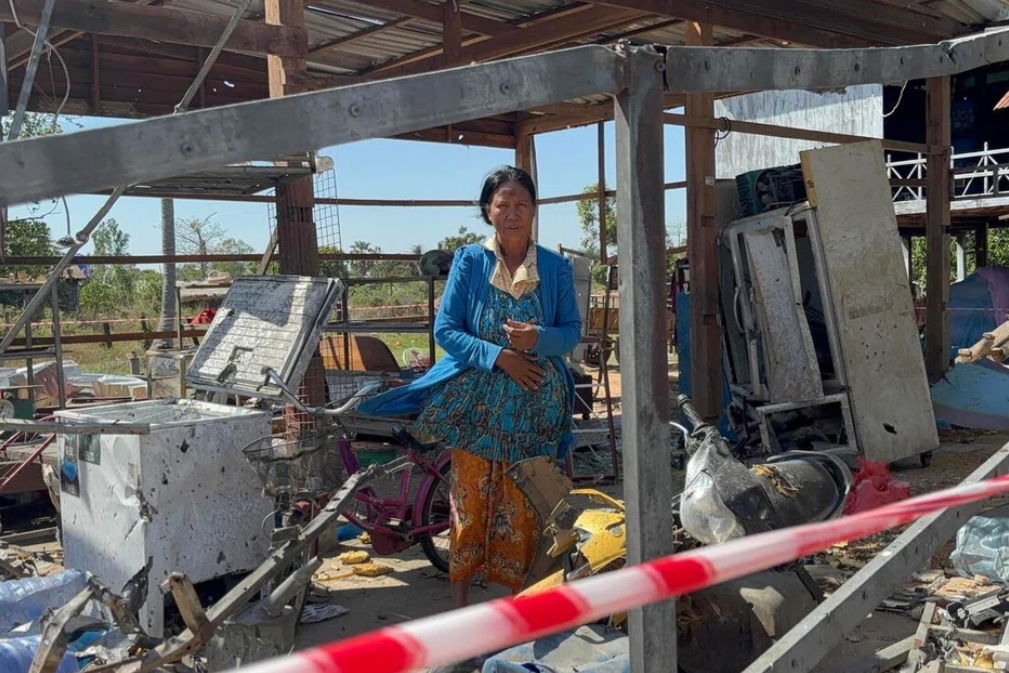
Picking through the twisted metal of damaged refrigerators and store shelves, the 58-year-old said she had saved for more than a decade before opening the shop three years ago, but now finds herself in financial distress.
Her husband died of illness in July, and she owes more than US$1,000 in microfinance loans she took out to pay his medical bills. She lives with her youngest son, 17, who makes charcoal in an improvised kiln in their backyard to help make ends meet.
“Now I feel stuck, I feel totally deflated,” she said.
Economic realities raise political pressure
The confluence of external pressures has come at an already precarious moment for Cambodia’s broader economy, which is still navigating a fragile post-pandemic recovery.
The property and construction sectors have cooled markedly after years of China-driven expansion, with slower investment and a number of delayed or stalled developments since 2020, particularly in Phnom Penh and coastal areas.
The International Monetary Fund estimates that Cambodia’s gross domestic product (GDP) has slowed to 4.8 per cent in 2025, from 6 per cent in 2024.
It expects the GDP to slow even further to 4 per cent in 2026 – a projection that does not fully account for the geopolitical headwinds of an unpredictable Trump administration and energy price shocks from the war in the Middle East.
With only about three weeks of fuel reserves under normal conditions, Cambodia is exposed to sudden supply shocks even during the best of times.
While barely any country can expect to remain unscathed amid the current tensions and economic shocks, Cambodia’s economy is particularly susceptible due to its reliance on manufacturing exports and tourism.
On the political front, Cambodia is also in a delicate phase of its leadership succession.
Despite stepping back from the premiership, Mr Hun Sen remains Senate President and the leader of the ruling Cambodian People’s Party. He is still widely regarded as Cambodia’s de facto leader, notably playing an outsized role in managing the military response in the conflict with Thailand. Meanwhile, Mr Hun Manet has sought to consolidate his authority within the party-state apparatus.
As the wave of nationalism and unity against a common enemy in the conflict with Thailand wears off, the stark economic realities are translating into tangible political pressure, with questions over the performance of Cambodia’s leadership and calls for reform.
“Before, it was just basically a lot of chatter among scholars and... people who are very close to the government – they might be chatting privately, they might be saying... the need for reform and all of that,” said Ou Virak, economist and founder of the Phnom Penh-based Future Forum think-tank.
“But now it’s a lot more public, it’s surfacing.
“Rallying around the flag is going to be temporary, naturally. It’s always about the economy, and household income and well-being will decide sentiment in the long term,” he noted.
Cambodia’s long-held concerns of over-reliance on its garment industry – which accounts for half of total export earnings and employs nearly one million workers – were laid bare when the sector’s viability was momentarily threatened by Trump administration tariffs, which were later negotiated down.
While the industry remains a key driver of Cambodia’s job creation and economic growth, its low-wage, low-entry-barrier model faces constant competition from other low-cost manufacturing hubs, particularly Bangladesh.
Microfinance woes
Another structural vulnerability lies in Cambodia’s vast microfinance sector, which has experienced breakneck growth to the point that the country – despite having one of the lowest financial literacy rates globally – now carries one of the world’s highest per capita microfinance debt.
Cambodia’s 18 million people hold more than three million micro loans worth over US$18 billion, with the average loan more than four times the median per capita income.
Originally promoted as a tool to support rural entrepreneurship, micro loans in Cambodia are no longer mainly provided by non-governmental organisations or informal lenders.
There is now a formal financial sector made up of microfinance institutions (MFIs) and banks. Globally, the microfinance industry has come under scrutiny for predatory lending behaviour fuelling over-indebtedness in developing countries, instead of reducing poverty.
In Cambodia, many households have taken on multiple loans, often secured against land titles, to finance farms or to pay for costs in relocating to Thailand for work. But in just as many cases, loans are taken out to keep up with appearances – home improvement renovations or purchasing a new motorbike, for example.
Many loan holders end up trapped in a cycle of loan repayments due to double-digit interest rates plus fees, and are left highly exposed when incomes fall.
Rights groups have documented forced land sales, food insecurity and suicide due to over-indebtedness.
Huot Len, 30, had been working on construction sites with her husband in Thailand for four years, most recently on a 10-storey condominium in Nakhon Pathom, west of Bangkok.
She was forced to return home, in Kouk Mon village, Oddar Meanchey province, when the first bout of border violence broke out in July 2025.
The mother of two said she had borrowed US$5,000 from a micro-loan provider in May to help sow a rice field to provide food for her family. At that time, she believed there would be no problem repaying the debt under the four-year repayment schedule, as both she and her husband had stable jobs in Thailand.

Cambodia’s Ministry of Labour and Vocational Training has said that about two-thirds of the 950,000 migrant workers who returned from Thailand have found work, though some economists and rights groups have questioned the veracity of the data.
In any case, many migrant workers who chose to go to Thailand did so because of better opportunities – from higher pay to better healthcare and education – as well as proximity to their home villages.
However, Thailand’s labour ministry on March 9 reaffirmed its position that it will not allow new Cambodian workers to enter the country and has no plans to reopen land border crossings.
While Thailand’s private sector has expressed concerns over labour shortages, it has already taken measures to diversify its migrant labour supply away from Cambodia, further decreasing the likelihood of a swift relief for Cambodia’s stressed labour market.
Initially after returning from Thailand, Huot Len ventured to Phnom Penh, where she found a job at a construction site. But she was forced to return home again after being duped by her subcontractor boss who failed to pay his workers.
Huot Len told ST that the pay and working conditions in Thailand were better than in Cambodia. “If not for war, I would not have come back,” she added.
She and her siblings had applied for jobs through the Ministry of Labour and were awaiting responses, while her husband found work at a hydropower dam in Cambodia’s Koh Kong province in January.
Scam central: A moment of reckoning?
Hun Sen’s towering political presence in Cambodia stems from his rise out of the turmoil of the Khmer Rouge era, when he began as a young cadre before defecting and aligning with Vietnamese-backed forces that toppled the regime.
Emerging from this period as a battle-hardened operator, he consolidated power through a mix of political manoeuvring and ruthless control over the security apparatus, ultimately becoming prime minister in 1985 and entrenching his authority for nearly four decades.
By contrast, Hun Manet, who has been groomed for power since young, lacks the same revolutionary credentials. Educated at the United States Military Academy at West Point, and holding a doctorate in economics, he has struck a more measured and technocratic tone as he built a career as a senior commander of the Royal Cambodian Army before becoming prime minister in 2023.
If part of the domestic political challenge is for Hun Manet to step out of his father’s shadow and prove that he can make decisive calls without second-guessing himself, the upheaval from the conflict with Thailand may have helped force his hand.
The conflict has drawn greater scrutiny of Cambodia’s industrial-scale online scamming operations, with Thailand launching assaults on scam compounds along the shared border with the wider purpose of “confronting global crime”.
In a rare interview with Agence France-Presse during a February visit to Brussels, Hun Manet acknowledged that scam centres were harming Cambodia’s economy and reputation, as he sought to rebuild confidence and garner support among Western governments.
This came after Cambodia arrested scam kingpin Chen Zhi and extradited him to China in January, marking a shift from its previous approach of mostly denying the existence of scam centre activity happening under its nose.
“The scam network, or what we call the black economy, is destroying our honest economy,” Hun Manet said.
“It’s put a bad reputation on Cambodia, distracting tourism and investment. So this is the reason why we need to clean this out so that the real economic activities can be promoted.”
That pivot, analysts say, can be largely attributed to mounting pressure from both China and the United States. But it raises hopes that the younger generation leadership has the appetite and impetus to take on wide-ranging reforms – from streamlining Cambodia’s bloated bureaucracy to tackling corruption, and broadening the economic base.
“You know, we have a Prime Minister who is reluctant to make any decision that the elders may not be happy with, and therefore might be reluctant to make any major move,” Ou Virak said.
“But this (pressure) will help expedite the transition a bit more because there might be a realisation that there needs to be a clear mandate and clear empowerment of the leadership of the young generation if the transition is to be more successful.” - The Straits Times/ANN