




Testing conducted by Chinese scientists has found that a solid rocket engine can ignite at 200 metres (656 feet) underwater – far deeper than submarine-launched missiles – suggesting new possibilities for deep-sea weapon systems.
Ballistic missiles that can be launched from subs are central to strategic deterrence for nuclear powers – for example, the M51 used by France, America’s Trident system, and China’s Julang series.
With these missiles on board, submarines, moving stealthily through deep oceans, can launch strikes from almost anywhere.
But it is technically difficult. Each step presents challenges – from underwater ignition to the controlled exit and a stable ascent – and these missiles are typically launched from a depth of around 30 metres.
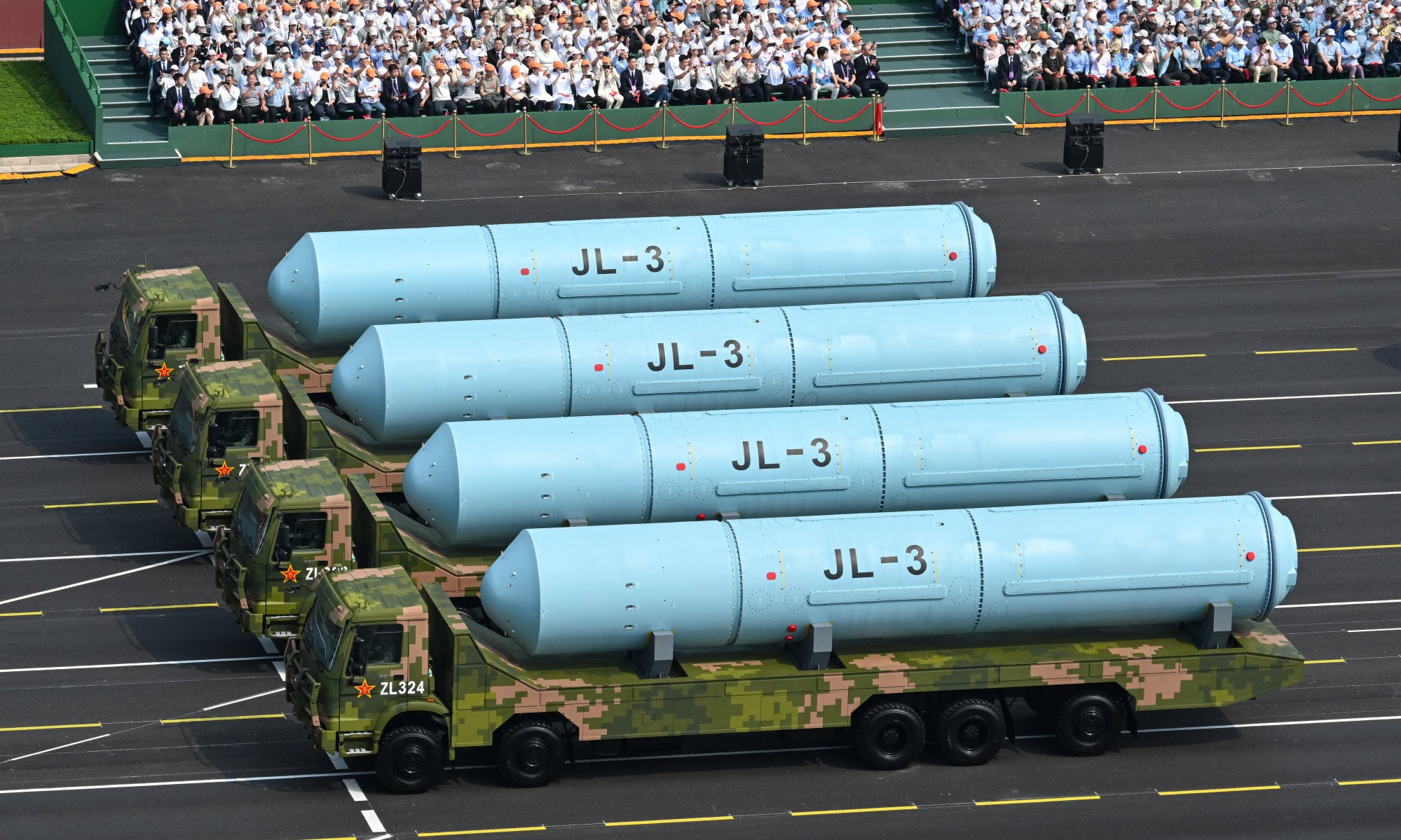
A team of scientists in central China have been pursuing ways to achieve the military goal of firing these weapons from greater depths of “hundreds of metres, or even deeper”.
That could expand China’s strategic missile launch facilities from the land to vast waters such as the South China Sea, boosting the country’s nuclear deterrence capabilities.
To find out if it was possible, engineers Li Yiming and You Chuang conducted underwater ignition tests on a solid rocket engine at a simulated depth of 200 metres.
The researchers – from the Mechano-Electrics Engineering Institute and the Key Laboratory of Underwater Intelligent Equipment in Zhengzhou, Henan province – published their findings in the February issue of the Chinese peer-reviewed journal Tactical Missile Technology.
“Solid rocket engines are characterised by simple construction, high reliability, and superior stealth capabilities,” Li wrote in the paper.
He said that made them the top choice for pre-positioned weapons such as submarine-launched missiles and deep-water precision-guided mines.
“However, due to the costs and conditions involved, open-water tests are currently conducted at relatively shallow depths, mostly below 100 metres,” Li said.
He noted that this was not deep enough to assess the feasibility of launching pre-positioned underwater weapons.
To put the engine to the test at a greater depth, the team developed what they called a “deep-water environment simulation experiment platform”.
They said the platform was designed to replicate the thrust and plume flow of a solid motor at a depth of 200 metres.
It has a simulated ballast tank for engine ignition tests, a tank to keep water pressure stable, a system to mimic different depths using compressed air, and sensors and high-speed cameras to measure pressure, thrust and jet flow.
The experimental motor used a solid rocket propellant known as hydroxyl-terminated polybutadiene, with an ignition charge mass of 2.2kg (4.85lbs) and a burn time of about 5 seconds.
At a simulated depth of 200 metres, the motor’s combustion pressure matched ground-test levels with no major oscillations, showing it could operate reliably under deep-sea pressure, according to the paper.
It said during the initial moments of ignition, the gas jet interacted violently with the water, producing brief pressure and thrust fluctuations. But the fluctuations only lasted for a few tens of milliseconds after ignition, and the thrust stabilised once the gas jet channel was fully established.
The team said that compared with a ground-based test, the motor thrust decreased by 32.7 per cent at an underwater depth of 200 metres.
That finding is in line with a numerical simulation conducted by the Beijing Institute of Technology in July last year. It found that at a depth of 300 metres, the average thrust during the motor start-up phase could drop to between 42.8 per cent and 47.1 per cent compared to the thrust at ground level.
The Zhengzhou researchers said the simulation platform helped them to understand how solid rocket engines behaved under high pressure, in tight spaces, and interacting with gas and water.
They said the results of their study could inform the design of power systems for submarine-launched missiles, the assessment of launch safety, and the development of next-generation deep-sea weapon systems. -- SOUTH CHINA MORNING POST


