
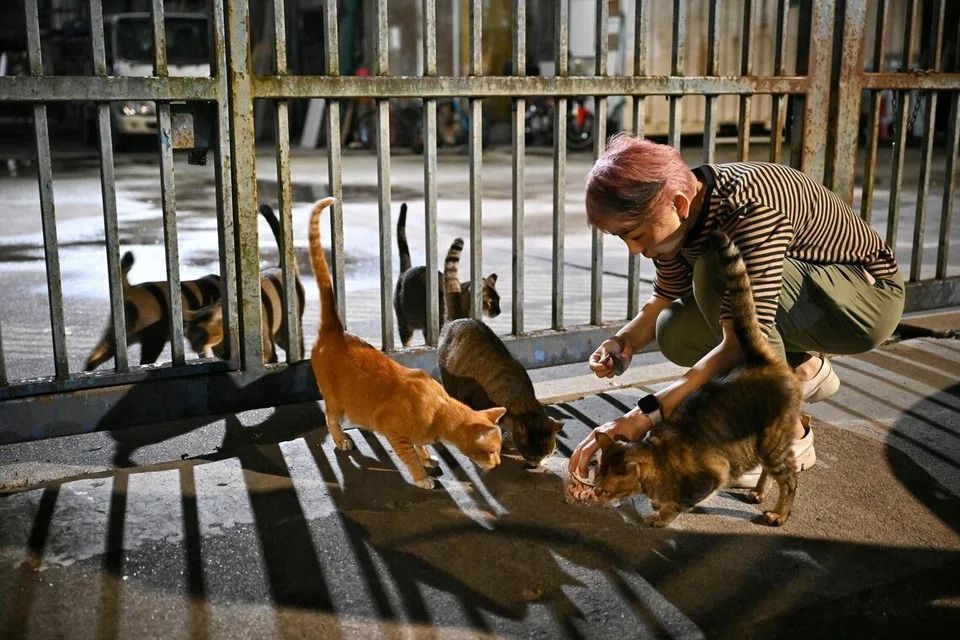
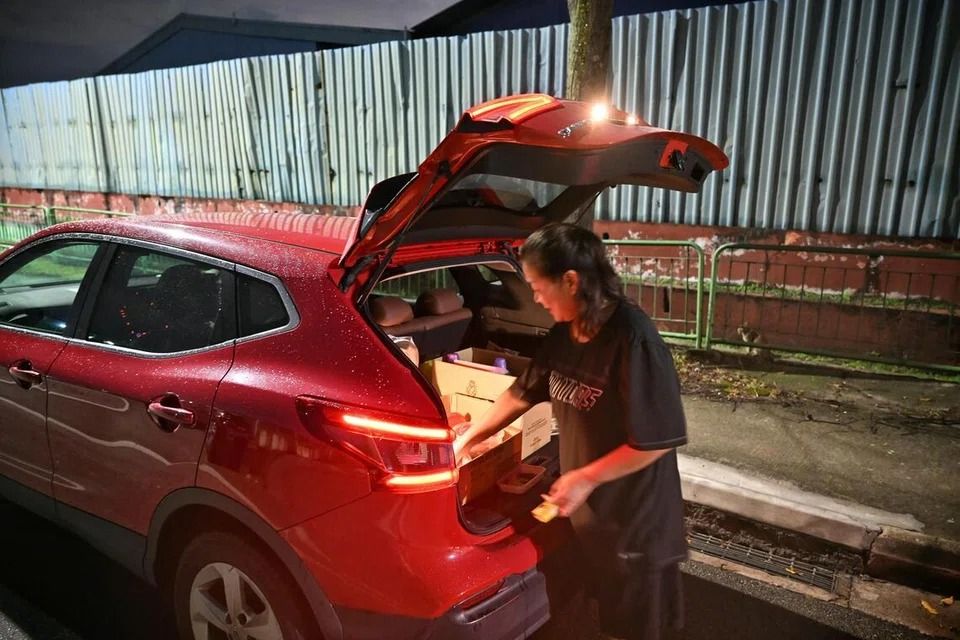
SINGAPORE: Cat feeders Sharon Tang and Angela Toh drive twice a week to Sungei Kadut in the north of Singapore, with their car boots filled with canned food and kibble.
They have been going to the area – one of Singapore’s oldest industrial estates and home to heavy, timber-related and manufacturing industries – for the last 10 years to feed stray cats.
In recent years, they have noticed the number of cats increasing.
“When I first started doing this, I was also helping the animal welfare groups trap and sterilise the cats before releasing them back. We managed to keep the population down. It has, however, boomed in the recent three to four years,” Tang told The Straits Times.
Tang, 55, and Toh, 53, learnt that some foreign workers have brought cats and kittens from other areas to the dormitories and industrial areas in Sungei Kadut and Tuas.
“I guess they miss their families and children, and these cats become ‘pets’ that they can show affection to,” Toh said.
“Unfortunately, many of the young cats they bring back are unsterilised. Once a pair is released, the cycle of reproduction starts.”
This, she believed, has rendered the nationwide Trap-Neuter-Rehome/Release-Manage (TNRM) programme for cats ineffective.
Under the national programme launched in September 2024, close to 3,000 cats had been trapped, sterilised and vaccinated as at January 2026, and returned to the community.
Veterinarians told ST that cats reproduce “incredibly fast”, with the females becoming sexually mature and fertile as young as five to six months old. An unsterilised feline can produce 12 to 18 kittens annually.
Dr Kenneth Tong, founder and head veterinarian of Animal and Avian Veterinary Clinic, said: “Each litter is around two to four kittens, and the mother can get pregnant again a month after giving birth. The pregnancy period is 63 days.”
Feeders in Sungei Kadut said there are currently more than 40 cats in the area, while those feeding cats in the Tuas industrial estates – which cover about 3,000ha – estimate “around 100” cats.
However, Amy Sim, founder of TNR Project Singapore, believes that the number of strays in the Tuas area “is much closer to between 700 and 900”.
“I know of dormitory management that had asked the workers to catch the cats, and then, using a lorry, took them as far away as possible to be released. These are unsterilised cats. We have posted about this on our Facebook page,” said Sim, who is in her 50s.
TNR Project Singapore is a ground-up initiative focused on trapping, neutering and rehoming stray cats to control their population and prevent abandonment.
Left behind to fend for themselves
After the master plan for the 500ha area in Sungei Kadut was unveiled in 2020, businesses in the timber, furniture, construction and waste management industries moved out to make way for new growth sectors, such as agri-tech and environmental technology.
The stray cats in the area were left to fend for themselves.
“The factories are already empty. The workers have left, and the cats fully rely on the feeders who drive down every day to feed them. There are more than 40 cats in the area, and we are looking to rescue and rehome them,” said Jes Chua, 21, a member of Luni Singapore, a non-profit organisation.
Chua said that. unlike the stray cats in residential areas and within the community, those living in industrial estates “are often flying under the radar”.
“I believe many cats in the industrial area were actually abandoned, and people choose these places, where there is no CCTV monitoring, to dump their cats.
“These cats sometimes go hungry when feeders cannot make it,” she added.
To help rehome them, Chua turned to Give.Asia, a Singapore-based crowdfunding site for medical, charity, and personal causes across South-east Asia. She has raised more than $30,000 for the sterilisation and rehoming of the Sungei Kadut felines.
Luni Singapore and TNR Project Singapore work with the Government and others like the Society for the Prevention of Cruelty to Animals and Cat Welfare Society to trap, sterilise, vaccinate and manage stray cats in the community.
Dr Anna Wong, group director of community animal management at the Animal and Veterinary Service (AVS), told ST that the agency is aware of the population of community cats in the industrial and dormitory areas of Tuas and Sungei Kadut.
AVS is the agency that administers the TNRM programme.
“AVS is working with the Ministry of Manpower, JTC and dormitory operators to engage and offer assistance to tenants and workers in these areas through the TNRM programme, with the aim to enhance sterilisation efforts for animal population management and promote responsible animal care,” Dr Wong said.
“AVS will continue to work closely with our partners to increase our TNRM efforts in areas such as industrial areas and dormitories,” she added.
Sim said there is no such sterilisation programme in the countries where the foreign workers come from.
“They need to be educated. After all... these workers are a good source of help for feeding and caring of the community cats,” she added.
“What we (also) need is compulsory sterilisation and microchipping for cats and the message needs to come from the top. That way, it will definitely help the cats, as well as the community feeders.” - The Straits Times/ANN