




It has been a turbulent year for the fraught US-China relationship. In the third part of a series looking back at the events of 2025, we examine China’s growing military might and how it’s narrowing the tech gap with the US.
US defence chief Pete Hegseth told a conference in Washington this month that America would maintain a “clear-eyed appreciation” of China’s “rapid, formidable and holistic” military build-up.
That build-up is being watched globally, with defence experts in recent years tracking the country’s military advances as the People’s Liberation Army – the biggest standing army in the world – modernises at a rapid clip.
In the past 12 months, observers have been keeping tabs on social media for any clues as to the progress of two sixth-generation fighter jets under development in China.
Meanwhile, there has been much discussion about the purpose of a mysterious submarine-like vessel, as well as underwater drones being tested in the South China Sea.
In space, there have been reports from satellite companies on the docking of two Chinese satellites that are believed to have carried out an in-orbit refuelling some 36,000km (22,370 miles) above Earth.
And from time to time, images of large Chinese drones under development have appeared on military websites.
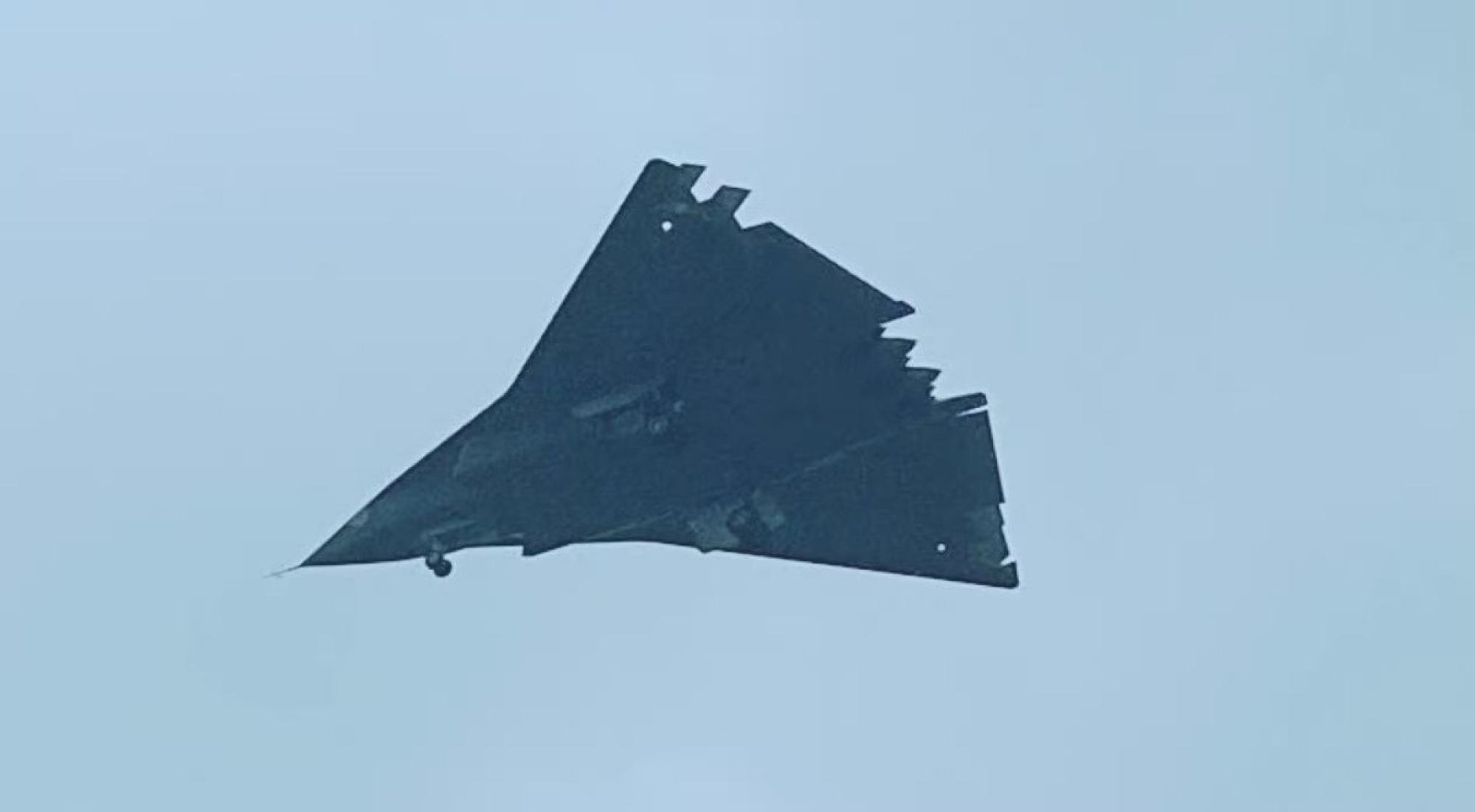
The speed and scale of China’s military advances has rarely been seen in modern history.
In just a few years, China has narrowed the military technology gap with the US in a number of areas. And in some technologies – such as satellite refuelling and hypersonic missiles – it has even taken the lead.
That is the result of years of catch-up efforts ahead of the PLA’s 100th anniversary in 2027, by which time Beijing aims to have made significant progress on the modernisation push, and particularly on information warfare and strategic projection.
That will lay the foundation for Beijing’s ultimate goal for the PLA – for it to be a world-class military by 2049.
Analysts have attributed the military’s rapid progress to a nationwide emphasis on cultivating talent in hi-tech sectors, the country’s formidable industrial capacity, and years of sustained investment in research and development.
“Innovation is key across all PLA branches and it empowers China to make major breakthroughs and even overtake the world’s most advanced standards in some areas,” said Fu Qianshao, a Chinese military expert based in Beijing.
China’s industrial system is one of the world’s largest and most complete, and it has provided robust support for the defence industry. It is also the main reason for China’s rapid innovation in military technology, along with a pipeline of talented young engineers and scientists.
“It is precisely because we have trained large numbers of specialists in advanced technologies so we can drive our military equipment development,” Fu said.
“Also, most of our talent is cultivated domestically, showing that China has a complete and robust education and training pipeline to support this progress.”
China has redoubled its efforts to nurture STEM talent as it looks to achieve technological self-reliance to counter US moves to curtail its progress.
Military schools and courses have also been expanded.
But at the heart of the tech drive is a civil-military fusion strategy that has gained momentum since 2016.
The aim is to accelerate the integration of military and civilian technologies such as quantum computing, semiconductors, communications, aerospace and artificial intelligence.
And to do that, the private sector has been encouraged to take a bigger role in an industry once dominated by state conglomerates.
The rapid rise of China’s drone industry is one example of this.
“Much of this stems from innovation, enabling us to achieve low costs and high performance – especially in the field of intelligent drones, where it can be said that China is already in a leading position,” according to Fu.
“Future warfare is likely to be intelligent warfare. Whether in tanks, aircraft or other weapons – including drones, underwater vehicles, and more – we are extensively adopting intelligent technologies.”
China’s latest unmanned aerial vehicles include an aerial drone carrier, the Jiu Tian, which had its first test flight last week. The CH-7 assault stealth drone – with a 27-metre (88 feet) wingspan – completed its maiden flight this week.
Collin Koh, a senior fellow at the S. Rajaratnam School of International Studies at Singapore’s Nanyang Technological University, said China was producing some world leaders in scientific patenting.
“That very often has dual purpose – civilian and military,” he said.
“Given that the prevailing climate in the US is not necessarily so conducive for foreigners, China is tapping the opportunity to draw scientific talent from all over the world to come and contribute to its faculties.
“China has formed a civil-military fusion ecosystem, with an entire national ecosystem of military or civilian institutions doing various types of STEM research and contributing to knowledge-building for the next generation of military solutions.”
Koh said China had been making “quite interesting strides” in the sector.
Alongside the military tech push, the PLA was overhauled in 2015 with the aim of creating a smaller but more nimble modern fighting force.
In the decade since then, the defence budget has more than doubled, going from 887 billion yuan in 2015 to 1.81 trillion (US$256.7 billion) in 2025.
China is also building up a blue-water navy with global reach. It launched the Shandong, its second aircraft carrier – and the first built in China – in 2017. Five years later, it launched the Fujian – the first Chinese aircraft carrier with an advanced electromagnetic catapult launch system. The Fujian went into active service last month.
Other advanced warships added to the PLA Navy fleet since 2017 include Type 055 guided-missile destroyers, which form part of the aircraft carrier strike groups. Also Type 075 landing helicopter assault docks, which are key to PLA preparations for a potential amphibious assault on Taiwan.
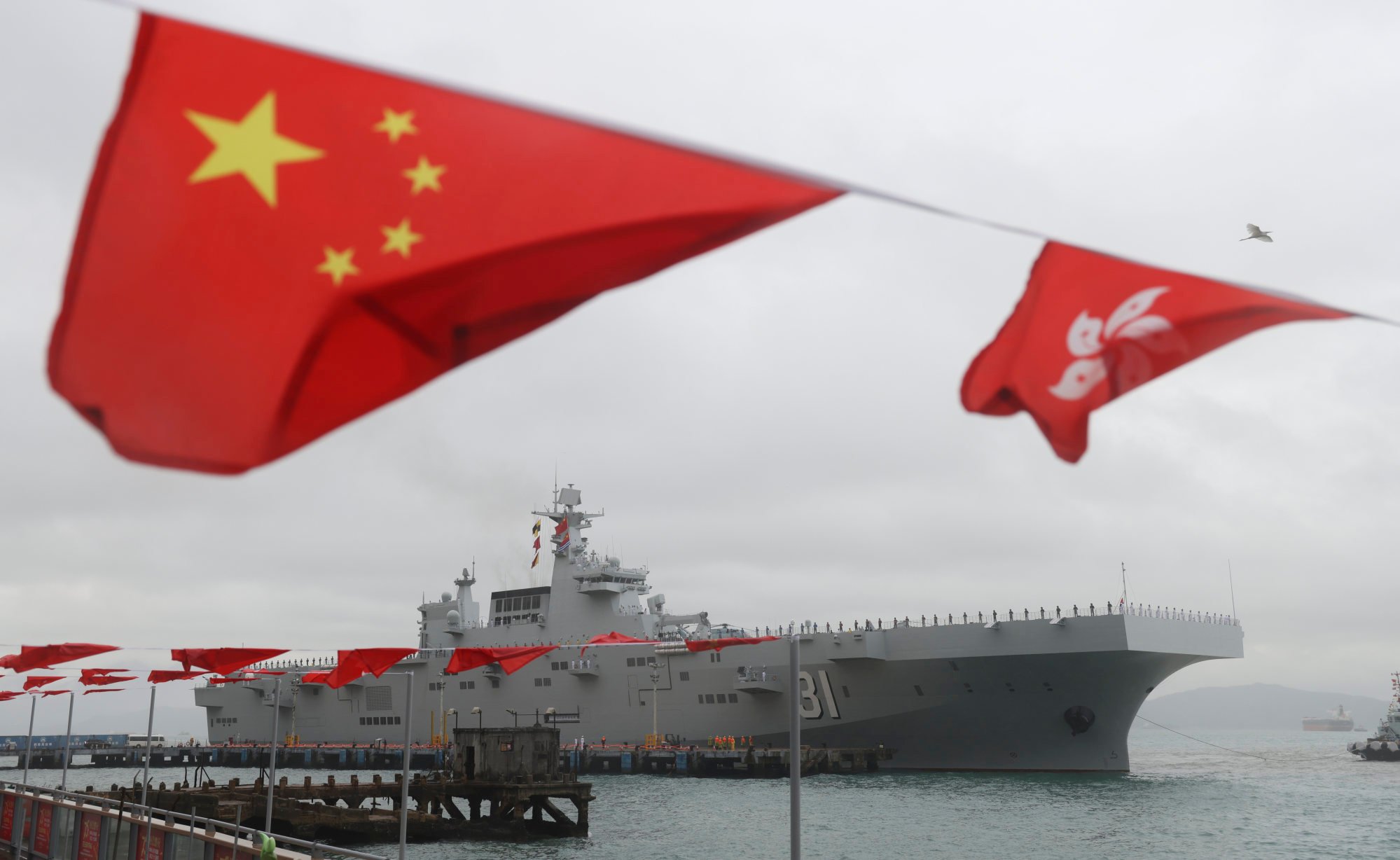
In addition, sea trials are under way for the Type 076 “drone carrier” amphibious assault ship known as the Sichuan, which also has electromagnetic catapults for faster and more frequent aircraft launches.
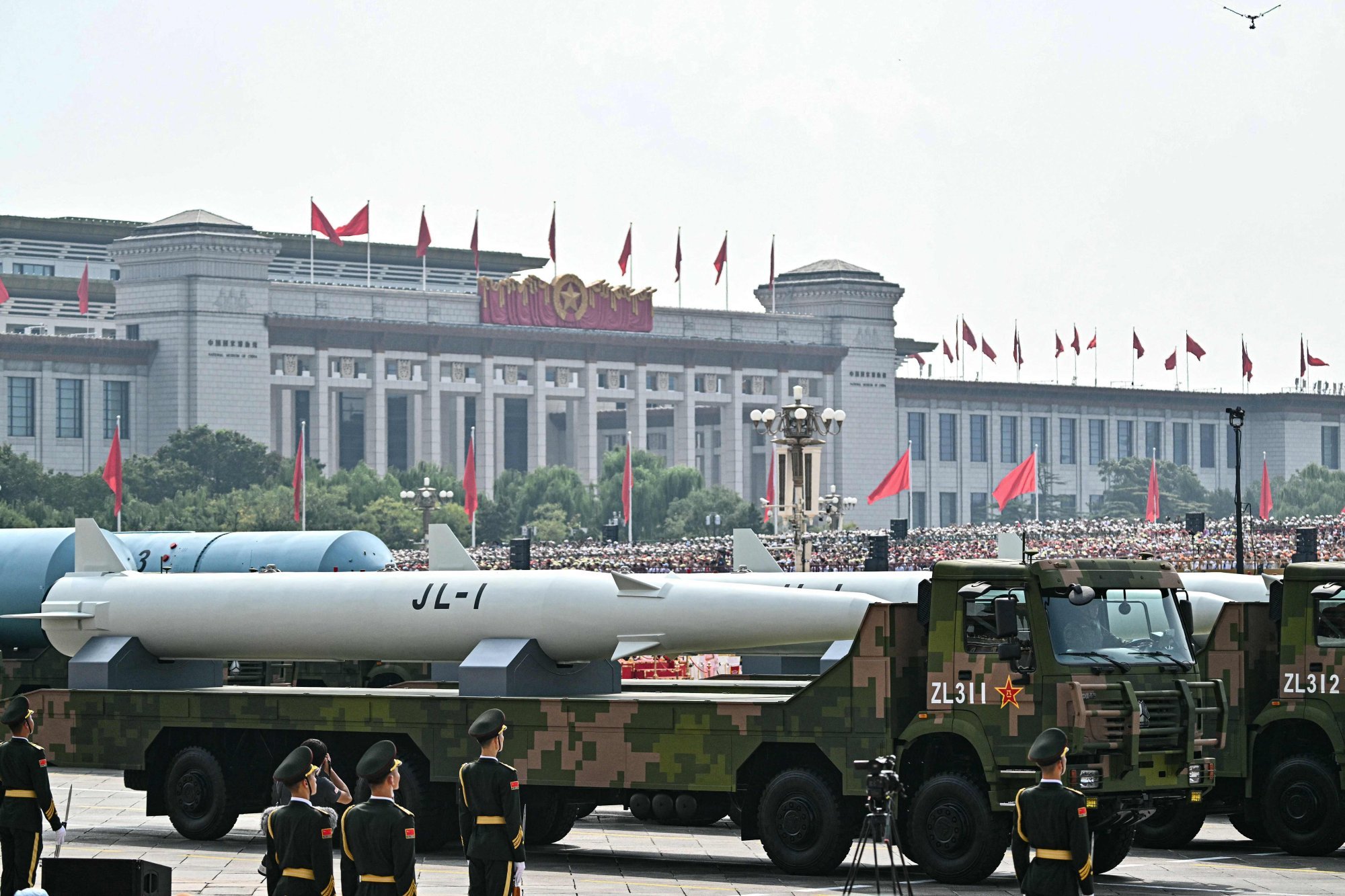
China’s military progress was on full display in September when it held a huge military parade to mark the 80th anniversary of the end of World War II. More than a dozen next-generation weapon systems made their debut at the closely watched event in Beijing.
Among those commanding attention was the JL-1 missile. The world’s only long-range hypersonic missile that can carry nuclear warheads, the JL-1 is believed to be the final jigsaw piece needed to complete the PLA’s nuclear triad – giving it the ability to deliver nuclear weapons from the air, land and sea.
Also on show, new anti-ship hypersonic missiles – the YJ-17, YJ-19 and YJ-20 – reflecting rapid advances in propulsion, guidance and terminal manoeuvrability. These missiles expand the PLA’s long-range maritime strike options.
New-generation Type 100 tanks also made their debut in the parade. Military mouthpiece PLA Daily said the tanks marked a departure from traditional armoured vehicle design and a fundamental shift towards “intelligent, information-driven and unmanned” warfare.
But Timothy Heath, a senior defence researcher at US-based think tank Rand Corporation, noted that these advances in military technology and equipment did not directly translate into combat readiness.
“Weapons are an important part of combat effectiveness, but hardly the whole story. The quality of the personnel matters far more,” Heath said.
“An effective military has skilled, well-trained troops and commanders, a command system that encourages and rewards innovation and initiative, and an organisational culture dedicated to excellence in combat above all else,” he said, adding that the PLA was “seriously deficient” in those areas.
He said part of the manpower “deficiency” could be to do with the long and sweeping anti-corruption campaign in the military.
In the most recent cases, nine top generals were expelled from China’s ruling Communist Party and its military in October.
They included He Weidong, former vice-chairman of the Central Military Commission, who became the highest-ranking general caught in the anti-corruption net in recent years.
Other high-profile figures included Miao Hua, who was the PLA’s ideological and personnel chief, and two former defence ministers who were purged in 2023: Wei Fenghe and his successor, Li Shangfu.
Helena Legarda, head of foreign relations at the Berlin-based Mercator Institute for China Studies, also said the human factor was essential.
“The PLA remains largely untested, as it has not fought a war in decades,” Legarda said.
“Advanced weapons and capabilities are important, but they are not the only thing the PLA will need if it wants to have a combat-ready military.”
China fought a brief but bloody war in early 1979 with neighbouring Vietnam, followed by border clashes that continued for a decade. The two countries also had a naval clash in Johnson South Reef in the South China Sea in 1988. And most recently, China and India had a border clash in the Galwan Valley in 2020 in which 20 Indian troops and at least four Chinese soldiers were killed.
Over the decades, the PLA’s overseas operations have been largely confined to UN peacekeeping and anti-piracy missions in the Gulf of Aden.
“Factors like jointness or the ability to operate by coordinating across domains and services will be another area that the PLA will need to work on,” Legarda said.
According to Fu, China has stepped up training based on real combat scenarios.
“The foremost objective is strong combat capabilities,” he said. “But deterrence equally matters to prevent war and regional conflict.” -- SOUTH CHINA MORNING POST


