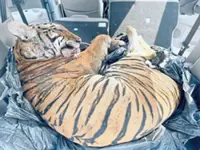
SOUTH-EAST ASIA (Bernama): Tiger trafficking has entered a dangerous new phase globally, with criminal networks increasingly trading in whole live or dead tigers rather than individual parts.
According to TRAFFIC’s latest report, Beyond Skin and Bones: A 25-Year Analysis of Tiger Seizures from Jan 2000 to June 2025, illegal trade in tigers remains an unrelenting crisis with at least 3,808 tigers confiscated in 2,551 seizures worldwide over the past quarter-century.
Seizures of the big cat have quadrupled since the early 2000s. "Globally, seizures involving whole tigers (dead or alive) rose from 10 per cent in the 2000s to 40 per cent from 2020 onwards,” the report showed.
Tiger Range Countries (TRCs) accounted for 83 per cent of all tigers confiscated during the assessment period. India, China, Indonesia, and Vietnam recorded the highest seizure numbers.
Over the past five years, Vietnam, Indonesia, Thailand, and Russia, the top four TRCs, made up 63 per cent of all whole-tiger seizures.
These countries now dominate whole-animal trafficking operations, with record seizures in 2023 signalling an industry expanding faster than authorities can contain.
Between 2020 and 2025, countries without viable wild tiger populations, or those hosting large captive-breeding facilities, reported some of the highest proportions of whole-animal seizures.
This shift has raised deep concerns about captive-bred tigers making their way into the black market.
While tigers confiscated in India and Indonesia are most likely poached from the wild, those seized in Vietnam are believed to originate primarily from captive sources.
The report also highlights that although tiger skins and bones continue to feature prominently in the illegal trade, seizures involving claws and teeth - used for fashion accessories and amulets - have risen sharply since around 2020.
TRAFFIC has renewed its call for governments to strengthen enforcement and prosecution with a measurable impact. It stressed that investigations should go beyond seizures and trace the entire supply chain to dismantle criminal networks.
The organisation also urged stricter regulation of captive tiger facilities, including mandatory registration, continuous monitoring, and inspections in line with Convention on International Trade in Endangered Species of Wild Fauna and Flora (CITES) requirements. It added that any facility breeding tigers for commercial purposes should be shut down.
TRAFFIC further called for targeted, evidence-based campaigns to curb consumer demand for illegal tiger products. It warned that the persistently high number of seizures demonstrates unabated trafficking across the region that poses a serious threat to the survival of this already imperilled species.
TRAFFIC is a leading non-governmental organisation working to ensure that trade in wild species is legal and sustainable for the benefit of the planet and people. The full report can be read at https://www.traffic.org/publications/reports/beyond-skin-and-bones-a-25-year-analysis-of-tiger-seizures-from-2000-to-june-2025/#. - Bernamas
TAGS