




The world’s longest cable-stayed bridge opened to traffic in Jiangsu province, eastern China on Tuesday, connecting the cities of Changzhou and Taizhou and slashing the travel time from over an hour to just 20 minutes.
The Changtai Yangtze River Bridge stretches 10.3km (6.4 miles) with a main span of 1,208 metres (3,960 feet). It is the river’s first crossing to carry an expressway, regular road and intercity railway, all on the same structure.
Officials said the bridge – which took six years to complete and was built using a number of world-first techniques – would boost regional growth and tighten links across the Yangtze River Delta.
One of the structure’s most distinctive features is its asymmetrical lower deck, with a 200km/h (124mph) railway on one side and a regular road on the other – the first time a side-by-side traffic layout has been used in a large-span bridge.
China Railway Group chief scientist Qin Shunquan, the bridge’s lead designer, explained the engineering challenge in March, when he appeared on a youth-focused talk show on state broadcaster CCTV.
Because rail systems typically weigh about three times as much as roads, most bridge designs maintain balance by placing the railway in the centre with the roadways split on either side and traffic moving in opposite directions.
“But that set-up creates major inconveniences,” Qin said. To rejoin the city road network, lanes must loop around, dipping under the railway and merging again, wasting large areas of valuable urban land. And if lanes are split, emergency vehicles cannot simply cross over if they need to reach an accident.
To keep their asymmetrical design balanced, Qin and his team adjusted the cable tensions on the bridge’s railway side in an effort to hold the deck level. But that fix shifted the structure towards the lighter side, misaligning the centreline.
They resolved the issue by calibrating the shape of each prefabricated bridge segment during production and then allowed the deck to naturally straighten out once it was assembled.
“We split the problem into two parts and solved them separately,” Qin said. “That’s how we cracked the challenge of building the world’s first asymmetrical large-span bridge.”
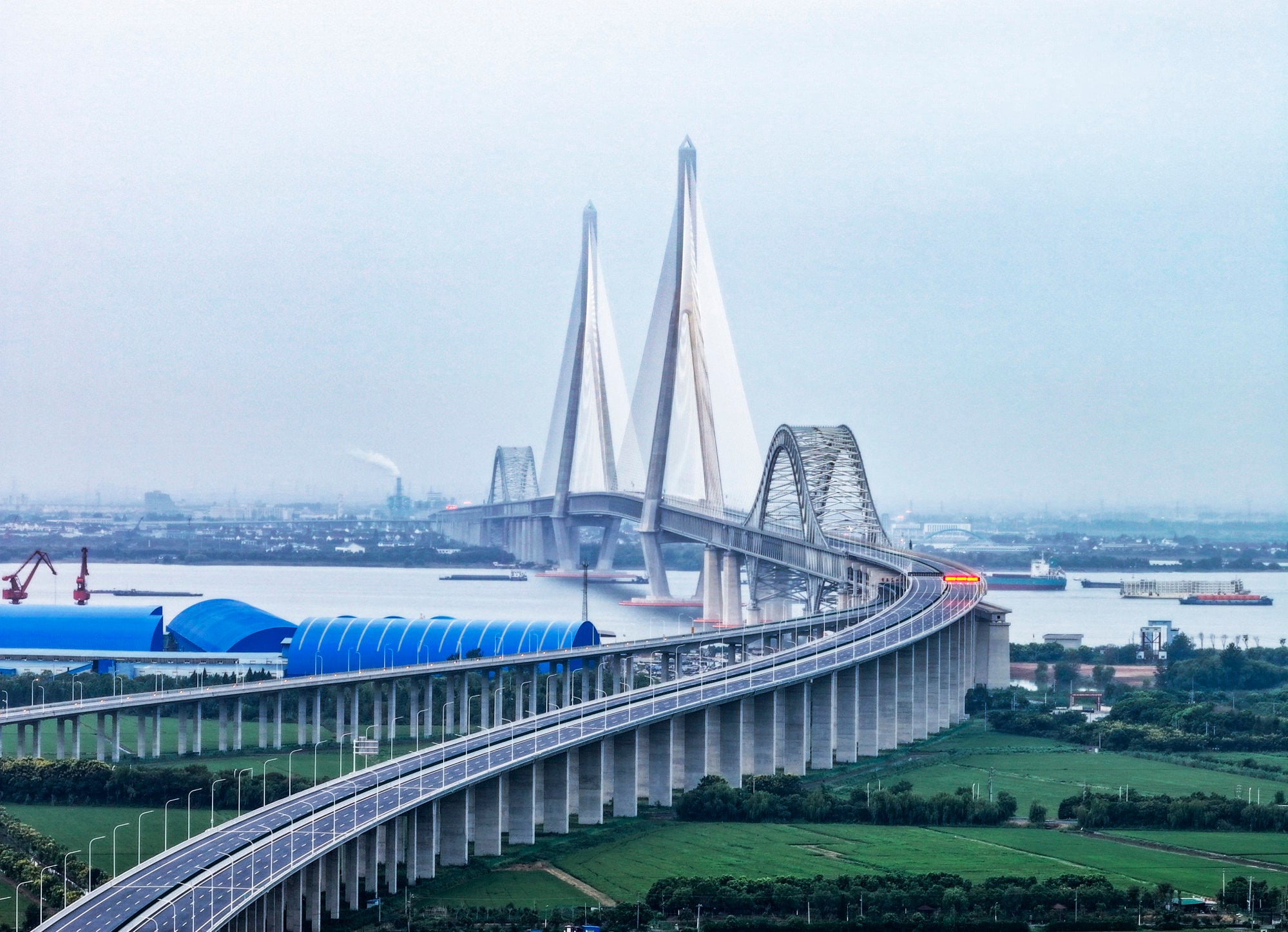
Speaking to Chinese media on Tuesday, project leader Zhong Aixiu, from state-owned China Communications Construction Company, said the bridge’s challenges pushed engineers to invent their own tools.
The team developed a satellite-guided tower crane to lift materials precisely onto the bridge towers, Zhong said. The engineers also built the world’s largest bridge-deck crane to roll along the span and position massive segments with millimetre-level accuracy.
Li Zhen, the project’s on-site chief for the Jiangsu transport department, said the team also introduced several unique features, including a foundation designed to withstand the Yangtze’s powerful currents.
Li said other first-of-their-kind elements included the bridge’s diamond-shaped towers made of steel and concrete for added stability, and flexible joints that adjusted to temperature changes.
A cable-stayed bridge has a main deck supported by numerous cables running to one or more towers that bear the load.
The previous record-holder was the 3.1km Russky Bridge in Vladivostok, Russia, with a main span of 1,104 metres (3,620 feet), linking Russky Island to the mainland peninsula.
Suspension bridges – another major design type, which hangs the deck from cables that drape between towers and are anchored at both ends – can stretch even farther and are often used for the world’s longest spans.
Famous examples of this type of construction include the Golden Gate Bridge in San Francisco and Turkey’s 1915 Çanakkale Bridge, which holds the record at 2,023 metres.
According to CCTV, there are around 150 bridges along the 3,000km main stretch of the Yangtze River. China aimed to increase that number to 240 by 2035 – averaging one bridge every dozen kilometres, it said. - SOUTH CHINA MORNING POST


