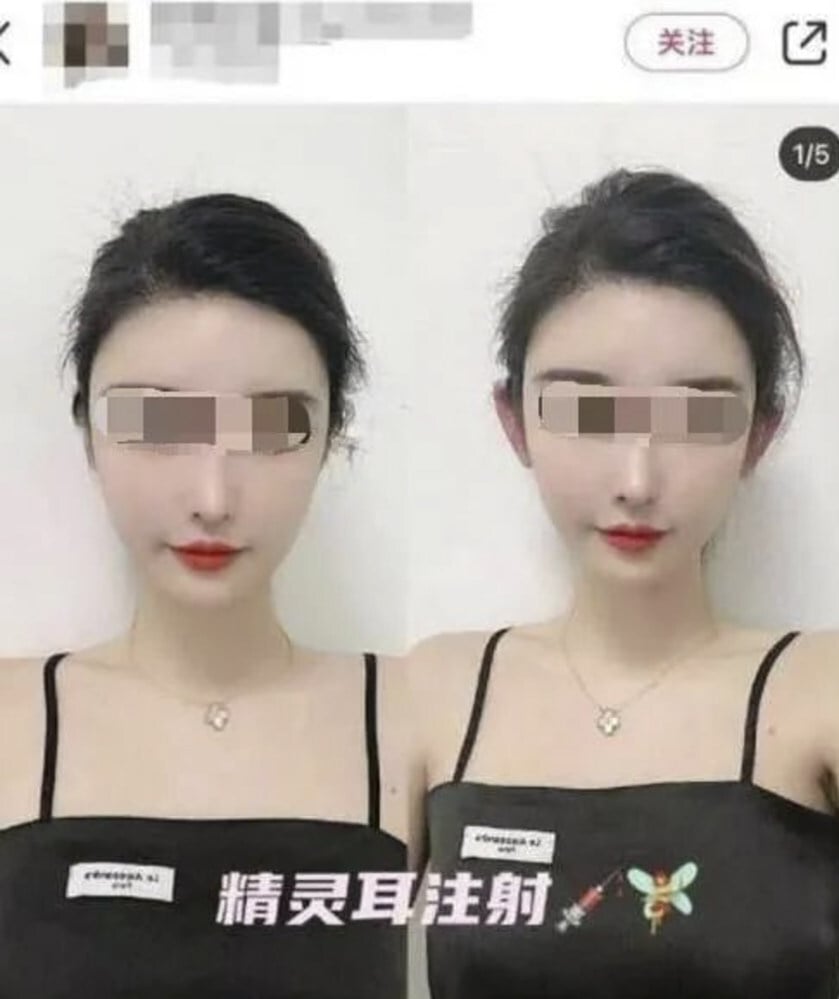
An “elf ear” usually refers to a birth defect that results in a pointed ear shape, but it’s now the latest fad among young Chinese people amid a rapidly growing cosmetic surgery market.
Turning their ears into those that look like an elf’s has become one of the most sought-after procedures among China’s post-2000s generation recently as it’s believed to be able to make their faces look slimmer, and even younger.
Chinese social media is awash with people enthusiastically promoting the results of the ear procedure.
Do you have questions about the biggest topics and trends from around the world? Get the answers with SCMP Knowledge, our new platform of curated content with explainers, FAQs, analyses and infographics brought to you by our award-winning team.
“It is magic! I haven’t changed anything on my face and yet all my friends said I look different the day I got it done. (My face looked smaller, and I looked smarter etc,)” one user said of the procedure on lifestyle sharing platform Xiaohongshu over the weekend.
“Oh I want it too”, “definitely worth it”, “so unbelievable”, others commented.
Beauty seekers, both male and female, have flocked to hospitals seeking the procedure.
At Shanghai-based Mylike Medical Cosmetic, a major domestic surgery service provider in the city, demand is so high that customers have to line up to get the procedure, saleswoman Linlin told the South China Morning Post.
“It’s very safe and popular. We have customers queuing up for this every day,” she said.
Yu Wenlin, a doctor specialising in otoplasty at Gaoshang Medical Cosmetic Center in Guangzhou, said he sometimes performs up to six elf ear surgeries a day.
“I only realised that actually many young people, mostly post 2000s, were looking for ways to make ‘elf ears’ after I helped one online celebrity do it at the beginning of last year. Then more and more people came to me after that,” he said.
Yu said the popular ear form is something between what is medically called a Stahl’s ear and a protruding ear.
A Stahl’s ear deformity consists of an extra cartilage fold in the scapha portion of the ear, which results in a pointed ear shape.
A protruding ear is one that sticks out more than 2cm from the side of the head, which in China is traditionally considered a symbol of good luck.
The underlying motivation behind the elf ear craze is the belief that it makes the face look slimmer and younger.
“Having more prominent ears somehow makes one childlike. If you look at a child, when he’s around six, his ear is already 90 per cent the size of an adult, but his face is definitely under this proportion,” Yu explained.
Some people want their ears changed because they are not visible if looking from the front, which does make the face seem bigger, or because they can’t tuck their hair behind them, added Yu.
There are two common methods for obtaining the look. One way is to add a piece of artificial material or cartilage from other parts of the body to the area behind the ear, which Yu routinely does. The other is to inject hyaluronic acid, which Mylike offers.
Wang Jiangyun, a cosmetic surgeon at The Third People’s Hospital in Zhengzhou, in central China’s Henan province, warned that there can be risks of infection, cicatrices, and ears ending up asymmetrical when adding extra cartilage, and infection, allergic, blood clot and skin necrosis when using hyaluronic acid.
“I dare to say that after this ‘elf ear’ frenzy, there would be an army of beauty seekers requesting to get their original ears back, just like those ‘online celebrity nose’, ‘European-style double-fold eyelids’, etc that once were very popular,” he said.
“As time passes, you will find that fashionable stuff becomes ugly. So I’d suggest people be more rational about this,” he added.
Yu, the Guangzhou surgeon, said the popularity of elf ears had come as a surprise to him.
However, he agreed that the craze would pass quickly, so he would refuse those who request to cut parts of the cartilage to look exactly like elves in movies, because there’s no turning back in such cases.
“As doctors we have to consider the patients in the long run. Many kids are asking for it on an impulse,” he said.
China’s cosmetic surgery market climbed from about 64.8 billion yuan (US$10.1 billion) in 2015 to nearly 177 billion (US$27.7 billion) in 2019, leading the world’s growth in cosmetic surgery, according to a report by Deloitte Consulting in January.
The industry’s annual growth rate was 28.7 per cent, well above the global growth rate of 8.2 per cent, it said.
More from South China Morning Post:
- Chinese social media horrified after video emerges of pole dance at a wedding, given rural funerals are where dancers occasionally perform
- Top Chinese university under fire for using sex to sell school
- China: Peking University’s ‘ugliest maths teacher’, once thought an ‘idiot’, now internet celebrity after awkward interview
- Chinese university professor complains ‘lower IQ’ daughter is ‘mediocre student’ due to poor primary school results in viral video
- Top Chinese university graduate working as a domestic nanny highlights challenges for job-seeking graduates
For the latest news from the South China Morning Post download our mobile app. Copyright 2021.
Already a subscriber? Log in
Get 20% OFF The Star Digital Access
Cancel anytime. Ad-free. Unlimited access with perks.