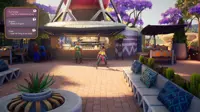
JOHANNESBURG: Behind glass display cases and elaborate security systems, an unusual crew is planning its heist. In the video game Relooted, African stolen art is to be returned from Western museums to its places of origin.
Instead of weapons, the crew uses its wits – turning the break-ins into an entertaining adventure built around a serious cultural and political question: Is it theft to take back what was wrongfully stolen?
Relooted was developed over eight years by the Johannesburg studio Nyamakop.
Set in a fictional world in the 22nd century, the game sees players break into European and American museums and private collections to steal African cultural objects – with an unusual mission: not personal enrichment, but the restitution of the works.
The fictional crew is led by Professor Grace, a retired South African art historian. Her fellow players are not classic criminals but specialists in science, technology and martial arts.
Rather than using weapons, the crew devises clever plans in the non-violent game, using technical tricks and deception to overcome museum security systems.
Entertainment with a serious message
The game is entertaining, but the premise behind it is serious: Who owns objects that made their way from Africa to Europe and North America during the colonial era?
Each of the 70 cultural artefacts selected for the Afrofuturist video game is real. Players learn where each one comes from, where it was made and what it means.
Relooted is an invitation to learn more about African culture and history and people," says Ben Myres, chief executive and creative director of Nyamakop.
Tens of thousands of African cultural artefacts were shipped to Europe and North America during the colonial era. According to estimates by Unesco, Europe holds 90% of Africa's cultural heritage.
Critics argue that the objects are presented mainly from a Western perspective and that their significance in African art and cultural history is often left unexplored.
Several African governments have been demanding the return of cultural artefacts for years. Germany and France are actively working on the restitution of many of these works.
Among the best-known examples are the Benin Bronzes from present-day Nigeria, which are held in numerous German museums.
Intelligence instead of weapons
The idea for Relooted came after his mother saw the Nereid Monument – an ancient tomb from present-day Turkey – on display at the British Museum in London, Myres says.
Her outrage set him thinking. He decided to develop a game that would be fun but at the same time shine a light on the slow pace of restitution of African cultural artefacts.
It was important to him that the objects be stolen back using intelligence, not weapons. "We wanted to contrast the very violent way these artefacts were often taken," says the 33-year-old.
Myres does not see Relooted as a political game but as a contribution to popular culture, which he says can make complex ideas accessible to a wide audience in simplified form.
"Possibly more people might have learned about feminism through Barbie than through bell hooks," he says, referring to the US literary scholar and feminist.
In the months since its February release, Relooted has already sparked debate.
The Manchester Museum in England and the Fowler Museum at the University of California, Los Angeles (UCLA) have organised exhibitions of the game alongside panel discussions, he says.
Myres adds that he was very pleased that museums were using the game to open conversations about their own collections.
Reversing colonial perspectives
South African art historian Pitika Ntuli says Relooted turns the issue of restitution into a participatory experience.
"The players encounter real African objects, learn that they were removed from particular peoples and histories, and must act within the consequences of that removal."
Ntuli highlights as a particular strength the way in which the act of stealing back inverts colonial language. The fact that the majority of African cultural artefacts remain outside the continent is "an extraordinary cultural amputation," he says.
"Imagine European children having to travel to Africa to encounter the principal physical evidence of European civilisation."
Ntuli says there is a risk that a video game could oversimplify complex cultural and political issues. At the same time, it gives people access to those issues.
"Simplification becomes dangerous only when it closes conversation. Relooted can be valuable precisely because it opens one," he says. – dpa