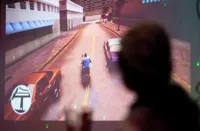
Pittsburgh, 2045: The sun shines brightly, solar panels twinkle on the skyline and everyone is unionised. For most residents, the city has become a bona fide paradise, the dream of ecosocialism made real. But for the cantankerous boomer in the new open-world video game Future? No Thanks!, it is hell on Earth.
He yearns for a return to the bad old days of the early 21st century: the freedom to burn fossil fuels, spout casual sexism and gorge on red meat and Coca-Cola.
The game’s maker, Paolo Pedercini, has long diagnosed the ills of modern capitalism through countercultural video games like Phone Story (2011), which depicted the exploitative supply chain of a smartphone. (It was duly banned from the App Store.) But in recent years, Pedercini has focused on societal remedies, driven by crises he considers urgent: a rapidly warming climate, democracy slipping into autocracy, enormous concentrations of wealth.
“It’s not even about our great-grandchildren being able to survive and live comfortably,” said Pedercini, who was born in Italy and teaches art and game design at Carnegie Mellon University in Pittsburgh. “It’s about us and our very immediate material conditions.”
Pedercini sees his latest game as a call to arms and a proof of concept: “It’s time for art and media to envision a better world.”
Future? No Thanks! plays like an indie version of Grand Theft Auto, tasking you with crossing off activities on its protagonist’s bucket list within a freely explorable near-future Steel City. Smoke a cigar; drive a gas – not electric – car. But rather than simply skewering the American dream, Pedercini’s game imagines an entirely new one.
The game can be preachy, yet the gag-filled script – which evokes early 2000s Futurama – ensures it remains a good time. The political left is satirised, too: Older people in a care home discuss the Bechdel test; the city’s children attend the Hypermontessori School; and lawns in this urban utopia are illegal, presumably so biodiverse meadows may flourish.
One of the game’s funniest characters is an artificial intelligence supercomputer rendered as Karl Marx himself. Pedercini explained that it is a socialist deep cut riffing on Project Cybersyn, a radical experiment of Salvador Allende’s government in 1970s Chile. Allende and his tech scientists attempted to use clunky computer technology and a network of telex machines to plan the economy.
The game’s humour reflects Pedercini’s roots. He started out making agitprop for grassroots labour organisations in northern Italy during the early 2000s before moving to the United States to pursue academia. He refers to his early work as the child of the “Silvio Berlusconi era” and the “global justice movement”. His games retain an activist bent: They are intended to be “sneaky, viral, guerrillero”.
While modern blockbuster titles are often ideologically evasive, posing questions rather than pushing politics, in fear of alienating players, Future? No Thanks! is unapologetically didactic. The only in-game person sceptical of its society for the 99% is the imbecilic main character. For him, this kind of politics is “new age, woo-woo crap”.
Pedercini thinks Future? No Thanks! is not quite so far-fetched as it might seem. He sees similar momentum in his work and the new generation of young democratic socialist politicians, including New York City Mayor Zohran Mamdani. “It’s all part of the same movement, the same wave,” Pedercini said.
The fully 3D and voice-acted Future? No Thanks! is far more complex than Pedercini’s earlier work, simple yet punchy Flash games playable on web browsers. He worked on it in a mostly solo capacity for the past five years, enlisting the vocal talents of a Pittsburgh theatre company where his partner performs.
As Pedercini toiled on the project in his spare time, the video game industry entered its own crisis: Mass layoffs became the norm, and funding for independent outfits dried up. Pedercini likens the new landscape to that of music: “You might be very serious about it, but you don’t generally become a professional until you have a hit.”
The run-up to the game’s release on PC and Mac in early September was fraught. Future? No Thanks! was originally intended to be out in late July, but Pedercini had to delay it as the online gaming store Steam assessed the scope of its nudity: “brief”, he said, and rendered in the game’s chunky, cartoon style. Weeks turned into months while Pedercini received cryptic updates.
“I feel like this relatively mild game is a collateral victim of ongoing culture wars,” Pedercini said, noting increased government regulation of online content.
All of the turmoil has only amplified the punk DIY credentials of Future? No Thanks!, which Pedercini called an “exercise in resourcefulness.” It is his attempt to see how ambitious you can be without relying on “big publishers, big teams and big marketing budgets” – to make a game, in large part, free from the pesky meddling of profiteering capitalists. – ©2026 The New York Times Company
This article originally appeared in The New York Times.