




Artificial intelligence (AI) is now solving maths puzzles that have long stumped humans, prompting mathematicians around the world, including in China, to ponder not only whether machines will replace them, but also what achievement and research in their field will mean in the future.
In early October, OpenAI released manuscripts showing progress on 372 categories of mathematical problems, including many which have long defied solutions. Recently, the American AI firm announced three further discoveries.
Human teams are now interpreting the AI-generated results in mathematics, computer science and physics, OpenAI said. The outcome of the analysis is seen as an indication of how fast AI is evolving.
Recent discussions in the mathematical community have also sharpened debate about how the technology will affect a field once seen as one of the most difficult and tedious fields of study.
H. Holden Thorp, editor-in-chief of the academic journal Science, said in an editorial that the recent AI achievements “sent the world of mathematics reeling”. Thorp wrote that they raised a broader question: “Can the satisfaction of understanding ever replace the thrill of discovery?”
Australian-American mathematician Terence Tao has repeatedly criticised OpenAI. In a public interview, the 2006 Fields Medal winner said AI coming up with solutions before mathematicians amounts to “strip mining” of earlier work.
Tao and 24 other Fields Medal winners, known as the “Nobel Prize of mathematics”, warned in a joint letter last month that AI-generated mathematical solutions must be developed and integrated into the field by humans.
They said short-cuts would undermine how the subject is passed down and how students learn.
Tao also argued in the editorial published in Science that AI is changing the research paradigm, leaving humans to interpret and understand AI-produced proofs rather than develop them.
Concerns raised in China over AI use in mathematics
China has raised similar concerns. Shing-Tung Yau of Beijing’s Tsinghua University is leading an alliance of more than 1,000 scientists to develop AI models specifically for mathematics.
Yau said AI’s development in mathematics was “like a tsunami”, and China lags behind the US in AI systems for advancing mathematics and physics.
Yau will serve as editor-in-chief of the new Journal of AI-Assisted Mathematics, set to begin publication in 2027. The journal was described as a forum for rigorous, AI-assisted research in pure mathematics.
Yau said theorems must meet the same proof standards as leading pure mathematics journals, regardless of AI’s role, and authors must explain how the technology contributed to the findings and how they verified AI-generated claims.
Other mathematicians have argued that some AI results should be considered “Fields Medal-worthy”.
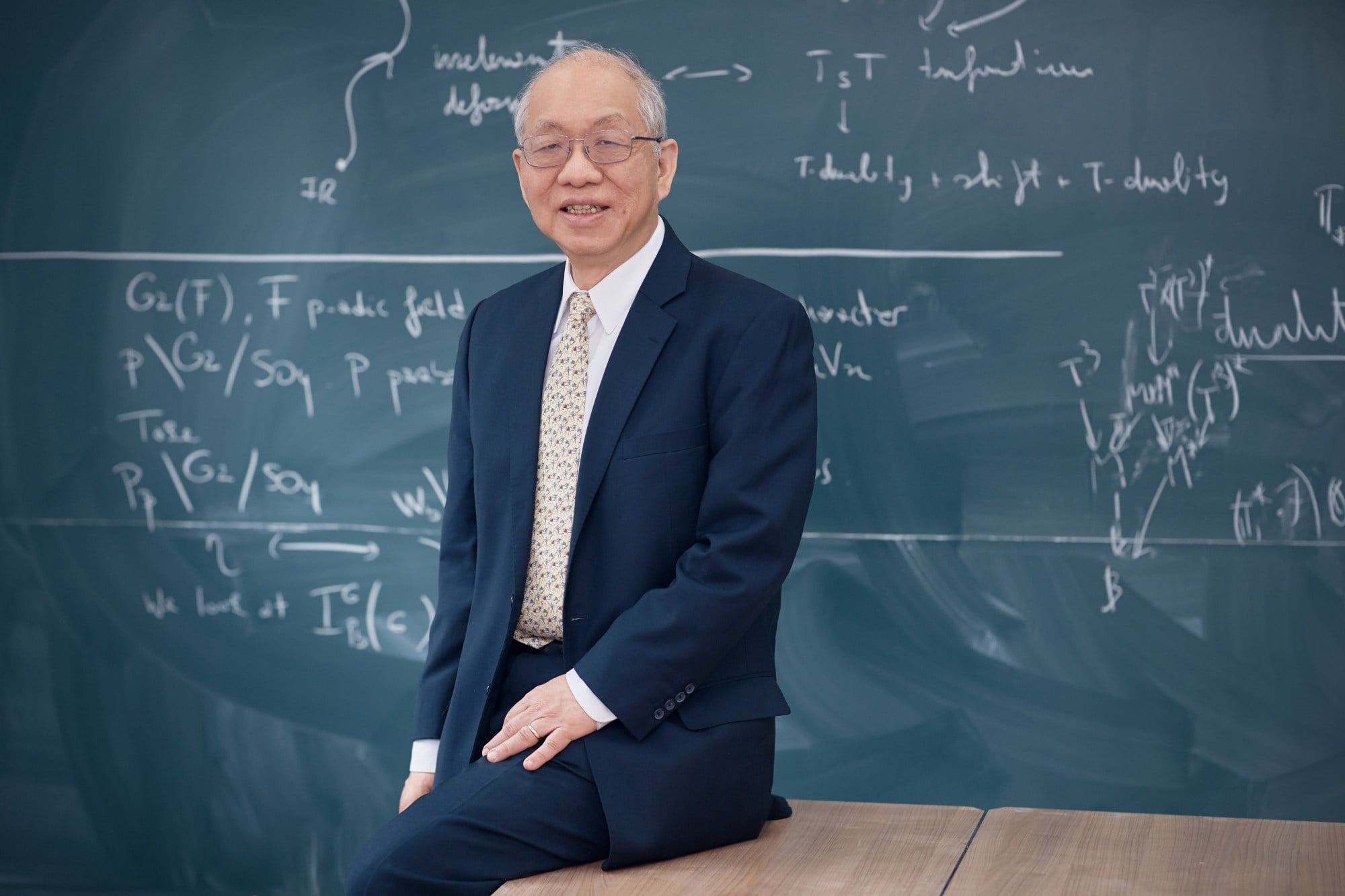
Babak Haghighat, a German-Iranian mathematician based at Tsinghua University, argued that in the right framework, AI is a powerful tool for connecting fields that individuals could previously learn only over a lifetime.
In an Oct 20 talk delivered at Kyoto University, Haghighat said AI would help to explore solutions and research tasks that were previously impossible.
However, he warned that large AI companies hold the most advanced models, deepening international inequality.
“AI models are now essential to mathematical research, yet mathematicians cannot access the top companies’ models or check and test how their results were produced,” he said. The researcher said mathematics used to be focused on the public good built through global collaboration.
Now that large AI companies decide who can use these tools, not only Chinese researchers but all mathematicians are at a disadvantage, he said, warning against giving a small number of private interests control.
Haghighat called on China to work with universities and mathematicians to train advanced AI models, noting that current Chinese models are good at programming but not mathematics, and that a model good at mathematics is also more likely to perform better in commercial or security fields.
Experts see positive impact from using AI to find solutions
Others in the field see a positive impact from AI involvement.
Grant Sanderson, creator of the popular mathematics-focused YouTube channel 3Blue1Brown, said now is the best time to learn mathematics, since proofs have become easier to obtain and mathematicians can focus on theory building.
“AI is changing mathematics’ academic culture and credit-allocation system, and the community is looking for new standards,” Sanderson said.
When AlphaGo defeated human masters in the ancient Chinese board game Go, many people lamented that the game had lost its challenge. Now, top players use AI-assisted training, offering a possible way forward for mathematicians.
Sanderson said AI being better at solving problems than human mathematicians should not stop researchers from getting stronger.
“The analogy is going to the gym: sure, machines can lift heavier weights than you, but that doesn’t negate the value you get from lifting,” he said. – South China Morning Post


