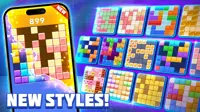
Have you played Block Blast yet? Seems like everybody is these days. And one developer is saying say the game is rigged.
Released in 2021, Block Blast is a simple mobile puzzle game consisting of an 8×8 grid filled with different coloured blocks. Users have to fit three new pieces into the grid each round hoping to fill and eliminate entire rows and columns to make new space on the grid. If you can’t fit a piece into the grid, the round is over. It’s sort of like Tetris without the stress of being under the clock.
The game fits in the hypercasual category, characterised by its minimal interface and infinite loop playability. Flappy Bird, released in the 2010s, is considered the first modern hypercasual game, starting a trend that has overtaken the mobile game space.
Block Blast is among the Apple App Store’s most-downloaded free games chart and has a 4.9 out of 5 rating with nearly 3 million reviews. It’s free to download and free to play, but that doesn’t mean the app’s Singapore-based company Hungry Studio isn’t making any money off of it.
In fact, they’re making a ton.
As of January 2026, Hungry Studio, said they have 70 million daily active users and around 300 million monthly active users. Digital intelligence and app analytics firm Sensor Tower estimated in their gaming deep dive ad monetisation report that Block Blast was the top-grossing game by ad revenue. They estimated between January and May 2026, the app grossed US$127mil (RM518mil). The second place app, Vita Mahjong, trailed by nearly US$38mil (RM154mil).
But Block Blast’s monetisation strategy is actually to rig the game, according to one developer’s analysis.
Is Block Blast rigged?
Developer and content creator, Ayomide Omolewa, recently dove into Block Blast’s backend to figure out exactly how they’re able to make so much money. To do this Omolewa decompiled Block Blast, which is a process where a computer program is translated back into a high-level, human-readable code language like JavaScript.
“It turns out, how well you do in the game has less to do with your skill, and more to do with how much you’re worth to them in ads,” Omolewa said in a viral Instagram post, which has racked up over 15 million views.
He went on to explain that the app takes account of factors like the country you’re in, what phone model you have, and, most importantly, how much you’ve made them in ad revenue previously.
One rule in the game, which Omolewa called the “Reward High Value Ad Harvest Trait,” is dependent on a few conditions before triggering a lethal puzzle via the “death algorithm.” This means that the game will purposely deal an impossible set of pieces that won’t fit on the board, therefore ending your game with an option to watch an ad to revive.
“It waits for three things to line up: you finished your last three rewarded ads, the ad loaded right now is worth at least 3.5 times your last one, and you’re 1,000 points past your high score,” Omolewa wrote in a breakdown of the decompiling process.
A rewarded ad is a voluntary ad, something like a revive button where you watch an ad to keep playing. When the game knows you’re likely to watch these ads, and they have a very valuable one lined up, it will want you to fail in order to watch that ad. Adding further sweetener to watch that next ad, they’ll only trigger the lethal puzzle once you’ve surpassed your high score.
Sometimes, after certain revival offers, the game will add a bonus of up to 10% of your high score to the current game as an incentive. Various other rules create punishments for playing too fast or going above your high score. On the flip side, if you’re playing well under your high score, the game triggers a rule to provide easier pieces. After all, there needs to be a balance of difficulty; otherwise, users may quit out of frustration and not engage with ads.
Block Blast says it’s just a game
The game developers have framed these designs as experiments instead of rigs.
“Block Blast! may look simple, but it is powered by an extensive A/B testing framework,” Jason Wang, the VP of brand & marketing at Hungry Studio said in a January press release. “In 2025 alone, our team ran more than 10,000 A/B tests, with over 300 experiments running in parallel each day. We also developed our own user behaviour simulation platform, Block AI, which enables high-density automated testing before new versions go live.”
Some of these tests measure how many minutes into a game should a lethal piece combination be dealt to be most effective for an individual user to click a revive ad, Omolewa noted.
“All things considered, Block Blast isn’t really a puzzle game, it’s more of an ad harvest with a rigged game loop built to squeeze every penny out of you,” Omolewa said.
Hungry Studio did not reply to a request for comment ahead of publication. – Inc./Tribune News Service