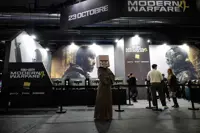
SEOUL: A fictional North Korean invasion of Seoul is becoming fodder for a real political battle in South Korea, with the latest instalment of the blockbuster Call Of Duty franchise drawing politicians into a debate over national security, inter-Korean relations and freedom of expression.
Call Of Duty: Modern Warfare 4, which depicts a devastating second Korean War triggered by a surprise North Korean attack, has become an unlikely political talking point in Seoul, with opposition politicians urging President Lee Jae Myung to pick up a controller and experience the consequences of what they describe as his administration’s overly conciliatory approach towards Pyongyang.
The controversy has even reached the National Assembly’s annual audit, where Culture Minister Choi Hwi-young was pressed on Oct 23 on whether the game featuring battles against North Korean soldiers and the fictional death of the country’s leader should face government scrutiny.
Choi’s answer was straightforward: Video games, like films, are protected forms of creative expression.
“Games are not subject to prior censorship,” Choi told lawmakers during the parliamentary audit, stressing that the government cannot suppress creative works simply because of their political content, as freedom of expression is protected under the Constitution.
Officially released worldwide on Oct 23, Call Of Duty: Modern Warfare 4, developed by US studio Infinity Ward, depicts a fictional second Korean War triggered by a full-scale North Korean invasion of South Korea, with the storyline also featuring political turmoil within the North Korean leadership.
Players take on the role of a South Korean soldier fighting alongside fellow troops against North Korean forces, with battles unfolding across the peninsula, including urban combat in Seoul. A sequence featuring an assault on a compound resembling the North Korean leadership’s headquarters has also attracted attention online.
Real security concerns
While the game’s dramatic portrayal of conflict on the Korean Peninsula has captivated gamers, it has also provided opposition lawmakers with fresh ammunition against Lee’s North Korea policy, considering the 1950-1953 Korean War was halted with an armistice rather than a peace treaty, leaving the two Koreas technically still at war.
Conservative lawmaker and former Justice Minister Han Dong-hoon joined the debate on Oct 23, urging Lee to play the game himself to appreciate the potential consequences of inadequate defence preparedness.
“Of course, it is a fictional story,” Han wrote on Facebook. “But North Korea’s invasion on June 25, 1950, was a historical reality, and the North Korean military threat remains very real today.”
Han acknowledged concerns that the game could fuel hostility towards North Korea, but argued that its fictional premise raised a question worth considering: Would South Korea be prepared if the North invaded again?
Han criticised Lee for describing North Korea’s nuclear arsenal as a “last-resort defensive weapon” during a meeting with reporters on Oct 19, when the president questioned whether Pyongyang would actually use nuclear weapons in combat despite its military disadvantages relative to South Korea. The president’s remarks came despite Pyongyang having codified circumstances under which it could launch a pre-emptive nuclear strike.
Han also questioned the administration’s push for an early transfer of wartime operational control from Washington to Seoul, as well as reductions in joint military exercises with the United States.
Expressing hope that the game’s depiction of a devastated Seoul would remain confined to the virtual world, Han suggested that Lee try playing it to understand the potential consequences of insufficient military preparedness.
“National security is not about hope, but preparation,” Han wrote.
Representative Ahn Cheol-soo of the main opposition People Power Party made a similar recommendation on Oct 20, accusing Lee of underestimating the North Korean threat.
Ahn suggested that even watching gameplay footage could help the president grasp the potentially catastrophic consequences of what he characterised as naive security assumptions.
The minor opposition Reform Party also weighed in, linking the game’s fictional warfare to a recent real-world incident along the inter-Korean border.
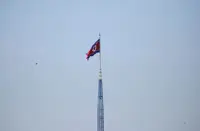
In a statement on Oct 25, party deputy spokesperson Choi Je-il pointed to the two land mine explosions inside the Demilitarized Zone on Sept 21 that injured three South Korean soldiers, two of them seriously. A joint investigation by South Korea’s military and the United Nations Command subsequently concluded that the blasts were caused by North Korean anti-personnel mines planted south of the Military Demarcation Line, in violation of the Korean War Armistice Agreement.
Choi criticised the administration’s approach to Pyongyang, arguing that genuine peace requires a clear-eyed assessment of military threats rather than reliance on goodwill.
“Politics must confront the reality of those threats more accurately than a video game does,” he said.
From battlefield simulation to freedom of expression
Beyond the security debate, Call Of Duty has opened another political front: whether lawmakers are applying consistent standards to creative works with politically sensitive themes.
The controversy has drawn comparisons with Assassin(s), a South Korean historical thriller released on the big screen in September, which depicts the 1974 assassination of former first lady Yuk Young-soo. It has faced criticism from conservatives over its suggestion that the South Korean intelligence agency at the time may have been involved in her death.
Conservative lawmakers have accused progressives of hypocrisy, arguing that those who defended the film as a fictional work should extend the same freedom to a video game depicting a North Korean invasion.
People Power Party Representative Park Soo-young made that argument in a Facebook post last week, calling on those who insisted that a film should be treated simply as a film to apply the same principle to Call Of Duty.
Another People Power Party lawmaker, Representative Joo Jin-woo, defended the game in a YouTube interview, arguing its depiction of a hypothetical future conflict should fall squarely within the bounds of creative freedom.
The debate has also inspired political satire outside the National Assembly.
Lee Sang-min, a former comedian turned political content creator, said on Oct 22 that he had bought the game as a gift for Unification Minister Chung Dong-young, who has championed a conciliatory approach towards Pyongyang that emphasises dialogue, engagement and peaceful co-existence over confrontation. Lee posted a receipt for the purchase online.
Many in the ruling camp, however, do not appear particularly troubled by the prospect of virtual combat against North Korean forces.
Representative Kim Han-kyu of the ruling Democratic Party of Korea took a decidedly more relaxed approach, posting a short video to his social media account on Oct 22 titled “What’s wrong with buying Call Of Duty?” – a playful Korean pun on the game’s abbreviated name, “Call Of Duty 4,” and “sa”, which means both “four” and “buy”.
Kim dismissed suggestions that a game involving attacks on North Korea was inherently inappropriate, asserting that video games should not be regulated unless they violate the law. He also suggested that familiar Korean settings could make the game more appealing to domestic players.
“Given that we are technically still under an armistice, it would be stranger if there were no games about fighting a war against North Korea,” Kim said. - The Korea Herald/ANN