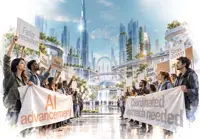
BERLIN: The world of work is changing at a never-before-seen pace, as innovation overturns all our assumptions about jobs.
Technology, particularly Artificial Intelligence (AI), is able to do many of the activities people have so far done, from cashiers in the retail sector being replaced by self-service checkouts to editors being replaced by AI tools.
For workers planning their careers, the decision is a hard one, to opt for a direction to take. Many ask, what constitutes a crisis-proof job? Who will be needed in the future?
Here are some of the key questions and answers.
What is a "safe" job? And do such jobs even exist anymore?
It partly depends on how you define a secure job, says Tobias Maier from Germany's Federal Institute for Vocational Education and Training (BIBB). For some, it means a permanent position with a large corporation. For others, secure careers might include jobs involving public authority, such as police officers, prison officers, teachers or soldiers.
Whatever the case may be, "With any job, it is uncertain whether it will still exist in 40 years’ time with the same job profile as it has today,” says Maier. However, he points out that this has always been the case and is not necessarily a bad thing in itself.
"For employees, this means they must always be prepared to engage with new developments,” says Britta Matthes from Germany's Institute for Employment Research (IAB). For example, with AI.
How can you spot a profession that has a solid future?
There are several criteria that should make a job safe in the longer term. These include:
- The job meets a fundamental social need: Jobs that meet long-term fundamental social needs include well-trained specialists in the healthcare sector. The construction industry and the hospitality sector have also been established professions for millennia as people need the services provided.
- The job requires social skills: Social skills such as empathy and emotional intelligence remain in demand – they cannot be replaced by AI. Such social skills play a major role in sectors such as care, education and human resources, Maier says.
- The job calls for creativity: Creativity is essential for creating competitive advantages through new ideas. "AI is often unable to achieve this either," says Matthes. Creativity is relevant in a great many professions – not just in the fields of design, marketing & advertising, and media & entertainment, she says.
- The job requires complex problem-solving: "Professions that involve complex problem-solving are also considered to be safe in the long term," says Maier. An example of such a profession is an electronics technician who installs wiring in a house. "AI tools can help them find the solution to a complex wiring problem,” says Matthes.
- The job can be adapted, but not replaced: each profession continues to evolve with new technologies. "In this context, AI does not replace people, but rather changes tasks and makes processes more effective,” says Matthes. This applies, for example, to roles in IT or administration.
Which sectors are particularly prone to change or are more stable – though of course you can't promise any guarantees?
Currently, AI and cloud computing are further automating routine tasks, a trend which affects not only the fields of IT, technology and software development, but also a wide range of other areas. "At the same time, however, new tasks are emerging and, as a result, new job profiles,” says Maier.
Matthes says there is increasing automation in the bakery trade, for example. Smart proving machines use 3D cameras and AI to measure the volume of dough pieces in real time and determine the optimum proving point. Robots can shape pretzels or other baked goods and load them into ovens. "Such technologies can make work processes more cost-effective and efficient, but ultimately they do not replace human labour,” says Matthes.
The following professions are currently seen as less likely to be lost to automation:
- Undertakers
- Doctors
- Mental health therapists
- Environmental engineers
- Social workers
- Craftspeople where personal empathy is also key, such as orthopaedic shoemakers, hairdressers or beauticians
Why is lifelong learning, and further training, more important than making the one right decision?
"The profession you initially choose often sets the direction for the career path you wish to follow," says Maier. But no one can predict how things will develop in the job they pick.
That's why it's important to keep learning, even after you complete your training. Try to attain further qualifications that are in line with your personal interests.
Continuing to develop yourself will increase your security in terms of having a job and, at the same time, opens up new career opportunities, often with greater earning potential, says Matthes. – dpa