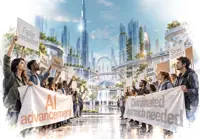
Grainy-looking hamburger meat, shrimp curled into a perfectly unsettling circle and furry sausages are just some of the more disturbing AI images that have crept onto restaurant menus, advertisements and social media postings.
It's a trend that has run rampant online, and it's also starting to creep into real life.
Customers are disturbed by these AI-generated images and routinely call them out on social media as "AI slop."
Restaurant owners seem to fall into one of three camps: AI is so easy to use that it's worth any backlash; they don't realise it's turning customers off; or they avoid it at all costs.
"I can't tell any of these apart. I can't even tell what restaurant this is. How am I supposed to know if I even want to eat here if it's not a real photo of the food?" said Jessica Krcmarik, a graphic designer and frequent patron of Metro Detroit restaurants, especially on the east side. "Honestly, the AI-generated food looks gross. The texture is actually horrifying."
We all have smartphones in our pockets with decent cameras. Why not just take a photo of the actual food that's coming out of your kitchen and use that? When the food doesn't exist yet, AI-generated imagery is tempting. A year ago, a restaurant owner might have used a cartoon image or stock photos, which was also misleading, but didn't have that unsettling glow that AI-generated food does.
Detroit favourite the Kitchen by Cooking with Que posted an AI-generated image of potential food, asking their customers to decide what they should make at their Ford Field outpost for the Thanksgiving meal. When a customer expressed dismay that the Kitchen was using "the AI monster," chef and owner Quiana Rice stepped in personally to defend the use of AI in an instance when no actual food was made yet.
"AI has not taken over our kitchen," Rice wrote on Instagram. "We have front-of-house team members, back-of-house team members ... and real food. When was the last time you stopped in?"
Other businesses tried AI imagery and faced such backlash from customers that they stopped using it.
Spicer Orchards in Fenton pulled AI-generated signage from their farm in September after customer complaints, the Flint Journal reports. Blind Owl in downtown Royal Oak posted handwritten signs to Instagram after customers complained about "ugly ChatGPT flyers."
Mark Kurlyandchik is a food content specialist and founder of Booth One Creative, which offers branding, marketing and other services to restaurants. He says businesses that are trying to stand out with colorful images made with AI may actually be making themselves invisible.
"I went to a big food festival this summer and there were 30 food vendors and they all had signage, but I want to say 70% of them all used AI for their signage, so you couldn't tell the difference between one place or another; it just all blended into one thing," he told The Detroit News.
"A restaurant is an extension of someone's point of view and personality – at least the most interesting restaurants are – and AI by its definition is the opposite of that," he said. "It's just taking the primordial digital slop and putting it together in this thing that looks like everything else. It's removing all personality from the branding."
What options are there for restaurants who can't afford a brand manager, publicist or marketing consultant?
"You can write the menu on the back of your hand with a Sharpie and take a picture of that with your cellphone, and that is a more interesting image than anything that AI can create," said Kurlyandchik.
Krcmarik is doing all she can to see fewer AI-generated posts from her small business neighbors. She's offered her design services for trade to any restaurant with a low marketing budget so they don't have to use ChatGPT or another AI service to create social media flyers or menus. She's also working to connect other designers, social media managers and photographers to restaurants that may need help.
"The impression that I'm getting is that (the restaurants) just honestly have no idea that their customers don't like the AI until recently," said Krcmarik. "You guys can trade me dinner or a couple drinks or something and I will make you some flyers and templates. I don't mind doing some work for trade. If it's a budget issue, I'm happy to donate some time to see less of them. I like living here and I would like my local restaurants to succeed."
Unsettling food imagery aside, AI can be a lifesaver for a restaurant owner who is juggling menus, inventory, staff and legal and financial details along with branding, marketing and social media.
Chef Omar Mitchell has two concepts in Detroit and plans to open a new restaurant in Macomb County later this year. At his Table No 2 in Greektown, he uses an AI program to answer the phones and he's also used it for marketing materials.
"I love AI. I'm a big fan of it," he said. "I don't think it's going to take over jobs like people are saying. We use AI to answer our telephones, but if the customer decided that conversation was not enough, then they can request to be transferred to a particular person to take the call from there."
"I use it for marketing. I use it for menu development. I use it for research and development," he said.
As he prepares to open a new restaurant, Noble Duck at Partridge Creek, Mitchell says AI has helped him plan the concept and layout.
"I even took my furniture that's going in the restaurant ... attach it to the AI file and it creates me a concept rendering in real time with the real furniture that I'm going to be using."
As for using AI images of food in marketing material, he doesn't want to show people a product that may not look exactly like it does at his restaurants.
"I only want to use my true images, but I do like the flyers that it makes," he said. – The Detroit News/Tribune News Service