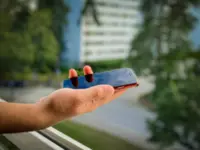
Ask most people what their phone is costing them, and they’ll point to their attention or sleep. But research suggests the cost may also be physical.
Doctors are now using the informal term “phone body” to describe changes that follow years of hunching, squinting, and scrolling.
On average, Americans now spend about seven hours a day looking at screens, according to DataReportal. It’s a norm the physical body adapts to over time.
Inc spoke with a spine surgeon, a vision scientist, and a medical sociologist to get the fuller picture. Most of the damage is preventable – but almost none of it reverses on its own.
Tech neck
The most visible symptom has a name of its own: “tech neck.”
When you tilt your head down to a screen, the muscles at the back of your neck fire to hold it up. At first, they carry the load and settle into ordinary aches, K. Daniel Riew, a cervical spine surgeon at Och Spine at NewYork-Presbyterian/Weill Cornell Medical Center, told Inc.
The problem really begins when the position repeats, loading the cervical disc past the point where it can compensate. Over the course of many years, that can trigger premature cell death and accelerate degeneration, he says. He now often sees patients in their 20s – an age group that once rarely appeared in his practice.
Phones are uniquely bad for your posture because people forget to manage them. At a desk you can raise a monitor, but a phone travels with you everywhere. “Even people with neck problems who have made adjustments to their workspace forget to think about holding their neck in proper alignment,” Riew said.
However, his recommendation deviates from the typical. The classic advice to sit up straight with hips and knees at 90 degrees, is, in his view, a trap that ends in slouching.
Instead, Riew suggests leaning back. By reclining at about 25 to 30 degrees – with lumbar support and a headrest – you can shift the weight of the head and torso into the chair.
“I can sit in that position for hours without feeling any pain,” he says. There’s a hard limit on this fix, though. “Once enough cells have died, there is no going back.”
Screens and your eyes
Rates of myopia, or nearsightedness, have climbed sharply among children. Screens are often pointed to as the scapegoat. But Donald Mutti, a vision scientist whose work on the landmark CLEERE study helped shape the field, says the screen probably isn’t the villain.
Mutti told Inc that screens are likely not raising the risk of myopia. Instead, since screens are keeping kids inside, the fault may rest with a shortage of time spent outdoors.
A recent study using smartwatch data agreed with CLEERE’s findings that outdoor time can protect children against developing myopia. Approximately two hours a day outside delivered the maximum protection against developing nearsightedness, providing that the duration of each trip outdoors lasted at least 15 minutes and the daylight reached 2,000 lux. Only such continuous, bright exposure carried the benefit; brief or dim time outside did nothing.
However, that shouldn’t be cause for concern, Mutti told Inc: “2,000 lux is easily obtainable outdoors, even in shade.”
The good news? When it comes to adults, he’s largely unworried.
“I don’t think there is much of any effect in adults beyond eyestrain,” he says. “Moderation in all things is always good advice.”
Grip strength
The subtlest part of “phone body” shows up in grip strength – a proxy for overall health and even longevity.
Grip strength can be defined as the muscle force necessary to carry out daily tasks, like carrying groceries, and serves as a strong indicator of overall muscular health.
Grip strength is on the decline among the general populace, and it’s easy to blame its fall on soft, screen-bound hands.
Johannes Beller, a professor of medical sociology at the Medical University Lausitz–Carl Thiem, told Inc that this decline urges caution.
In a 2019 study published in the peer-reviewed journal SSM, a team led by Beller traced the decline back to people born decades before smartphones even existed.
Rather than placing the blame on any single gadget, this pattern reflects broader shifts in how people live and work, he says.
“Grip strength is valuable precisely because it reflects overall strength and health, not because the hands themselves are the target,” he adds. “A single reading isn’t a diagnosis. Staying active and strong is something almost anyone can act on, at any age.” – Inc./Tribune News Service