
WHEN it comes to robot animals, most people would associate them with cute and cuddly companions. Examples include Paro, the therapeutic seal robot introduced in 1993, and Aibo, a robotic dog launched in 1999 that could walk, bark and respond to human interaction.
In recent years, robot animals have evolved beyond companionship and playtime, taking on more practical roles such as providing security, carrying heavy equipment and even helping ward off bears.
Howling success
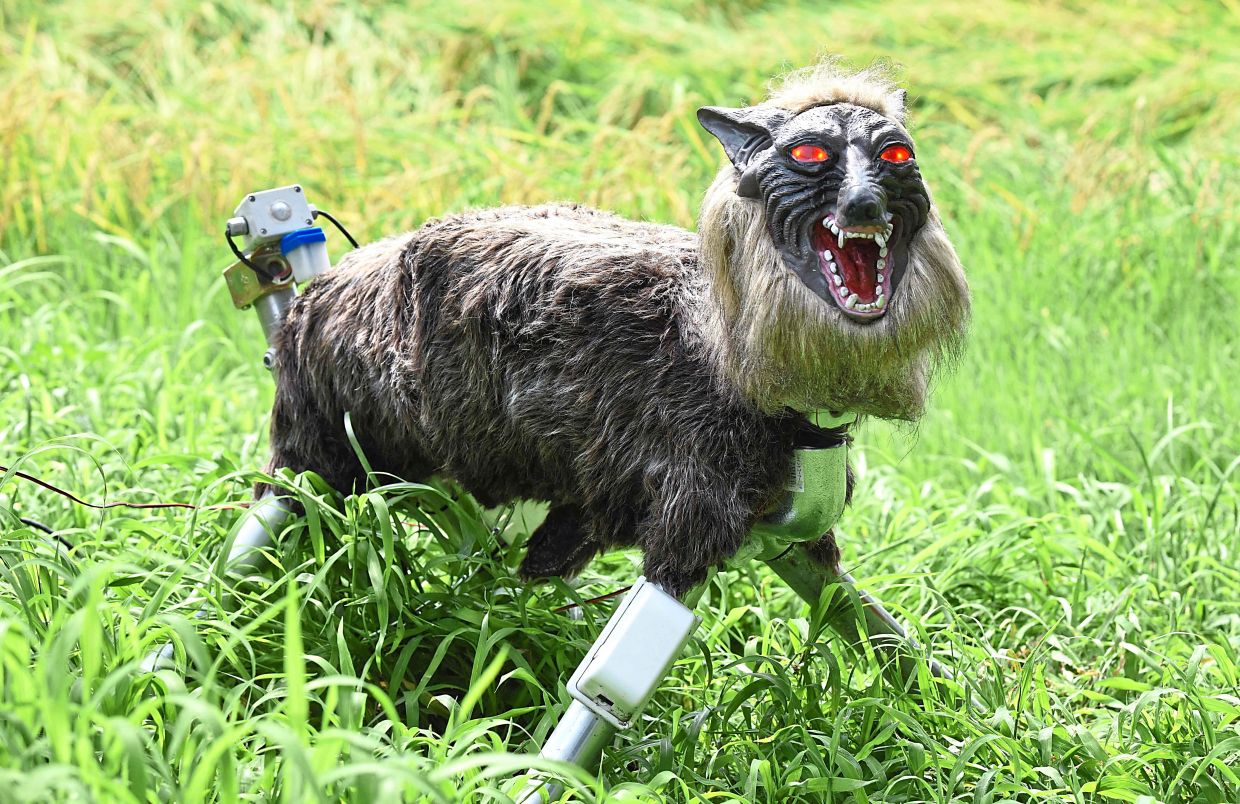
Last month, it was reported that Japanese company Ohta Seiki is struggling to meet the production demand for its animatronic scarecrow Monster Wolf. Customers including farmers and golf course operators are turning to the wolf robots with flashing red LED eyes to ward off wild animals, particularly bears. Japan is facing a record year of fatal bear attacks where 13 have been killed.
AFP cited company president Yuji Ohta saying the robots are made by hand and customers have to wait up to three months to receive their order. Priced from US$4,000 (RM15,716), the Monster Wolf is made from a pipe frame covered with artificial fur. It has a rotating head with sensors, solar panels and speakers that could broadcast more than 50 types of sounds. A video by USA Today showed that the robot emits sounds resembling sirens and gunshots.
In the future, the Monster Wolf may also be able to chase animals or patrol designated areas, as its maker plans to equip it with wheels.
Horsing around
For the Year of the Horse, China’s Deep Robotics unveiled a 0.5m tall, 30kg robot horse with a payload capacity of up to 50kg. According to website Interesting Engineering, the robot is built with bionic legs and hoof-like feet which is meant to replicate the natural movements of a horse.
It is also equipped with 96-line Lidar (Light Detection and Ranging) and advanced SLAM (Simultaneous Localisation and Mapping) technology, giving it 360° situational awareness and the ability to autonomously detect and avoid obstacles. Hot-swappable batteries allow the robot to operate for up to three hours on a single charge.
Can it run like a horse? Well, the company said it can reach speeds of up to 5m per second, but recommended a standard operating speed of half for “optimal stability”.
Priced at US$50,000 (RM198,325), it was described as a “premium collector’s item” or high-end marketing tool.
Love is in the air
In the US, a high school robotics team was enlisted to design and build mechanical grouse decoys in a bid to boost the population of the bird species in the Grand Teton National Park. The robo-grouse is an automated model that can move and dance to simulate mating rituals of the actual birds. Some models can also puff their chest just like the male grouse.
The park also installed concealed speakers to play breeding calls at 5am every day, where a spokesperson said the idea is to encourage the grouse species to begin displaying and mating at restored habitat sites.
Website Popular Science reported in April that the park rangers will be monitoring the grouse mating season through trail cameras.
Paw patrol
Last May, Malaysia’s National Aerospace and Defence Industries (Nadi) introduced Asuk, an AI-powered robotic dog designed as a quadruped unmanned ground vehicle (Q-UGV).
At 50kg, Asuk or Anjing Siber Unit Khas is equipped with Lidar, infrared sensors, camera, chemical sensors and can be tasked to perform reconnaissance in disaster areas or combat zones. Nadi group senior engineer Wayne Lim told Bernama that Asuk was developed in collaboration with US-based Ghost Robotics.
In terms of public safety, Lim said Asuk is programmed with speed limits and collision-avoidance features. Its operating frequencies are also regulated in compliance with the Malaysian Communications and Multimedia Commission standards to prevent signal interference.
In Singapore, robot dogs have also been tasked to serve as guides at tourist attractions. On April 18, the Singapore Tourism Board (STB) partnered with China-based travel platform Mafengwo to pilot a series of AI-powered, multilingual robodogs to provide real-time visitor assistance at Sentosa Sensoryscape.
According to a press release, the robodogs can converse with guests in English and Mandarin to recommend places of interest, and even perform dances.
The robodogs were also deployed at the Mandai Wildlife Reserve’s indoor attractions – a 10,000sqm nature-themed immersive experience called Exploria and a 4,600sqm family-friendly playscape called Curiosity Cove – to interact with guests.
The one-month pilot programme aimed to gather insights on visitor preferences and technology performance. STB stated that these insights would be helpful “for future deployments that could extend beyond tourism to educational and learning applications”.