Lenovo Group Ltd and other consumer electronics companies used the MWC Barcelona conference this week to test appetites for physical AI products with humanlike characteristics.
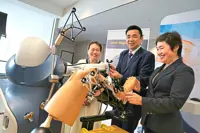
The Beijing-based firm arrived at the show with several proof-of-concept devices, including a desktop robotic arm with a built-in projector, microphones, speakers, cameras and a display with the oversized eyes of an animated character. The gadget, called the AI Workmate, is intended to plug into business environments, recognising users by their appearance and voice and surfacing pertinent information. The effort to humanise the technology is unmistakable, with the arm performing pet-like movements and gestures.
Not far from the AI Workmate, Lenovo’s Magic Bay Tiko is a magnetic attachment that the company has been refining for several months. It clips to the top of a laptop and serves as an animated AI assistant. The latest edition is an anthropomorphic cloud that looks over the user’s work and responds to voice-based commands and queries. The gadget doesn’t enhance the artificial intelligence capabilities, but it adds a character to the experience – which can sip coffee or read a book while you’re not interacting with it.
The broad push toward softening the edges of AI tech was apparent everywhere across the MWC show floor. China Telecom Corp had a humanoid robot doing calligraphy at its stand. China Mobile Ltd set up an entire robot restaurant, where various machines were demonstrating food preparation and service. China Unicom also brought a humanoid to the event, an eye-catching red machine that drew passersby.
It was more of the same from smartphone makers, with ZTE Corp erecting a pair of robot guardians at its booth and Honor Device Co demonstrating a humanoid robot – the first to be developed in-house by a smartphone maker, according to the company. Honor also showed off a so-called robot phone with an articulating camera arm that retracts into the body of the handset.
Traditional mobile devices like phones and laptops, long the centrepiece of MWC, were an afterthought at this year’s AI-centric gathering. Ericsson AB, Nokia Oyj and Qualcomm Inc pitched visions of 6G and AI blending together as the technologies of the future – Ericsson’s booth included the slogan "no AI without mobile” – while device makers like Lenovo were busy testing the waters for new types of AI gadgets. The 6G communication standard is set to replace 5G in wireless networks in the next decade.
Many of the novel devices and form factors being contemplated by companies now lean more into conversational interactions over input via a screen. Alongside inviting animated faces, the next wave of consumer electronics may shift the primary mode of input to natural-language prompts.
"We’re now beyond smartphones – the next class of devices like personal AI devices, connected vehicles, industrial devices, robots and much more are going to be connected,” Qualcomm Chief Executive Officer Cristiano Amon said in a keynote address. "AI makes voice important again, as we use a lot of voice to interact with agents.” – Bloomberg