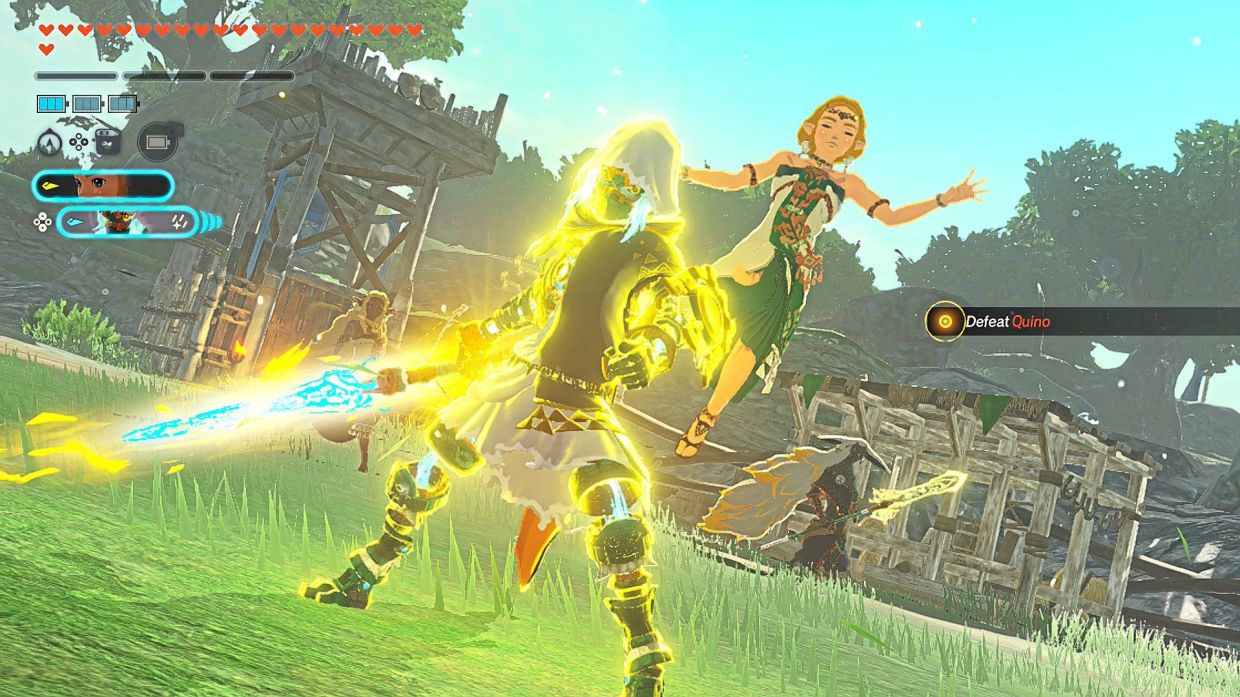
I’ve been enjoying Hyrule Warriors: Age Of Imprisonment a lot lately, but it’s such a hard game to recommend to my Zelda-loving friends because it’s so... very... well, dumb. I spend 95% of my time pressing Y and X to make things explode on screen, and the other 5% skipping cutscenes so I’m not even sure WHY I’m making things explode on screen.
I compare Age Of Imprisonment with the Zelda game that it’s spun off from – Tears Of The Kingdom – which features player-driven exploration, a creative crafting system, and a game experience that encourages improvisation and creativity. TOTK is a very un-dumb game; someone with a better vocabulary might even call it a brainy game.
While I love both games, I know that my friends who enjoy the dumb fun of Hyrule Warriors don’t have the patience for TOTK’s problem-solving mechanics; and my friends who love TOTK’s carefully-crafted and interactive world simply balk at Hyrule Warrior’s “don’t think about, just press buttons to hack-and-slash” philosophy.
So this got me thinking about what “dumb” and “brainy” gameplay really means in the context of video game design. Or, to use a more un-dumb term – let’s talk about complexity and complicatedness in video game design.
Complexity in simple terms
Alright, let’s start by setting out the terms I’ll be using in this discussion. When I’m talking about “complexity” in the terms of video game design, what I mean is this: how many different systems, rules, and pieces of information need to work together, to make the whole game work?
A rhythm game like Taiko No Tatsujin is “simple” in terms of interlocking systems and rules: there’s a music track that plays, and there are the buttons you need to press in time with the rhythm. Bam, done!
On the opposite end of the spectrum, a 4x game like Civilization VI requires a map & terrain system; which affects the mechanics of city growth; which ties into the economic & culture system; which impacts the diplomacy mechanics; which ties into warfare & combat; etc etc etc.
“Complexity” itself is an objective term, and a pretty neutral one at that – a complex game can be good or bad, same with a simple game.
“Complicatedness”, on the other hand, is a more subjective term – I define it as the amount of interlocking systems/rules/information that we the players need to keep/process in our brain at the same time, just to understand what the heck’s going on.
(Or another way of describing it: if this video game was a board game, how long would you need to sit down explaining the rulebook to your friends before y’all can actually start to play? If the game has a lot of rules, it’s complex. If everyone goes cross-eyed trying to follow your explanation, it’s complicated.)
So how does complexity and complicatedness matter? Well, it’ll help us talk about video games, and perhaps understand why simple games appeal to some, while complex games appeal to others.
Contextual complexity
To make this nerdy analysis a little easier to digest, let’s see if we can break down the idea of “complexity” into smaller pieces. The first piece, contextual complexity, is tied to the most basic question of video game design: “What’s this game about?” or, “Why the heck am I playing?”
In practical terms, the context of a game is what’s written on the intro on its Steam page, or the back of the box of a physical copy, or even its key art. If you can’t describe a game without diagrams, charts, and a 30 minute explainer video, then its context is probably a bit complicated.
Nintendo’s pretty genius at this bit, as the context of their games are usually simple to explain, with the actual complex & interesting bits hiding in the gameplay mechanics. Like, Mario is a game about a plumber rescuing a princess, and you get to jump everywhere. Splatoon is a game where you’re a squid kid, and you paint turf with ink.
(I said they were simple to explain, I didn’t say they were sane.)
Contextual complexity is often overlooked by veteran gamers, since we’re often too familiar with games that we take weird ideas for granted.
I was telling an Aussie friend that she might enjoy playing Genshin Impact, but then I realised I had to explain what a gacha game is. It went like this: “It’s like a JRPG, except it costs between £0 to play, or £100,000 if you want lots of waifus on your team. Don’t worry about it. There are seven elements and seven nations, oh, plus Nod Krai, which is the moon nation, but the moon isn’t an element, but- hold on, I’ll draw a chart. Why are you going cross-eyed?”
Rules complexity
The second piece, rules complexity, is all about understanding cause and effect. The question here is, “how does anything work?”.
A game is built out of several rules, and a rule is something as simple as “Ground-type moves deal 2x damage to Electric-type Pokemon”, or “a Pokemon can have 1 passive Ability”. Good rules are easy to understand (i.e. information clarity), interesting rules interact with others.
Players use these rules to make a mental model of the game; without understanding how things work, the game might as well be a random series of events from a fever dream.
There’s a tradeoff here: a lot of rules interacting with one another can lead to interesting gameplay and fun combos for pro players; but that same complexity can make other players confused as to what the heck’s going on. (e.g. “Why did I die to that attack?? I thought I was immune to X!”)
A good rule (ha!) of thumb is that, the more “except”, “unless”, “if”, and “but”s that are appended to a rule, the more complex it gets, and the higher the risk it gets too complicated for players.
Here’s one example of that: “Ground moves deal 2x damage to Electric Pokemon, unless the Pokemon has Levitate, which reduces Ground damage to 0, except when the attacker has Mold Breaker, which ignores Levitate; but, if the attacker was doused in Gastro Acid, then...”
Control complexity
The third piece is control complexity. Once a player understands how the game works, the question becomes, “what can I do right now?”
Playing a game is about making a series of interesting decisions, and those decisions are determined by the control you’re given. And by that I mean: look at your game controller. The next time you’re playing your favourite game, consider how many buttons (or analog sticks or etc) on that controller do something, what they do at any given time, and how often they matter.
On a console like the Switch 2, you’re probably moving your character with the left stick and the camera with the right stick. There’s at least a primary action button (to attack, or to say “yes” in a menu), a secondary action button (to jump or dodge, or to say “no” in a menu), and a button to open a menu. On a touchscreen device, does the game you’re playing only ask you to simply tap on things, or does it require actions like double-tap, tap-and-hold, tap-and-drag, and/or swipe?
And if you’re playing a flight sim on a PC with a keyboard, then heaven help you, because you’re going to need to remember some ridiculously complicated combos like pressing Ctrl+Shift+F2 to lower your landing gear and not Alt+NumPad5 which instead ejects your pilot.
Again, there’s a tradeoff here – a high amount of control complexity means players have a lot of tools & options to express themselves through gameplay (e.g. some TOTK players defeating monsters through skillful swordplay, others by building insane contraptions), but that same complexity can be a barrier for casual players and players with accessibility issues.
Interestingly, while Hyrule Warriors is a game where there’s actually a lotta buttons doing a lotta things (L2 to block, right button to open Abilities/Devices sub-menu, A for special attack but only if the meter is filled, etc) but I still argue its control complexity is pretty low, because I can – and I have – gotten away with just pressing Y (smack enemies) and X (smack enemies but harder) to win.
Complexity, continued
Given more time and an infinite word count, there’s still a lot I’d like to yammer on about. Like the idea of strategic complexity, which has the decision-making aspects of control complexity but stretched across a longer time span. Planning your character builds in Baldur’s Gate 3 or any Western RPG is a good example of this.
But hey, you know what, I think we’ve already covered enough of the major points today.
I find that complexity and complicatedness are interesting lenses to view video games – at the very least, it helps me communicate to my friends what kind of games they might like, whether they’re in the mood for simple fun or have an interest in complex gameplay.
As for me, I realise now that a big reason why Hyrule Warriors appeals to me so much is that it came out during a period where I’m especially busy at my programming day job, and I just don’t want to think too hard when I get time to myself. (Pro tip: if you want complex, complicated, AND confusing, try working with JavaScript.)
Give me a quiet, boring weekend though, and my brain will hunger for something more mentally engaging – and you’ll find me building mega factories in Factorio, or trying to find unorthodox puzzle solutions in TOTK just to see if I can.
Of course, all this talk has been from the players’ points of view – a follow up question is: given the tradeoffs between “easy to understand” and “interesting”, how do video game designers manage complexity and complicatedness in their games?
Well, turns out that complexity is too complex a topic for one article, so I’ll see you in 2026 for part two! Happy new year, y’all, and happy gaming!