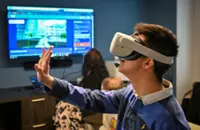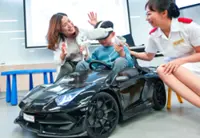
At a university auditorium in Kuala Lumpur, taekwondo athletes Gan Jing Yuan and Asadullah Mohamed Azvi prepare for a kyorugi, or sparring showcase. Their coach and manager, Master Tony Lee Chun Wah, reminds them to maintain proper distance.
The pair will go through three one-minute rounds, aiming to land clean, scoring strikes on each other.
Gan, a 20-year-old computer science student at Asia Pacific University of Technology & Innovation (APU), has been practising taekwondo since childhood. But at 14, she says that an ankle injury sidelined her from sparring, which is a contact-heavy discipline for athletes to earn points by landing strikes.
Today’s showcase is different.
Gan can return to sparring without risking injury, as her opponent’s strikes don’t land physically. Instead, the match takes place in a fully digital arena.
Welcome to VR taekwondo – where fighters gear up with headsets, motion sensors and joysticks to take down their opponents in a virtual arena.
Game on
When he first heard about VR taekwondo, Lee says he was immediately accepting of the concept.
“I’ve been involved in teaching taekwondo at university level for a long time so I had a sense that this will become a trend. As there is a lower risk of injury, I believe more parents would be more accepting to let their children participate in taekwondo if sparring is limited to VR,” he says during an interview with StarLifestyle in KL.

He also considered the growing popularity of esports among youth, recognising that digital competitions have become a mainstream way for young people to engage and challenge themselves.
“I realised it was time for me to step in and learn this new approach,” he adds.
Lee describes VR taekwondo as a “new baby in Malaysia” where some local clubs started introducing the practice to members last year.
“In VR taekwondo, you don’t just play the game from a smartphone or screen. You have to step into the game. I always say, ‘Don’t let the game play you. You play the game’. You have more control,” he says.
According to Lee, who coached the Malaysian team at the first World Taekwondo Virtual Championships held in Singapore last year, a Malaysian athlete made it to fourth place in one of the categories.
Get in the game
Each player dons a VR headset and holds two joysticks for blocking, while five body-mounted nodes track their movements: one on the back for upper-body actions and two on each leg to register every kick.

With the VR headset, players can see and face their opponents in a virtual setting. The objective is simple: land as many kicks as possible to deplete the opponent’s health bar, just like in arcade-style fighting games. Outside of the virtual arena, players can’t come into contact with each other.
“A referee will remind players to maintain their distance or pause the game to separate them if needed. They are also instructed not to touch their headsets during the match, as doing so could be used to force a technical issue and get a rematch,” Lee says, adding that it may be considered a form of cheating.
For example, he explains, a player on the losing side could attempt to trigger a rematch in order to start over.
When the match starts, players launch as many kicks in the air as they can, aiming to land virtual strikes on their opponent. Each successful hit reduces the opponent’s health bar.
As the match unfolds, spectators can follow every move on a large screen, with the action projected in real time for everyone to see.
The player with the most points or the fullest health bar remaining at the end is declared the winner.
If a player manages to completely deplete their opponent’s health before time runs out, the match ends immediately.
“That’s a knockout. For advanced training or for players who want to represent Malaysia at the national level for VR taekwondo, I require them to knock out their opponent in less than 30 seconds.
“So far, the fastest knock-out I’ve seen is from a 14-year-old player who did it in 10 seconds,” Lee says.
Levelling the playing field
Traditionally, competitors are separated by gender and weight to ensure fairness and safety. Lee says VR taekwondo changes this dynamic, allowing mixed-gender matches where players compete only within their age categories.
“That’s because there’s no contact,” he explains.
In the showcase match, Asadullah lands a knockout in the third round. The final score is generated by the system, which then declares him the winner – a process that Lee says helps remove human bias.
Despite the match being virtual and contact-free, Gan needed time to catch her breath and was sweating profusely.

Asadullah says that fighting in VR can feel even more taxing than a real physical fight.
“In a non-virtual sparring match, you take more time to read your opponent before delivering any hit. Each move is more calculated. But in VR, you can start hitting your opponent right away and have to keep kicking rapidly in one minute to increase your winning chances. I would say it’s more intensive,” says Asadullah, who is also a computer science student at APU.
Lee can be heard reminding Gan and Asadullah to focus on building their stamina.
Last July, the pair competed in the 2025 Virtual Reality Taekwondo Championship, an inter-university tournament featuring 19 teams. Both walked away with gold medals in the Young Adult (18–21) categories, with Gan taking the female title and Asadullah the male.
“Winning feels great and rewarding, considering that we didn’t have much time to train due to exams at the time,” says Gan.
Technical requirements
Lee explains that it took him a month to study the technical aspects of VR taekwondo. The software, called VTKD, was developed jointly by Singapore-based Refract Technologies – a company specialising in immersive sports solutions – and World Taekwondo, the international federation governing the sport.
In July, Lee attended a VR taekwondo technical certification course organised by World Taekwondo in South Korea.
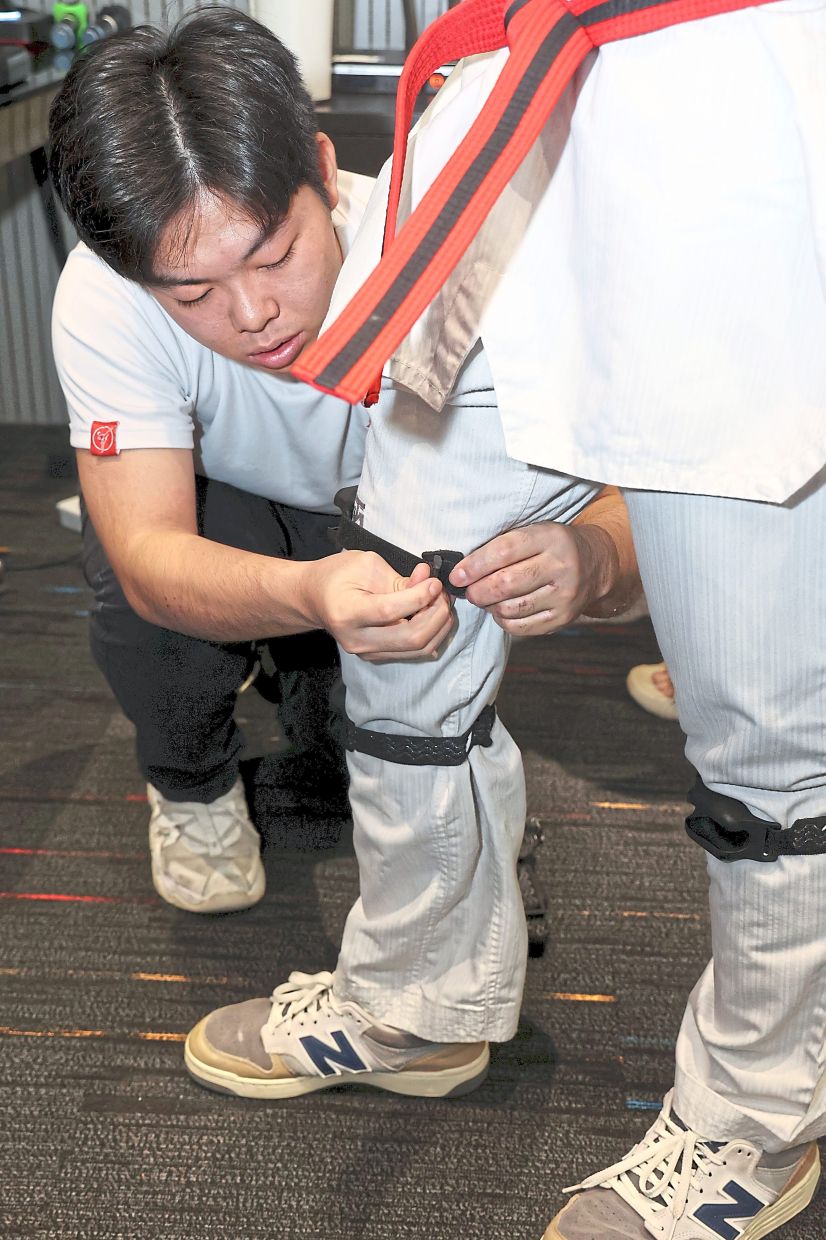
“You have to take a qualification course to be a certified VR taekwondo technician where you do both written and practical tests such as on how to operate the equipment, calibrating sensors, gears and be adept at problem-solving,” he says.
Lee says during competitions, technicians have about one minute to finish calibrating the gear for players. He explains that if a technical problem happens mid-match, the round may be paused or restarted.
“If the issue can’t be resolved, we then determine the winner by looking at the remaining health bar,” he adds.
As with some forms of technology, Lee says one of the main hiccups is related to connectivity or as he calls it “Internet problem”.
“The software will display connection issues and technicians have to figure out if any hardware needs changing or if we need to switch to another Internet service provider. We have to use WiFi 6 standard or above to achieve the smoothest gameplay. We also have set up our own portable router,” he says.
He adds that there is a standard operating procedure or SOP to configure the gear.
“You check the nodes, inspect the motion trackers, make sure the lights are working, and check the headset and cables. That’s how we make sure everything runs smoothly,” he says.
Safe space
Master Bhaskar B. of Scorpion Taekwondo Academy Malaysia in KL sees how technology like VR is changing sports training.

“Plus VR provides a safe space for beginners to practise without fear and it has motion tracking to help students correct their techniques,” he says when contacted by StarLifestyle.
During an introductory VR taekwondo session on Nov 30, which involved participants aged five and above, Bhaskar says participants get to experience virtual kicking, blocking drills, participate in speed and accuracy challenges as well as basic sparring simulation.
“Some of the most memorable feedback is when a few of the kids say, ‘This feels like playing a game, but I’m actually learning!’ In fact, I see them doing more workouts in VR because they are performing more kicks,” says Bhaskar.
He says parents appreciate the safer training aspect, especially for beginners, while older students mention that the real-time correction helped them understand their mistakes more clearly.
He adds that the academy plans to gradually incorporate VR into selected training sessions.
Taekwondo Malaysia vice-president 1 and Kedah Taekwondo Association president Grandmaster S. Krishnamurthy Suranna understands the appeal of VR taekwondo for younger participants.

“It’s like a video game but you have to perform actual movements to gain advantage over your opponent. We’re also hoping to attract more older participants who can think of this as a way of improving their fitness,” he says.
S. Krishnamurthy further adds that taekwondo clubs in Kedah like Changlun Star in the Kubang Pasu district have already incorporated VR taekwondo for training for more than a year.
He adds that Taekwondo Malaysia along with the Youth and Sports Ministry are looking to send two athletes to the next international virtual taekwondo competition in 2026.
“I believe it will be hosted in South Korea. The athletes will be based in the National Sports Council for training,” says S. Krishnamurthy.
Mind games
According to S. Krishnamurthy, a VR taekwondo set for two players can cost around RM15,000 to RM20,000 while Lee says the setup including television screens and gaming laptop can cost between RM25,000 and RM30,000.
“You need a gaming laptop to support the system, otherwise there will be lag and the program can’t run smoothly. A substantial investment may be required,” Lee adds.
Bhaskar declines to provide the cost of the set that his academy prepares for the students.
“I’m not able to share the cost details, but what I can say is that our decision wasn’t based purely on price. We chose a setup that aligns with our training goals and provides a meaningful learning experience for our students,” he adds.
Bhaskar says there is potential for VR to be a regular supplementary training tool.
“Traditional practitioners may take time to adapt, but many will realise that VR is not replacing real training. It is enhancing it. VR cannot replace physical sparring, discipline, or traditional techniques, but it can improve accuracy, increase engagement and help coaches analyse performance,” he adds.
Lee says some traditional players still prefer the physical method of sparring because they need to establish contact to feel the speed or force.
“It’s not easy to change the mindset of some traditional practitioners. But I am now 55 (years old) and I believe it’s never too late to change or learn to adapt with new technology.
“At the end of the day, I would say that this is still a sport where you’re expected to be active, work up a sweat and feel the physical strain,” says Lee.