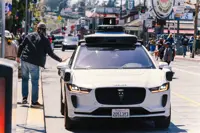
A slew of companies have sprung up to make the smarts, sensors and other integral systems for self-driving cars. Here comes one to tell these cars where to go.
Startup RideOS said that it has raised US$9mil (RM36.04mil) led by venture firm Sequoia Capital and reached a partnership with a division of Ford Motor Co. Started by two former Uber Technologies Inc employees, RideOS plans to sell software that gives routes and other dispatching instructions to fleets of autonomous cars. Add RideOS to a mounting list of companies competing to create markets around the nascent technology, which continues to reel in investment.
Most of these companies are building tools to make driverless cars a reality. RideOS, based in San Francisco, is aiming for the future when they are on the roads and need to navigate p hysical hurdles. When a car encounters road construction, for example, the software would warn others in the fleet, or it could call for a small sedan in some circumstances and a bigger car in another.
“It's kind of like an air traffic control center for all of these different vehicles,” said RideOS co-founder Justin Ho. “That entire [operating system] hasn't been built. It's just green field.”
Ho spent three years on corporate development for Uber's mapping and autonomous driving division, where he met his co-founder, Chris Blumenberg, an Apple Inc. software veteran. For an initial partner, the pair picked Autonomic, a subsidiary of Ford. Autonomic makes back-end software connecting cars to other devices, letting someone unlock a vehicle with a mobile app, for instance.
Autonomic and RideOS plan to produce a software product together, although they declined to say when. “We did look at several other companies, very established ones,” said Gavin Sherry, Autonomic's chief executive officer. That includes navigation incumbents TomTom NV and HERE. But, for routing, Autonomic bet on the newcomer.
The partnership gives Ford another toehold into transit services, a market it has tried to enter. In the race to create robot taxi services, the automaker lags behind General Motors Co and Alphabet Inc’s Waymo in investment but remains confident in its approach.
RideOS expects to work with several more automakers as well as ride-hailing services. Like Waze, the popular driving navigation app, the startup can benefit from a “network effect”, said Mike Vernal, the Sequoia Capital partner who led the investment. The more cars that use its routing and dispatching service, the better the offering becomes.
It’s similar to the booming field of companies providing “high-definition” maps that let self-driving vehicles see lanes, curbs and other objects on the road. But RideOS is not focused on spotting the road; it plans to work with these mapping providers. Instead, the company’s service would guide self-driving cars to handle road scenarios and interact with vehicles driven by humans.
Yet RideOS is entering a field with gobs of money and a reluctance to outsource critical assets. Tech website The Information first reported on the formation of RideOS. Other self-driving companies, such as Aurora, raised 10 times as much as RideOS in a similar financing period. Several people in the industry suggested that self-driving companies and ride-hailing firms, like Uber and Lyft, are likely to handle their own mapping and routing if they launch autonomous fleets.
Still, RideOS could have luck with traditional automakers, like Ford, that are interested in automated taxi services but have less software expertise. “Google has no experience with solving the multifaceted nature of routing,” said Brian McClendon, the former director of mapping for Uber and Google, who’s now an investor and adviser to RideOS. Uber has more of a technical edge with this skill, McClendon said, but the company is unlikely to offer routing services to competitors.
RideOS isn’t set on selling just to self-driving fleets, either. Blumenberg, its technical chief, noted how the electric scooters that have flooded San Francisco need routing services as well. These scooters advise riders not to take large hills, but have not way to enforce that for now, making them a potential RideOS customers. “Any type of next generation transport you can think of, we're there,” Ho said. — Bloomberg
Already a subscriber? Log in
Get 20% OFF The Star Digital Access
Cancel anytime. Ad-free. Unlimited access with perks.