


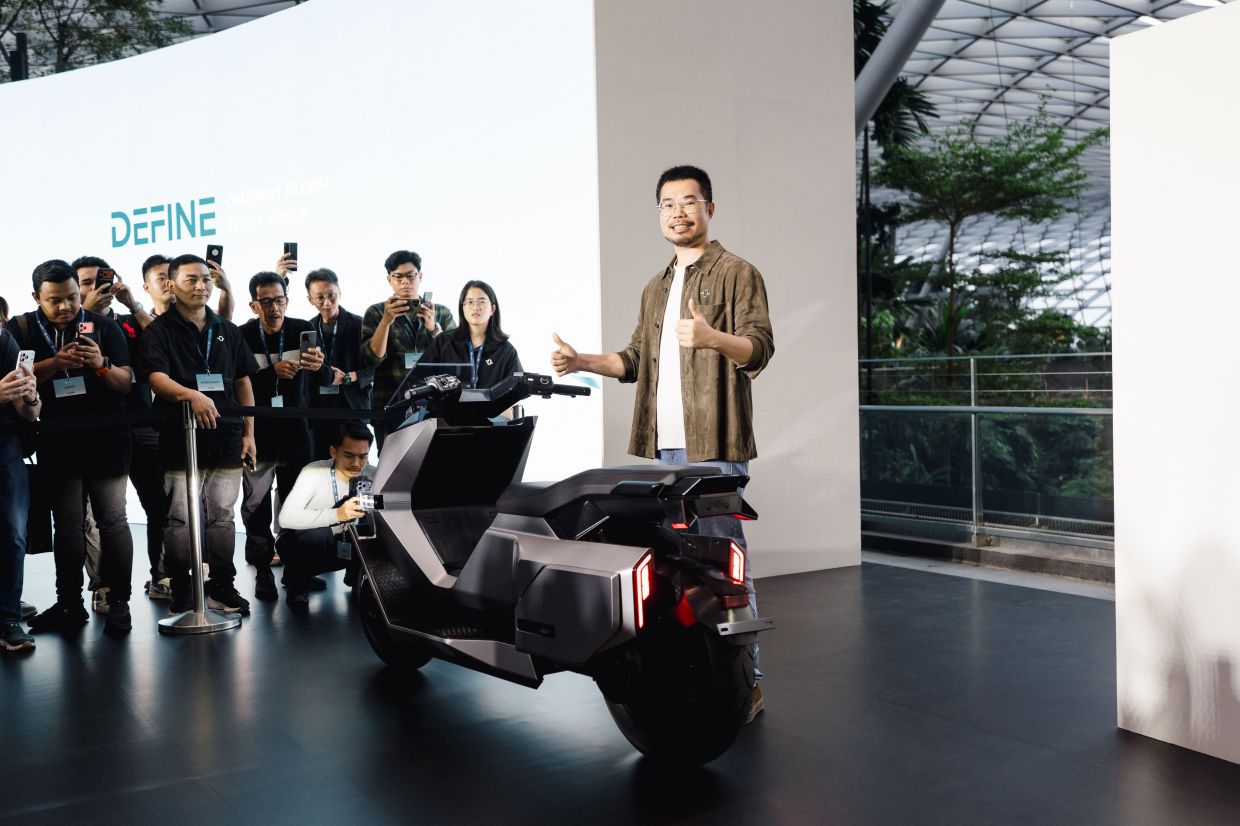
IN the fast-paced world of tech, it takes a lot to truly surprise an audience. But sitting in the crowd at Omoway’s global launch in Singapore, the atmosphere in the room shifted the moment the Omo X rolled onto the stage.
It didn’t have a rider on. It didn’t have a kickstand in the down position. Yet it simply stood there, perfectly balanced, rolling to a stop as if waiting for further commands. Before long, a kickstand slowly was deployed and the entire motorcycle shifted to lean on that in a typical resting position.
For the everyday rider, the implications of this technology could fundamentally change the daily commute.
City commute realities
For anyone who has endured the gruelling, stop-and-go crawl of heavy morning traffic or navigated sudden, treacherous downpours on a long stretch of highway, riding a motorcycle is as much a test of physical endurance as it is a mode of transport.
The heat, the constant balancing act, the exhaustion of putting a foot down every three seconds in a traffic jam – it takes a heavy toll.
Motorcycle purists might argue that a self-balancing motorcycle ruins the raw, mechanical joy of riding.
But let’s be honest: there is very little joy in inching through a 45-minute traffic jam in the sweltering heat.
Importantly, this self-balancing technology acts as an advanced riding assistant. It isn't a mandatory override; riders can choose when to engage the system, preserving the traditional thrill of the open road for the weekend while relying on the tech for exhausting traffic jams.
For the everyday commuter or the delivery riders who rely on two wheels for their livelihood, it’s about choosing safety, comfort and peace of mind over physical exertion.
How it works
So, how does a heavy motorcycle stay upright on its own? It comes down to the Omo-Robot Universal Architecture, combining a ‘Full-Stack Brain’ and a ‘Digital Cerebellum’.
As Omoway’s founder Todd He noted during the launch, "Intelligence truly serves humanity only when it is embodied.”
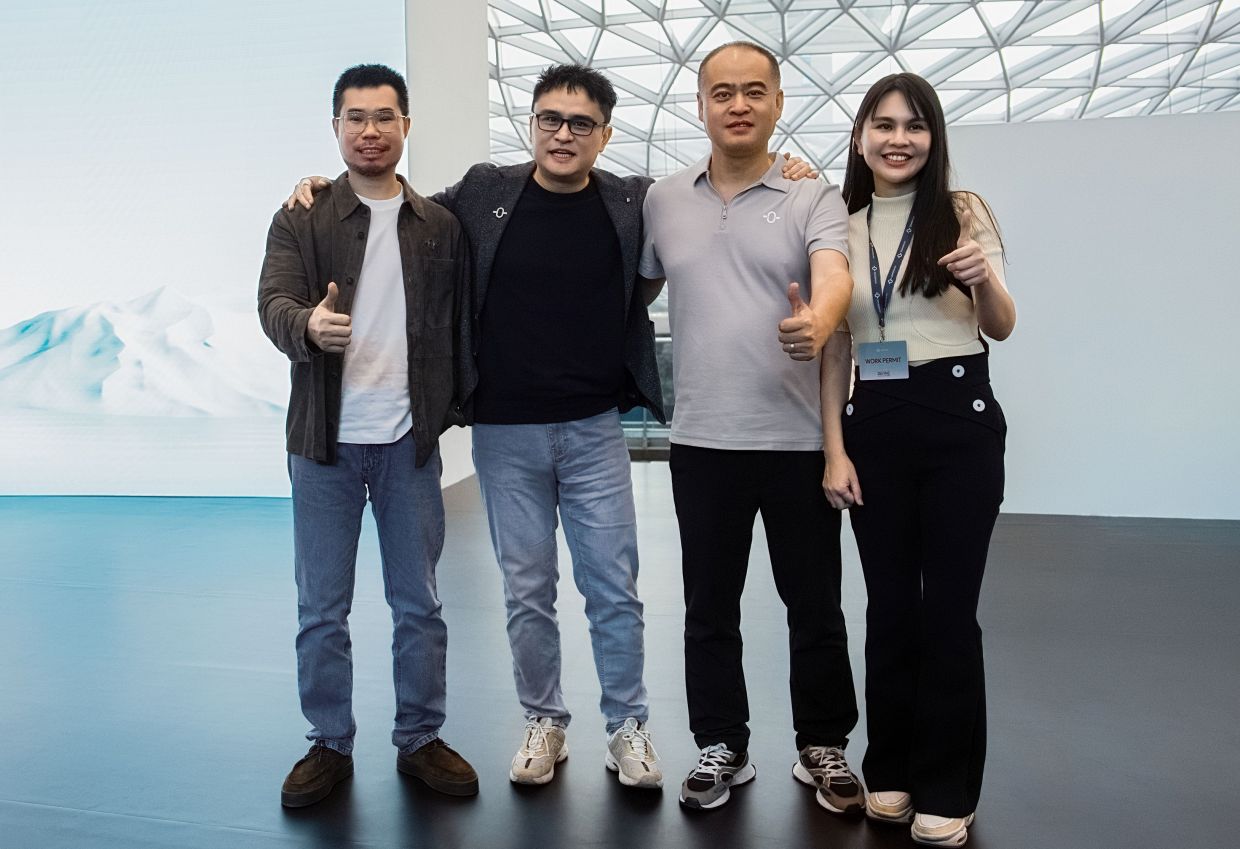
This architecture gives the machine four human-like instincts:
> See with insight: A 360° camera system constantly scans the road and predicts what is going to happen next.
> Think in depth: An AI model, honed through millions of virtual simulations, makes split-second safety decisions.
> Act with precision: A system that seamlessly coordinates the motors, brakes and gyroscopes to keep the motorcycle physically stable.
> React with lightning speed: An internal electrical/electronic network that ensures zero delay between the cameras spotting an obstacle and the wheels reacting to it.
For the rider, this means the motorcycle actively intervenes to prevent slips on wet surfaces, assists through sharp curves and executes emergency obstacle avoidance.
Because the system needs to precisely sense and control the motorcycle at all times, Omoway product manager Nick Yu shared that the company looked to the aerospace and shipping industries for inspiration.
They equipped the motorcycle with an aerospace-grade Control Moment Gyroscope (CMG) – the exact technology used to keep satellites oriented in space or stabilise massive ships, where safety requirements are exceptionally high.
Much like a rapidly spinning top that naturally resists falling over, Yu explained that the CMG acts as the motorcycle's ‘core muscle group’, giving it the physical strength to counteract the urge to tip over without draining the battery or compromising riding range.
The motorcycle that learns
Perhaps the most fascinating aspect of Omoway’s technology is its ‘Embodied Intelligence’. The Omo X doesn't just react to commands; it understands its environment.
Much like a child learning to stand, the AI starts its life in a virtual simulation. Omoway places thousands of virtual units in simulated environments, ranging from city streets to off-road trails.
Every future scenario is rehearsed in this digital matrix long before the motorcycle hits a real road.
But the learning doesn't stop once the motorcycle is purchased. Omoway has a continuous safety improvement loop: If a unit encounters an extreme physical state – say, the ABS triggers on an oil slick or the motorcycle experiences high G-forces and an extreme lean angle – it records those few seconds of data.
This data is sent to the cloud, where the exact scenario is replicated virtually. The AI learns from the event, determines the safest possible response, and then sends a software update back to every motorcycle on the road. Every lesson learnt by one rider is instantly shared with the entire fleet.
One motorcycle, three forms
Packing this level of aerospace and AI technology into a consumer product is a massive feat, and to be able to fit that into a futuristic chassis with notes of a minimalist starship aesthetic is likely why the Omo X recently won the prestigious 2026 German iF Design Award.
It is proof that complex autonomous stability can be integrated into an eye-catching form.
Adding to its urban appeal is its modular design. The Omo X is essentially a shape-shifter. Starting with the base scooter mode, riders can add a middle storage box to take on a more sporty street motorcycle form.
Attach the middle, side and tail boxes and it transforms into a cruiser, expanding storage for weekend trips or long-distance rides.
Pre-orders for the Omo X open in Indonesia in late April, with a full market debut in Jakarta in late May. But the motorcycle is just the beginning.
Delivery robot of the future
Omoway’s vision extends far beyond the highway. Along with the electric motorcycle, the company unveiled its vision for a multi-purpose two-wheeled robot – the Mobility One – that is set to redefine urban logistics.
Inheriting the exact same self-balancing ‘brain’ and obstacle-avoidance capabilities as the Omo X (which have been proven over millions of miles), the Mobility One is a driverless, modular robot designed for ‘all-road agility’.
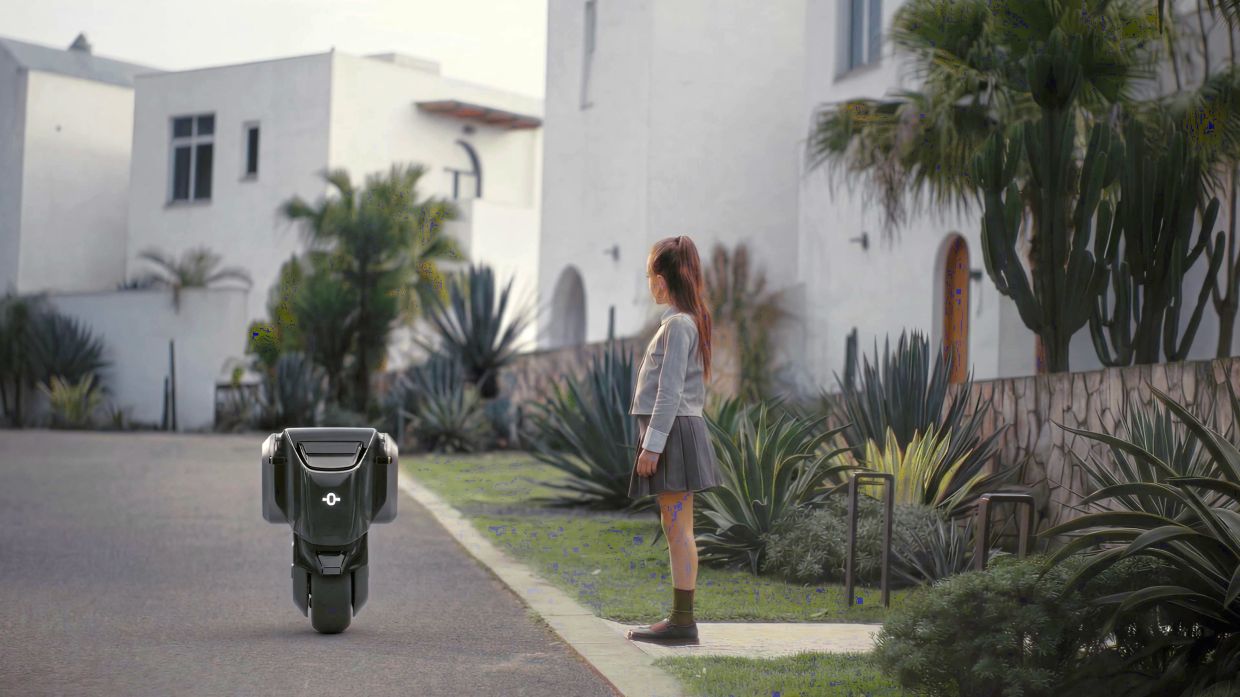
Compared to bulky four-wheeled robots that may be stopped by a narrow gate, the Mobility One is programmed to navigate narrow alleys and glide through doorways to arrive at its final destination.
The company also showcased plans to allow two units to connect to increase cargo capacity. This adaptability allows the robot to be seamlessly reconfigured to meet the evolving needs of daily life, bringing intelligent design into homes, workplaces and communities.
A smarter generation of transport
Omoway’s goal is not just about building a better motorcycle. Its aim is to leverage this self-developed balancing technology to enable a smart life for everyone, across all life scenarios.
Watching the Omo X balance silently on stage, it becomes clear that the future of urban transport is shifting.
By trading physical exhaustion for intelligent assistance, the era of the kickstand might just be making way for something much smarter.
For more information, visit the website.


