
OPEN University Malaysia (OUM) recently launched the Southeast Asian Manifesto on the Humancentric Application of AI Technologies in Education, a regional intervention that calls for more deliberate, ethical and context-sensitive approaches to the use of artificial intelligence (AI) in education.
Malaysia’s ambition to position itself as an “AI nation” by 2030 is commendable and supported by state policies that encourage the responsible and ethical development of AI.
Yet, despite this policy intent, there remains a marked lack of sustained questioning on how AI is being adopted and deployed, underscoring the need for the manifesto.
Too often, AI is treated as a self-evident good rather than as a set of choices that demand critical scrutiny, including why it is being introduced, for what purposes and in whose interests.
Without such interrogation, it becomes easy to lose sight of what AI is meant to serve, who benefits from its use and what forms of education and social value are ultimately being prioritised.
The manifesto responds to this unquestioning orientation by insisting that the use of AI in education must be guided by clearly articulated human, ethical and pedagogical purposes.
Crucially, it argues that such commitments cannot remain at the level of principle or rhetoric but must be embedded in concrete practices.
Rather than focusing narrowly on technological capability, the manifesto redirects attention to a more fundamental question: what education is for, and how digital tools might support those aims without undermining them.
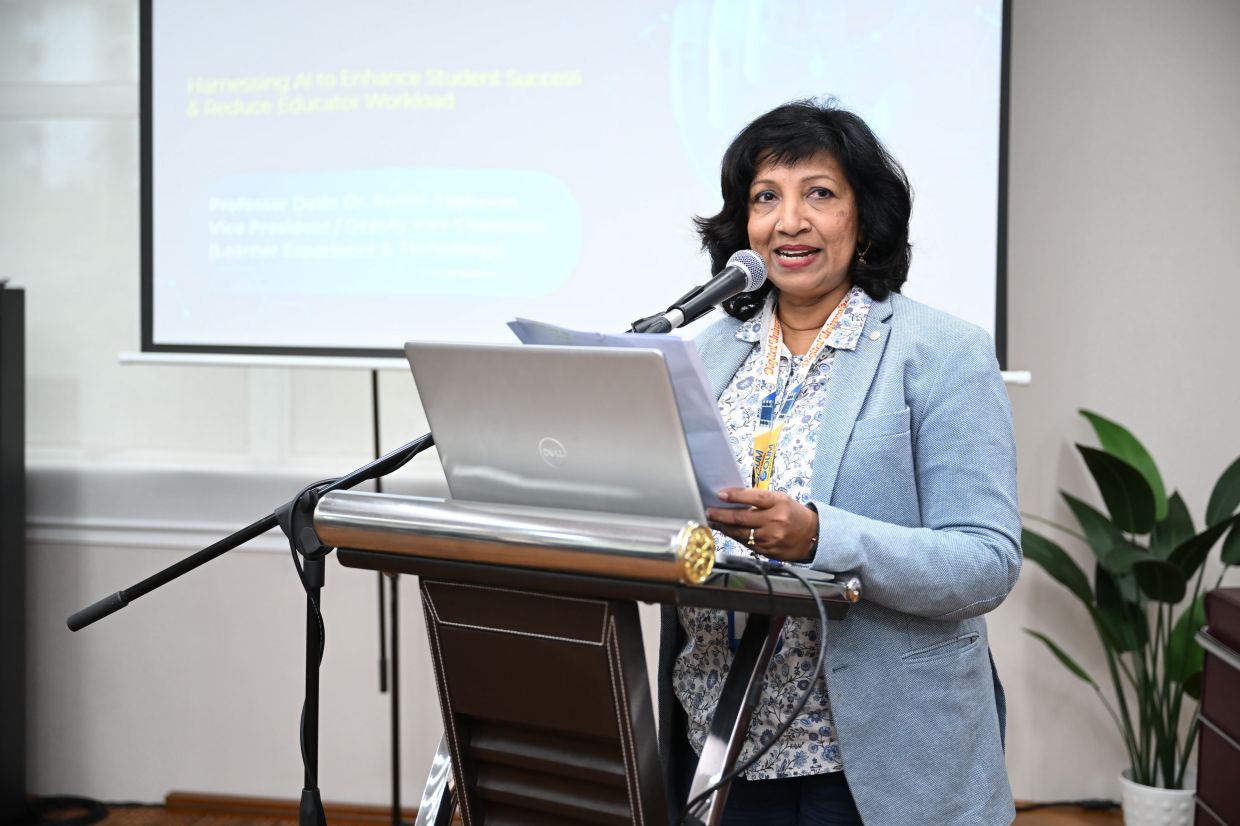
According to OUM president and vice-chancellor Prof Datuk Dr Ahmad Izanee Awang, national and global ambitions must be matched by clear institutional missions and evolving approaches to the management of powerful AI technologies, balancing innovation with accountability and governance.
While the drive towards AI reflects important foresight, what is required of educational institutions is not a simplistic embrace of technology, but its critical and context-sensitive application.
In this view, progress is measured not by speed of adoption, but by the quality of judgement exercised in deployment.
The manifesto further develops this position by arguing that AI should never be treated as a substitute for professional judgement, institutional responsibility or social deliberation.
It calls for careful attention to questions of equity, accountability, governance and data sovereignty, especially in educational settings where decisions have long-term consequences for learners.
These principles inform OUM’s leadership in human-centric AI in education, which is enacted through ethical engagement and transparent practices across how AI is developed, governed and applied within the university.
OUM vice president and deputy vice-chancellor Prof Datin Dr Santhi Raghavan, who is responsible for the university’s learner experience and technology, observed that technological interventions applied without sufficient critique may obscure educational realities rather than address them.
This is particularly the case when deeper structural and social challenges are mistaken for technical problems.
These concerns are especially pronounced in South-East Asia. The region is characterised by wide disparities in technological accessibility, infrastructure, financial and human resources and institutional capacity.

Educational systems operate within diverse cultural and economic contexts, many of which cannot be addressed through imported technological templates or one-size-fits-all solutions.
Uncritical adoption of AI therefore risks entrenching inequality and marginalising local knowledge and practices.
The manifesto positions the region as an active site of reflection and knowledge production rather than a passive recipient of global technological trends.
It foregrounds regionally grounded perspectives that take lived realities, historical conditions and future aspirations seriously.
By pairing innovation with critique, the manifesto creates space for more inclusive and contextually grounded conversations about AI in education.
For Assoc Prof Dr David Lim, the intent of the manifesto is deliberately modest yet principled.
As director of the OUM think tank, the Centre for Digital Education Futures (CENDEF), he characterises the manifesto as a thinking person’s compass for the critical application of AI in education, one that calls for critical reflection on how and why AI is introduced, and to whom its benefits ultimately accrue.
As a leading provider of digital education, OUM recognises that shaping sustainable digital futures cannot be borne by any single party alone.
It requires the participation of educators, policymakers, industry actors, civil society and the wider public.
The manifesto is offered as an open invitation for reflection, dialogue and collective endorsement of shared principles aimed at guiding, rather than dictating, the role of AI in education.
For more information, the manifesto is available for public reading and endorsement at cendef.oum.edu.my/sea-manifesto/.