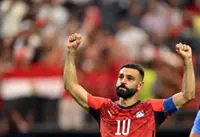
CAIRO, July 6 (Reuters) - Egypt's Mohamed Salah has spent much of his international career carrying the expectations of a football-mad nation while enduring World Cup disappointment, Africa Cup of Nations heartbreak and public disputes with the country's FA.
Now, whatever happens against Argentina in Tuesday's World Cup last-16 clash, the outgoing Liverpool forward has finally produced an achievement that had long eluded him and Egypt.
By captaining the Pharaohs to the knockout stage for the first time, Salah has secured a place in their football history. Before the finals, Egypt had never won a match at the World Cup.
The emotion of that breakthrough was evident after Friday's shootout victory over Australia in the round-of-32 clash.
Salah was in tears at the final whistle before embracing teammates and thanking supporters, a release after years of near-misses and criticism over Egypt's failure to translate his individual brilliance into tournament success.
"It's history," Salah told reporters.
"I told the boys before the game, 'Guys, this is the biggest stage you could play in your life. So just enjoy it. Don't let the pressure get into you and not enjoy the moment.' I'm glad that we managed to win the game."
LEADING CELEBRATIONS
The celebrations have continued well beyond the pitch.
After each of Egypt's victories, Salah has been at the centre of the festivities, carrying a portable speaker as teammates sang and danced in the dressing room before taking the celebrations onto the street outside the team's hotel.
The scenes have become one of the defining images of Egypt's World Cup campaign, reflecting a captain visibly enjoying an international success that had long proved elusive.
He has matched that leadership with his performances on the pitch. Despite battling a hamstring strain suffered in the group stage, Salah has scored, provided two assists and created 16 chances in four games, underlining his influence on Egypt's run.
Against Australia, the 34-year-old played all 120 minutes before calmly converting a Panenka penalty in the shootout.
Asked how he kept his nerve before taking the spot kick, Salah said: "If somebody will do it in the game, it would be me, more experienced than others, and I just want to give them confidence.
"I decided last minute probably. I don't know if that's my last World Cup or not, but I had to do it."
Salah's Egypt career has often been defined by disappointment despite his status as one of the world's leading forwards.
He scored the penalty that qualified Egypt for the 2018 World Cup after a 28-year absence, only to arrive in Russia carrying a shoulder injury sustained in the Champions League final weeks earlier as the team exited in the group stage.
Egypt also lost Africa Cup of Nations finals in 2017 and 2021 during his tenure, while Salah was involved in several public disagreements with the Egyptian FA over issues including image rights, travel arrangements and the team's management.
His willingness to play through injury against Australia has earned widespread praise in Egypt, and he now has another chance to add to his legacy against Lionel Messi's Argentina.
Whatever the outcome, Salah has already changed the narrative around his international career, leading Egypt to a World Cup run that generations of his predecessors were unable to deliver and providing the international success that had long been missing from one of football's most decorated careers.
(Reporting by Hatem Maher; Editing by Ken Ferris)