DESPITE opening up to the world fairly recently, Filipino martial art Pekiti-Tirsia Kali (PTK) has become a revered self-defence system used by many law enforcement and military forces around the world.
Although the PTK system was founded by the Tortal family in 1897, the Filipino martial art dates back to as far as during the colonisation of the Philippines in the 16th century, where it was used by locals to protect themselves and fend off intruders.
Key to the practitioners are its values – to believe in life, good health and success.
Locally, PTK Katipunan Malaysia principal instructor (Agalon) Tan Khong teaches the self-defence art to a small group of students who learn to use rattan batons followed by training weapons and finally, their bare hands.
Tan said the martial art focuses on practical and situational self-defence, and that to learn it, participants first need to develop good footwork during the first two months.
“After that, for between three and six months, I teach them how to use the sticks before they are allowed to use training weapons and then move on to the final stage where we train with just our hands.”
He said when most people think of Filipino martial arts, they usually think of arnis and escrima, and not kali.
“With PTK, the main difference is that we don’t disarm the attacker’s weapon or even block it. Instead, we use deflection and focus on footwork that counters attack.”
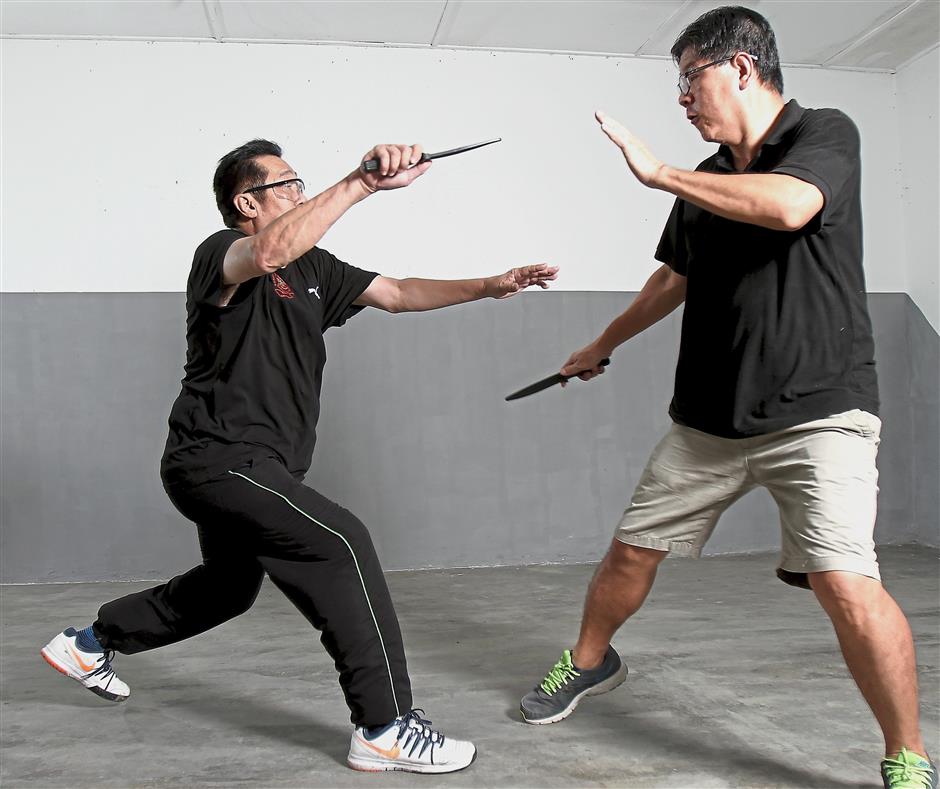
Footwork is key too, as the quick reflexes require a stable pose from where each movement starts and ends.
For the small group of around 10 middle-aged students, the training equips them with a skill that can be useful to them or their loved ones at the worst of times.
The beauty of the system, according to Tan, is that there are no fixed techniques to learn, so whatever the students pick up during training can be applied easily.
“Instead of focusing on techniques, we stress on the principle of a particular way of doing things.
This means there are no fixed moves and the choice of actions is up to the person.
“It is like teaching them to think and react in a self-defence situation instead of trying to remember techniques.
Tan, who travels to the Philippines to train with his teacher Tuhon Michael Alcaraz, has also had opportunities to train with the Philippine Army Scout Rangers. He has also trained community policing groups on the basics of the martial art.
He said PTK Katipunan Malaysia is in the midst of forming an association in anticipation of PTK Pilipinas launching its Junior PTK programme, which aims to impart the philosophy and principles of PTK.
Already a subscriber? Log in
Get 20% OFF The Star Digital Access
Cancel anytime. Ad-free. Unlimited access with perks.