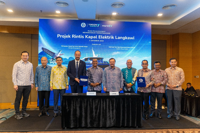
THE announcement that Yinson GreenTech and Langkawi Port have signed a memorandum of understanding to pilot Malaysia’s first commercial open-sea, fully electric passenger ferry service is an important milestone for the country’s maritime sector, “Yinson GreenTech, Langkawi Port ink MOU to pilot open sea electric ferry in Langkawi” (StarBiz, The Star, Oct 1).
When we talk about the future of maritime transport, we naturally think about reducing emissions, alternative fuels, electric and hybrid vessels, digitalisation and autonomous ships.
But technological change also creates new regulatory, operational and human-capability challenges. The question is whether Malaysia’s maritime ecosystem is evolving quickly enough alongside the technology.
First, we need a future-ready regulatory framework. The Transport Ministry’s work to review and modernise Malaysia’s maritime laws is important. The challenge, however, is not simply to update legislation that may have been written for an earlier generation of ships.
We need to ask what regulatory framework will be required for the vessels of tomorrow. How should electric passenger vessels be regulated? What happens when vessels increasingly depend on software, sensors, communications and remote control systems?
And how do we regulate autonomous vessels when the traditional concept of a ship’s crew and master begins to change? These are not theoretical questions. The Langkawi project itself demonstrates how quickly several of these technologies can converge in one vessel.
Second, regulation must be matched by technical and enforcement capability. Marine inspectors, surveyors and enforcement officers will increasingly encounter technologies that were not part of their traditional training.
This does not mean every regulator needs to become a software engineer. But the maritime regulatory system will need access to the right multidisciplinary expertise.
There is also an opportunity here for closer cooperation between government, classification societies, industry and universities to develop the necessary technical capabilities.
Third, infrastructure must evolve with the vessels. An electric ferry cannot operate simply because an electric vessel exists. It needs reliable shore charging, adequate grid capacity, appropriate electrical infrastructure, emergency response arrangements and operational procedures.
The same principle applies to other alternative fuels. If Malaysia wants to encourage low-carbon shipping, where will these fuels be produced, stored, transported and bunkered? Is the electricity used for maritime charging increasingly sourced from low-carbon generation?
The transition therefore involves much more than the vessel; it involves the entire shore-to-ship ecosystem.
Finally, we need the right people. Our universities, maritime academies and training institutions must continually update their curricula. The maritime professional of the future will need to understand not only naval architecture and marine engineering but also batteries, alternative fuels, automation, data, cybersecurity and human-machine interaction.
Malaysia has strong universities, maritime institutions, professional bodies and an established maritime industry. The challenge is to bring these capabilities together before the technology becomes widespread.
Malaysia’s maritime future will not be determined by technology alone. It will depend on whether regulation, infrastructure, enforcement capability and human capital develop together.
DR OMAR YAAKOB
Adjunct professor
Marine Technology Centre
Faculty of Mechanical Engineering
Universiti Teknologi Malaysia (UTM)
Already a subscriber? Log in
Get 20% OFF The Star Digital Access
Cancel anytime. Ad-free. Unlimited access with perks.