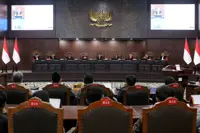
I WAS present at the Palace of Justice in Putrajaya on the morning of Feb 9, 2024, listening as Malaysia's Chief Justice, Tun Tengku Maimun Tuan Mat, read the concise and comprehensive summary of the majority judgement in the petition challenging the constitutionality and legality of 18 provisions under the Kelantan Syariah Criminal Code Enactment (1) 2019. From the very beginning of the ruling, Tengku Maimun emphasised the Federal Court's commitment to upholding the Constitution and ensuring justice for all Malaysians, irrespective of religion or ethnicity.
Ever since they embarked on this journey in 2022, there has been a lot at stake for petitioners Nik Elin Zurina Nik Abdul Rashid and her daughter Yasmin, who are both lawyers. Their lives have been significantly disrupted, and their personal safety was and continues to be a concern. They decided to do what they did not only because they were concerned about constitutional integrity, but also as a matter of public interest that could potentially affect many who live in this country. It is not an exaggeration to say that the Malaysian people owe these two courageous women – who have been unfairly labelled by some as busybodies – a debt of gratitude for submitting this petition.
At the press conference later held in the Palace of Justice's lobby, Kelantan Deputy Mentri Besar Dr Mohamed Fadzil Hassan lamented over why it had been necessary to challenge these provisions as they had already been on the state books for several years.
This goes to the heart of the problem, which this case vividly demonstrates.
Over the past few decades, in many state legislative assemblies around the country, similar provisions and enactments have been tabled, passed and gazetted into state law by different state governments. These include assemblies in Penang, Perak, and Terengganu, and even the Federal Territories. They cover offences such as incest, sexual harassment, sodomy, vice, acting as intermediaries for certain offences, and destruction of places of worship.
Former law minister Takiyuddin Haji Hassan was correct to point out that Friday's Federal Court judgement is likely to have a ripple effect on related Syariah enactments across the country. Kelantan will now have to drop these provisions as they overlap with existing federal legislation and offences already covered under civil law. Other states must also be prepared to do the same.
The laws overturned by the Federal Court were not determined or ordained by Allah, but were enacted by the Kelantan state legislature for use in the state Syariah Court. Islam was not, and is not, in jeopardy. Neither Nik Elin and Yasmin's case nor the rendered judgement were intended to undermine Islam or "bury" the Syariah courts, as alleged by some senior lawyers. This should not be interpreted as a "victory" over Islam. What this case sought to do was to remind the states not to exceed the powers, mandate, and responsibilities entrusted to them by the Federal Constitution.
The problem is not the Federal Constitution. The Constitution does not need to be amended. It does not need to widen the scope of state powers under the Concurrent List, which both Parliament and Legislative Assemblies can make laws on.
Even the Syariah Judiciary Department concurred with the Federal Court's judgement, saying that the affected provisions exceeded the jurisdiction granted to states, and that state legislative assemblies have a role to play in ensuring that enactments do not exceed the powers provided to them. As emphasised by the Chief Justice, this case never impinged upon Islamic doctrine.
However, for years, these state legislative assemblies, aided by their respective legal advisors, seemed to have wilfully (or unwilfully) taken a collective approach in passing state legislation for offences which are already covered under federal law.
Unfortunately, in response to last week's ruling, there are now those who are calling for a constitutional amendment to be introduced to expand the Concurrent List. Rather than ensuring that state legislative assemblies comply with the Constitution, these people's proposed solution is to amend the List. This would be a mistake.
Surprisingly, there are current Members of Parliament who are now accusing – or gaslighting – others of having a topsy-turvy, skewed, and colonialist interpretation of the Federal Constitution. These MPs appear to be intent on igniting and stoking culture wars by creating fear and insecurity and preying on gaps in public knowledge and understanding. Take a look at family WhatsApp groups.
Worse, the tone of the conversation online seems to question and undermine the bedrock of Malaysia's secular Constitution. In Malaysia, Islam's position is not threatened by secular law but is, in fact, protected by secular law.
Claiming that the Syariah system is weak, disempowered, and threatened is a straw man argument. It distracts from the socioeconomic and everyday issues faced by vulnerable people, creates enemies where there are none, and seeks to create suspicion, distrust and division. The authority of Syariah courts does not need to be strengthened, for it was never weak.
If such MPs really believe that Islam is no longer protected by the Federal Constitution, they should resign in protest.
Many in this country are exhausted by the neverending games of one-upmanship played by political parties that are eroding our civil liberties, especially the civil liberties of Muslim Malays. These politicians continuously need to show that they are the self-appointed defenders, or champions, of the faith. The stairs of palaces are worn down by politicians who claim to speak for the rakyat and in the rakyat's name. Unfortunately, most of them do not have a clue.
In the weeks ahead, those who have been enjoying the schadenfreude watching their colleagues from Kelantan struggle with this new reality will themselves need to look at similar unconstitutional provisions in the states that they control, and repeal them.
On the surface, it may seem that Nik Elin and Yasmin have flipped the table, but what they have actually done is to remind the people and those in power of the responsibility to uphold and strengthen constitutional principles, to build a fair and just society for all Malaysians, and to work towards a more equitable society. This must be demonstrated in both words and deeds.
AZRUL MOHD KHALIB
Kuala Lumpur
Already a subscriber? Log in
Get 20% OFF The Star Digital Access
Cancel anytime. Ad-free. Unlimited access with perks.