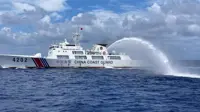
THE Auditor-General's Report cannot be clearer: From 2016 to 2019 - which ranges across the administrations of former prime ministers Datuk Seri Najib Razak and Tun Dr Mahathir Mohamad - China's People's Liberation Army Navy, coast guard and illegal flotilla of fishermen encroached into the Malaysian exclusive economic zone 89 times.
That's not counting how many submarine activities China might have carried out in these waters.
In turn, the Foreign Ministry sent six diplomatic notes to protest China's behaviour.
Unfortunately, it was all to no avail. This is why former foreign minister of Malaysia Datuk Seri Anifah Aman affirmed in a letter to Malaysiakini that the time had come to "form a special committee" to report directly to the Prime Minister.
As ironic as it may seem, this would bypass the Foreign Ministry he once led.
Suggesting the above does not mean that Malaysia does not want to have a good relationship with China. As a trading nation, Malaysia needs China, just as China benefits from trading with Malaysia too.
Be it bird's nest or traditional Chinese medicine, there's enough built-in incentive to enhance the relationship of the two countries.
China is aware that the trade volume between itself and Asean has exceeded that between China and the European Union (EU).
There is no escaping the fact that if China wants to continue to make Asean its critical trading bloc, it has to send true diplomats – not wolf warriors – to talk to Asean and the claimant states of the disputed waters of South China Sea.
“Wolf warriors," for the lack of a better phrase, are those who insist that China is right on every issue. For example, China has the right to encroach into the territories of Malaysia not only 89 times but perhaps 10 times more since these waters fall under China's "nine-dash line" territorial claim in the region.
But in international maritime law, there must be latitude and longitude to form the exact basis of claims. The waves, the currents, even the topography of the sea keep changing. Every negotiator on maritime issues knows this. This is a big ocean with huge currents, not a static geographical area.
Some geopolitical scholars have concluded that to “take the extreme of any position, by all sides, war can be imminent; adopt the scientific and middle road approach, then all sides can thrive, including the tricky Sino-US relationship."
The likes of such scholars understand China's Century of Humiliation (starting around the mid-19th century, during which the country lost almost every war it fought, and was often forced to give major concessions in subsequent treaties) too. However, China must also understand the five centuries of colonialism experienced by South-East Asia.
There is a Chinese saying that all negotiators proficient in Mandarin would know: "When will peace prevail if vindictiveness is never at an end?"
In Malay, there is a saying that goes: "Tak kenal maka tak cinta" (One cannot love what one does not know). It's time to love South China Sea as a global commons, where freedom of navigation is not threatened in any way.
Without this, China and Malaysia cannot set a good example for the rest of the claimant states.
China has ancient wisdom by the shipload with its 5,000 years of history. So does South-East Asia. But with South China Sea's maritime trade estimated to be worth US$5-6 trillion (RM20-25tril) a year, freedom of navigation is a must.
South China or East China Sea cannot belong only to China, in the same way that – as Dr Mahathir once put it – the Indian Ocean cannot belong to India only.
That's not counting how many submarine activities China might have carried out in these waters.
In turn, the Foreign Ministry sent six diplomatic notes to protest China's behaviour.
Unfortunately, it was all to no avail. This is why former foreign minister of Malaysia Datuk Seri Anifah Aman affirmed in a letter to Malaysiakini that the time had come to "form a special committee" to report directly to the Prime Minister.
As ironic as it may seem, this would bypass the Foreign Ministry he once led.
Suggesting the above does not mean that Malaysia does not want to have a good relationship with China. As a trading nation, Malaysia needs China, just as China benefits from trading with Malaysia too.
Be it bird's nest or traditional Chinese medicine, there's enough built-in incentive to enhance the relationship of the two countries.
China is aware that the trade volume between itself and Asean has exceeded that between China and the European Union (EU).
There is no escaping the fact that if China wants to continue to make Asean its critical trading bloc, it has to send true diplomats – not wolf warriors – to talk to Asean and the claimant states of the disputed waters of South China Sea.
“Wolf warriors," for the lack of a better phrase, are those who insist that China is right on every issue. For example, China has the right to encroach into the territories of Malaysia not only 89 times but perhaps 10 times more since these waters fall under China's "nine-dash line" territorial claim in the region.
But in international maritime law, there must be latitude and longitude to form the exact basis of claims. The waves, the currents, even the topography of the sea keep changing. Every negotiator on maritime issues knows this. This is a big ocean with huge currents, not a static geographical area.
Some geopolitical scholars have concluded that to “take the extreme of any position, by all sides, war can be imminent; adopt the scientific and middle road approach, then all sides can thrive, including the tricky Sino-US relationship."
The likes of such scholars understand China's Century of Humiliation (starting around the mid-19th century, during which the country lost almost every war it fought, and was often forced to give major concessions in subsequent treaties) too. However, China must also understand the five centuries of colonialism experienced by South-East Asia.
There is a Chinese saying that all negotiators proficient in Mandarin would know: "When will peace prevail if vindictiveness is never at an end?"
In Malay, there is a saying that goes: "Tak kenal maka tak cinta" (One cannot love what one does not know). It's time to love South China Sea as a global commons, where freedom of navigation is not threatened in any way.
Without this, China and Malaysia cannot set a good example for the rest of the claimant states.
China has ancient wisdom by the shipload with its 5,000 years of history. So does South-East Asia. But with South China Sea's maritime trade estimated to be worth US$5-6 trillion (RM20-25tril) a year, freedom of navigation is a must.
South China or East China Sea cannot belong only to China, in the same way that – as Dr Mahathir once put it – the Indian Ocean cannot belong to India only.
Dr Rais Hussin is a supreme council member of Parti Pribumi Bersatu Malaysia and chairman of Malaysia Digital Economy Corporation (MDEC).
Already a subscriber? Log in
Get 20% OFF The Star Digital Access
Cancel anytime. Ad-free. Unlimited access with perks.