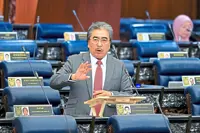
KUALA LUMPUR: Malaysia has called for the conclusion of an effective and substantive Code of Conduct (CoC) in the South China Sea to be expedited and given the highest priority to prevent tensions from escalating and preserve regional peace and stability.
Defence Minister Datuk Seri Mohamed Khaled Nordin said all parties must exercise restraint, avoid actions that could heighten tensions and resolve disputes peacefully in accordance with international law, particularly the 1982 United Nations Convention on the Law of the Sea (UNCLOS).
He said a meaningful CoC was essential to strengthening mutual confidence, preventing miscalculations and safeguarding peace in the region.
“No country stands to gain from a conflict in the South China Sea,” he said during his exchange of views at the 13th Asean Defence Ministers’ Meeting-Plus (ADMM-Plus) in Cebu, Philippines on Thursday (Oct 29).
Mohamed Khaled also stressed that Asean unity and centrality must be respected and upheld, particularly in the grouping’s engagement with its dialogue partners.
He said the ADMM-Plus reflected Asean’s belief that engagement and cooperation, rather than exclusion and confrontation, offered the best prospects for lasting peace.
“Just as Asean respects the interests and perspectives of our Plus partners, we expect similar respect to be extended to each and every Asean member state, without exception,” he said.
He added that the increasingly uncertain international security environment, marked by strategic rivalry, geopolitical tensions and conflicts in various parts of the world, offered important lessons for Asean.
One key lesson, he said, was that when dialogue gave way to confrontation and international law, norms and organisations were disregarded, the consequences extended far beyond the parties directly involved.
Asean must learn from these developments and remain united, exercise restraint and preserve the peace and stability it had worked hard to build, he said.
Mohamed Khaled said Asean’s strength lay not in the absence of differences among its members, but in their ability to manage them through dialogue, consultation, mutual respect and consensus.
He said the principles of non-interference, respect for sovereignty, peaceful settlement of disputes and adherence to international law had guided the regional grouping through difficult times.
On emerging technologies, Mohamed Khaled said artificial intelligence presented opportunities to strengthen defence cooperation but also brought new risks and challenges.
He urged the partners to continue providing practical and meaningful assistance that addressed Asean’s priorities, strengthened member states’ capabilities and enhanced collective resilience.