



RELIGION, in its many forms, has played an important role throughout human history. Whatever one's personal beliefs may be, it is difficult to deny its influence upon the development of societies and civilisations.
Islam is no exception.
The coming of Islam transformed the Arabian Peninsula. It brought together communities divided by tribal loyalties and contributed to the emergence of a civilisation whose achievements in scholarship, philosophy, medicine, mathematics, law, architecture and other fields became part of humanity's intellectual inheritance.
I say this not merely because I am a Muslim. The contribution of Islamic civilisation to world history is well documented. Other religious civilisations, too, have made their contributions to humanity.
But as a Muslim, I am particularly concerned about what we are doing to Islam today.
I was undoubtedly influenced by my Islamic upbringing and increasingly by my own study of the Quran. At the same time, intellectual honesty requires me to acknowledge that there are many interpretations of Islam throughout the world. Muslims themselves have disagreed for centuries on theology, jurisprudence and religious practice.
Differences of interpretation do not trouble me greatly so long as they do not produce hatred, injustice or violence.
Indeed, the Quran itself praises those "who listen to what is said and follow the best of it". That is a remarkable invitation to listen, reflect and exercise judgment.
No human being has a monopoly over God's words. Surely humility requires every Muslim, scholar and layperson alike, to remember the simple qualification Muslims have uttered for generations: Allah knows best.
What's troubling Muslims in Malaysia
What troubles me in Malaysia is something else – the politicisation of Islam.
There is an important distinction between Islamising politics and politicising Islam: the former seeks to bring Islamic values such as justice, integrity and compassion into political life; the latter uses Islam as an instrument for political advantage. My concern here is with the latter.
Religion has increasingly become a convenient political weapon. Quranic verses and religious expressions can be selectively deployed to support one's political position, condemn opponents, frighten voters or portray one group as somehow more Islamic than another.
Politics being politics, politicians will seek advantage wherever they can find it. But there must surely be boundaries when religion is involved.
When Islam is constantly dragged into partisan warfare, ordinary Muslims pay a price.
I want to practise my Islam peacefully. I want to read the Quran, reflect upon it, pray, question, learn and try to become a better human being without being constantly told by politicians, influencers or self-appointed religious gatekeepers whom I must hate, distrust or politically support in order to be a good Muslim.
Increasingly, the noise does not come only from politicians. Social media influencers and, regrettably, even some academics and religious personalities sometimes make statements that inflame suspicion between Malaysians, including among Muslims themselves.
This is where I believe we should understand the Government's concern over the so-called 3R issues – race, religion and royalty. The purpose should not be to suppress legitimate discussion about religion. Religion must remain open to scholarship, debate and thoughtful disagreement. But deliberate provocation, incitement and the exploitation of religious sentiment to generate hostility are something altogether different.
By law of the land
There is also a constitutional dimension that deserves greater attention.
Article 3(1) declares Islam to be the religion of the Federation while expressly providing that other religions may be practised in peace and harmony. Article 11(1), meanwhile, provides that every person has the right to profess and practise his religion.
We usually invoke these provisions when discussing relations between Muslims and non-Muslims. But perhaps we should consider another dimension.
Muslims, too, are entitled to practise their religion in peace.
That peace can be disturbed not only by attacks upon Islam from outside. It can also be disturbed from within – when religion is relentlessly politicised, when Muslims are divided into supposedly "good" and "bad" Muslims according to political allegiance, or when disagreement over politics is transformed into judgment about another person's faith.
Article 11 belongs to Muslims too.
I hope that our judges will consider this dimension too the next time an Article 11 issue comes before the courts: that the constitutional freedom to profess and practise one's religion must surely include, for Muslims as well, the freedom to live their faith in peace, without unnecessary political intrusion, intimidation or interference.
Protecting Islam therefore cannot mean merely punishing those who insult it. It should also mean protecting the religious space of Muslims from those who exploit Islam for political power, personal influence or commercial popularity. We see the consequences even in Parliament, where the politicisation of Islam can sometimes derail or overshadow serious debate on bread-and-butter issues affecting the people. Important questions of governance, the economy, education, healthcare and public welfare should not be displaced by unnecessary religious political theatre.
The Quran does not require Muslims to surrender their minds to the loudest religious voice in the room. It repeatedly calls upon human beings to think, reflect and consider.
Perhaps one of the greatest services we can render Malaysian Muslims today is therefore surprisingly simple: allow them to think, to disagree, to learn and to practise their faith in peace, without politicians constantly turning God into an election campaigner. Islam deserves better than that, and so do Malaysian Muslims.
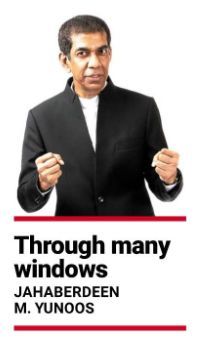
Senior lawyer Dato Seri Dr Jahaberdeen Mohamed Yunoos is the founder and chairman of Yayasan Rapera, an NGO that promotes community-based learning activities and compassionate thinking among Malaysians. The views expressed here are entirely his own.


