Backup protocols needed for potential outages before Jan 1 start
THE much-touted Johor Baru-Singapore Rapid Transit System (RTS) Link is on track to begin operations between Bukit Chagar and Woodlands North.
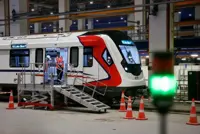
Train trials have begun and all necessary fine-tuning is expected to be completed before operations begin early next year.

The Malaysian Border Control and Protection Agency (AKPS) has allocated about 640 personnel to man this Immigration, Customs and Quarantine (ICQ) Complex alone, apart from some 1,400 stationed at nearby Bangunan Sultan Iskandar Customs, Immigration and Quarantine Complex (BSI).
AKPS director-general Comm Datuk Seri Mohd Shuhaily Mohd Zain was quoted recently as saying that 400 personnel were undergoing training at the Police Training Centre in Segamat, and expected to report to the complex in October.
Both the commander and deputy commander for the RTS ICQ complex are new appointees, coming from Transport Ministry (MOT) and Putrajaya’s Immigration Department foreign passport division respectively.
All staff are expected to undergo familiarisation programmes from October to December, to prepare them for operations at the new facility along with personnel from six other agencies.
They include Immigration, Customs, Wildlife and National Parks, Health Ministry, MOT and Malaysian Quarantine and Inspection Services Department.
The new RTS station will also co-locate Immigration facilities from both countries.
This means Malaysian and Singaporean Immigration officers will operate within the same building but on different floors, allowing travellers to clear both countries’ checks at a single point.
However, both countries will be using their own Immigration clearance system, as there is no integration.
During a recent media tour, RTS Link project director Zulkifli Mohamed said commuters would be able to clear immigration in a matter of seconds.
Commuters would first go through body scanners before proceeding to the e-gate to clear Immigration at Bukit Chagar ICQ complex.
Zulkifli said there would be 100 e-gate lanes, designed to support Immigration clearance by QR code or passport.

The ICQ Complex will also be equipped with 10 security screening lanes for body checks, 18 baggage scanners and dedicated lanes for passengers travelling without luggage, all aimed at minimising bottlenecks and ensuring smooth passenger flow.
RTS Link, scheduled to begin operations on Jan 1, 2027, is a 4km shuttle service connecting the seven-storey Bukit Chagar in Johor Baru to the six-storey Woodlands North in Singapore.
Once open, it is expected to fundamentally transform the commute for the 350,000 people who currently use the Causeway daily.
The system is designed to handle 10,000 passengers per hour in each direction, with a projected daily ridership of 40,000.
On paper, everything looks promising.
However, my primary concern is whether 10 manual hybrid counters will suffice during a system breakdown, especially given past system failures at BSI and other major checkpoints nationwide (see graphic).
Do we have e-gates for families, similar to what Singapore has?
Do we have any back-up systems in place or can the Immigration system be available via a secured off-line mode?
Do we have a standard operating procedure (SOP) – supported by regular simulation drills – for handling major system breakdowns that last several hours while managing crowds in the thousands?
Currently, visitors from 64 countries besides diplomats serving in Malaysia and their immediate family members are eligible to use autogates for faster immigration clearance.
Nationals from 72 countries are allowed to use the autogates when exiting Malaysia.
The time has come for the Government to fine-tune existing laws governing tourists, by making all autogates available for more individuals but with restrictions.
Implementing a minimum threshold of six to eight annual visits for eligible foreign nationals would help distinguish genuine visitors from those seeking unauthorised employment.
AKPS or the Immigration Department should use artificial intelligence to carry out monitoring of people using autogates, to single out those abusing the system.
Malaysia needs to get all these fine-tuning done in the next four months, to avoid any form of embarrassment caused by system failure.
Any failure and chaos, if it happens, will clearly be felt by our Singaporean counterparts, who will be stationed one floor above Malaysian Immigration, in our own ICQ Complex.