I WENT “overseas” last week, my first trip in two years. That body of water I crossed was the Straits of Johor for a visit to that Little Red Dot a.k.a. Singapore.
Not being able to travel during the pandemic had been one of my biggest frustrations. But when my brother-in-law, Huzir Sulaiman, called me in early March to ask whether I could go to Singapore as a surprise for my sister Claire’s birthday at the end of the month, I hesitated.
I knew it wasn’t just a matter of packing my bag and buying a ticket. Even though the Vaccinated Travel Lane (VTL) had been set up, there would be a lot of red tape to go through.
Still, I hadn’t seen my sister, except for WhatsApp video calls, for more than two years and it had been six years since my last visit to the island state. After mulling over it a bit, I said yes.
That started me on a fact-finding mission to discover all the Covid-19 requirements of both countries so that I could go and come back in one piece.
Since I was flying on March 25, a week before the reopening of the borders on April 1, I had to check over and over again what were the SOP and protocols, which seemed to be changing by the minute.
Getting into Singapore was actually quite easy, as all the requirements were clearly stated, fully updated and consistent on the relevant websites.
What was extremely helpful was its safe travel concierge site that provided a checklist of what forms, tests, and documents were required and when these actions should be done.
Making sure I got everything right for my entry back to Malaysia was something else. My most helpful travel agent tried her best to give me the necessary information, but she too was never quite sure what was the latest.
My biggest concern was the homeward bound pre-departure and arrival at the airport tests. Initially, I planned a very short trip, returning on March 30. But that meant I would have to take the more expensive PCR test at Kuala Lumpur International Airport (KLIA) and there were horror stories about the long waiting time involved.
There were also contrary reports as to whether Malaysians had to pay for the test.
Trying to get answers was most frustrating. I called first the National Security Council (NSC) since it was the pandemic coordinating body, and got referred to the Health Ministry. The person there told me to contact the Crisis Preparedness and Response Centre (CPRC).
I finally got someone who tried to be helpful. But I was gobsmacked when he said the on-arrival airport test was free only for Malaysians returning from their umrah or haj. When I questioned the veracity of his statement, he referred me to the KLIA Health Office. I called the number and it went unanswered despite several attempts.
The CPRC chap also surprisingly advised me not to bother filling up the form on the MySejahtera Traveller icon as it would screw up my status by turning it red. I had no idea what turning red would mean.
In exasperation, I called my friend who is an editor at The Star and finally got some concrete answers that helped me decide to extend my stay till after April 1.
On the day of my flight, I arrived three hours before my departure time, together with printouts of all the documents: Vaccinated Travel Pass, SG Arrival Card, travel insurance policy, vaccination certificates and pre-departure RTK test result.
The check-in counter staff scrutinised my documents, issued my boarding pass and checked in my suitcase.
At Changi Airport, I again had my set of documents ready. But apart from my passport, the immigration officer showed no interest in them. This would be the same experience on my return to KLIA. There was no more mandatory airport testing but like Singapore, a pre-departure RTK test was required. But no one asked to see my test report or whether I had filled the Traveller form on MySejahtera, which I did and my status did not turn red.
I spent 10 very happy days in Singapore. Claire, who was completely surprised by my appearance at her doorstep, and I had an emotional reunion.
It truly felt wonderful to be in a different environment even though Covid-19 was a constant presence with people wearing masks and I had to register my movements with Tracetogether, Singapore’s version of the MySejahtera app.
I spent most of my time in my sister’s home, but I managed to visit three landmark places – Changi Airport, the Esplanade and National Museum. All are wonderfully maintained, vibrant, and full of activity and purpose.
Both Changi and the Esplanade are amazing destinations in their own right. The airport was never just a place for planes to land and take off. It has amazing attractions like the Rain Vortex, mazes, sky nets and a canopy bridge.
The Esplanade is the nation’s gorgeous, lively cultural hub with its varied and imaginative performances, programmes and workshops. To me, its amazing location near the mouth of the Singapore River is a stroke of sheer genius.
As for the National Museum of Singapore (NMS), I love how the magnificent colonial building that dates back to 1849 has been renovated in a way that melds its elegant architectural legacy with modern, innovative glass and steel extensions.
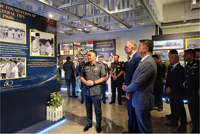
I made time to visit an ongoing exhibition, Dislocations: Memory & Meaning of the Fall of Singapore, 1942.
From the sheer size, rich content and research involved, this must have been in the works for several years, which fortunately was not cancelled by the pandemic.
I found the exhibition very compelling and deeply moving as it captured the fear, confusion and hardships of the people affected by war which are now being repeated on the other side of the world in Ukraine.
Whatever one might think of straitlaced Singapore with its legendary fines, it does plan with imagination, build with care and maintain to high standards.
In glaring contrast, our Istana Budaya may look great on the outside but is literally empty on the inside. It only comes alive when there is a performance.
Our Muzium Negara’s original building is indeed unique in design, but you can’t say the same of the dreadful extended exhibition space.
While there are exhibitions, there is little on its website to pique your interest. It doesn’t even have an update on Covid-19 SOP. In contrast, the NMS website is informative, accessible and interactive.
Istana Budaya’s website is hardly any better. Both websites are skimpy on information and outdated. What’s really mortifying is the English on Muzium Negara’s homepage. It is so excruciatingly bad, it made me shudder.
But these are very places tourists are interested in. Honestly, the people in charge should seriously take a leaf from their Singapore counterparts’ book. Reopening our borders isn’t just about having more tourists coming with fewer pandemic control restrictions. It’s about gearing up the country with attractions to make it worth their while to come.
There is so much more I can go on about how Singapore outperforms us on so many fronts. That includes their darn Sing dollar. I felt really poor and I simply cannot fathom how a miniscule nation with barely any natural resources not only has the most powerful passport in the world (together with Japan) but a currency that is worth almost as much as the Australian dollar.
Of course, Singapore is not perfect, no country can be. But it is like the Energiser bunny, never staying still and always thinking far ahead.
I have come to the conclusion that size does matter but in reverse because the tiny state that Indonesia once dismissed as a red dot has proven that when you are that small, you really have to think big. Majulah Singapura? You bet!
The views expressed here are the writer’s own.
Already a subscriber? Log in
Get 20% OFF The Star Digital Access
Cancel anytime. Ad-free. Unlimited access with perks.